Showing posts with label Jonathan Dimmock. Show all posts

Tuesday, February 1, 2011

In Case You Missed The Organ Loft

In case you missed last Sunday's Organ Loft program, we thought we would at least give you a sample of what you would have heard:


Make sure you get your copy of Mendelssohn Organ Sonatas featuring Jonathan Dimmock!

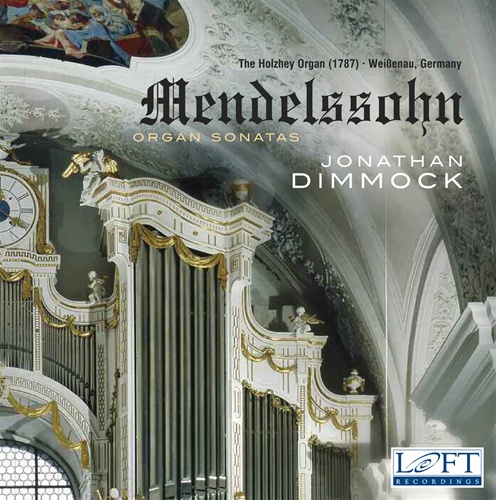
Mendelssohn Organ Sonatas
Holzhey Organ (1787)
Abbey church of Weißenau, Germany
Jonathan Dimmock, organist

Recorded on the spectacular Holzhey organ at Weißenau Abbey (Bavaria)—an organ which Mendelssohn loved—these Sonatas synthesize Baroque and Classical style with Romantic sentiment, establishing the musical vocabulary later used by Schumann, Brahms and Liszt.

“Dimmock's recording succeeds in illustrating Mendelssohn's lineage to the great Bach tradition with extremely persuasive performances of the six organ sonatas." —Choir and Organ


Tuesday, June 29, 2010

Catching Up With Jonathan Dimmock!

This past Sunday, we featured Jonathan Dimmock on The Organ Loft. So today we took a look at what this phenomenal artist has been up to!

Sunday, June 6, Jonathan Dimmock was featured on artist Sarah Cahill's NPR program "Then and Now" on San Fransisco's local KALW Radio. And it wasn't just his music, it was a full live interview as well!

On June 10th, his ensemble AVE performed and received an outstanding review in the San Fransisco Classical Voice! Here's a quote from that review (find the rest at SFCV.com):

Crafting an expert Gesualdo performance is no mean feat. In addition to the technical demands of mastering this difficult music, the conductor and singers need to internalize its emotional content and convey it effectively to the audience. “I always try to put myself in the shoes of the audience. I think a concert should be educational, uplifting, fun, stimulating, and contemplative,” Dimmock says. “Above all, it is the responsibility of the choir and me to communicate. Music without passion is merely an exercise; and very little music of the Renaissance can match the passion of Gesualdo. So we have a tall task — not the least because this music is well-known by many people. We’re aware that the expectations will be extremely high.”

Dimmock also finds great value for modern listeners in entering the sound world of this unique composer, even if the original liturgical context can’t be recaptured. “We can find in this music a solace that can only come from extreme honesty and the desire for release from intense pain,” he says. “This music doesn’t represent a single cathartic moment in the composer’s life, nor in ours as listeners, but rather the fruit resulting from months, or even years, of spiritual introspection and self-scrutiny. This is music for contemplatives. As listeners today, you, too, are being issued an invitation to find beauty even in areas of pain and suffering.”

Also, Jonathan Dimmock and AVE both have Facebook Pages so we encourage you to give them both a "Like" and keep up with this fantastic artist! We know we will!

Here's a piece from Jonathan Dimmock's latest release on Loft Recordings - "Mendelssohn Organ Sonatas"


Friday, June 25, 2010

The Organ Loft - Vater Unser im Himmelreich


The Organ Loft - June 27, 2010
Vater Unser im Himmelreich
Webcast and Broadcast Schedule


Program:Vater Unser im Himmelreich (Click "play" for promo)

1. Patricia van Ness: My Heart is a Holy Place

2. Maurice Duruflé: Prélude et fugue sur le nom d’A.L.A.I.N., Op. 7

3. Morten Lauridsen: Ubi Caritas

4. Toon Hagen:Vater unser im Himmelreich

5. Felix Mendelssohn: Sonata 6, opus 65 5


Recordings Used: (Click links to purchase these recordings)

1. “From the Heart” The King’s Singers, Signum SIGCD177
2. “Maurice Duruflé: Sacred Choral Works – Organ Works, Volume 1” Eric Lebrun, organ; Naxos 8.553196
3. “Sounds of Light” The Trinity Choir, Trinity Church, Boston, Brian Jones, director; Gothic G-49245
4. “Thomsen Chapel Inaugural Recitals” Roger Sherman, organ; reZound RZCD-5012
5. “Mendelssohn: Organ Sonatas” Jonathan Dimmock, organ; Loft LRCD-1112

Find the Broadcasts online from:

KING-FM Seattle's Classical Choice — Sundays at 10:00 PM

And

OREGON: KWAX-FM and the University of Oregon radio network — Sundays at 8:00 AM and 6:00 PM


Wednesday, May 26, 2010

See Jonathan Dimmock Live

Jonathan Dimmock and his AVE ensemble are going to have a busy summer, so you'll have plenty of chances to see them live! Today we thought we would highlight a couple that are coming up soon!

The 10th edition of the Berkeley Festival & Exhibition, running June 6-13 will host Jonathan Dimmock and the AVE ensemble. Check out the details from the Contra Costa Times:

Also being presented as "Main Stage" artists are two well-known Bay Area ensembles — Warren Stewart's Magnificat vocal and instrumental group and Jonathan Dimmock's AVE chorale. For the festival's final concert, all of the above-mentioned artists, plus the string ensemble Archetti, gather in First Congregational Church at 4 p.m. June 13 for a "Vespers in Venice from Monteverdi to Vivaldi" program that will include a performance of the latter's "Magnificat" canticle. Check out the full lineup of the festival on the Contra Costa Times website

May 29th Jonathan Dimmock performs the Durufle Requiem with the East Bay Singers! Info from the Tri-City Voice Newspaper:

East Bay Singers perform Durufle's 'Requiem'

Submitted By Diane Daniel
What a treat we have for you! The East Bay Singers and Oratorio Society, accompanied by Jonathan Dimmock on the 5,298-pipe Cathedral of Christ the Light organ, will perform Maurice Durufle's "Requiem" on Saturday, May 29...For ticket, location, and time information click here!

And if you're unable to make it to either of these concerts, you can still listen to his wonderful recording of Mendelssohn Organ Sonatas available from The Gothic Catalog!

Tuesday, May 11, 2010

Mendelssohn Organ Sonatas & Jonathan Dimmock

Recently our artist Jonathan Dimmock has been giving many so many different concerts in such diverse musical roles that we thought it would be prudent to remind you that here at The Gothic Catalog, we know him mainly as an organist, and share some more information about his latest release with us, "Mendelssohn Organ Sonatas."

Mendelssohn’s six organ sonatas are not sonatas in the classical sense of that term, but rather a collection of pieces which he composed mostly between 1844 and 1845 - one year after his founding of the Leipzig Conservatory. Although we know that Mendelssohn made numerous corrections and changes to the first two editions which were published (Coventry, London and Breitkopf & Härtel, Leipzig), there are no indications of registration choices. In his “Prefatory Remarks” he says: Much depends in these Sonatas on the right choice of the Stops; however, as every Organ with which I am acquainted has its own peculiar mode of treatment in this respect, and as the same nominal combination does not produce exactly the same effect in different Instruments, I have given only a general indication of the kind of effect intended to be produced, without giving a precise List of the particular Stops to be used. By “Fortissimo” I intend to designate the Full Organ; by “Pianissimo” I generally mean a soft 8 foot Stop alone; by “Forte” the Great Organ, but without some of the most powerful Stops; by “Piano” some of the soft 8 foot Stops combined; and so forth. In the Pedal part, I should prefer throughout, even in the Pianissimo passages, the 8 foot and the 16 foot Stops united; except when the contrary is expressly specified; (see the 6th Sonata). It is therefore left to the judgment of the Performer, to mix the different Stops appropriately to the style of the various Pieces; advising him, however, to be careful that in combining the Stops belonging to two different sets of keys, the kind of tone in the one, should be distinguished from that in the other; but without forming too violent a contrast between the two distinct qualities of tone.

By the time these sonatas were composed, Mendelssohn was well-known as composer, pianist, and organist, having made many tours as a soloist throughout Germany and England. His improvisations were highly regarded; and it was while on tour in England that he was approached, by a publisher there, to compose some works for the organ. The 35 year old Mendelssohn may have wanted to impress his English colleagues, or perhaps even show them up, because he composed works with extremely virtuosic pedal parts, at a time in history when English organists had marginal pedal technique. Perhaps he wanted to assert his lineage to the great Bach tradition and the magnificent German organs which influenced his tonal pallette. Regardless, his masterworks for organ are justly regarded as the finest examples of Classical German organ literature.

These pieces are marked by two affects, strength and beauty. From the full and dramatic F minor chords of the opening sonata to the toccata-style final variation of “Vater unser im Himmelreich” (Sonata 6), it’s clear that this is intensely masculine, strong, technically demanding, and emotionally assertive music. Yet the magic of Mendelssohn’s pieces lies in his ability to play with light and shadow so convincingly. Assertiveness yields to lyricism and gentleness over and over again. In the midst of an angry opening section of Sonata 1, a simply-stated, soft chorale (“Was mein Gott will, das g’scheh’ allzeit”) enters to calm the storm. Slow movements of heart-rending beauty blend the yin and yang of his musical vocabulary as if he were touching our very soul.

It is this assimilation of the Romantic sentiment expressed within Classical and Baroque forms that makes this music so important to us today. The lineage from Bach to Mendelssohn is clear. But looking forward, we can also see how Mendelssohn’s Romantic side influenced the music of Schumann, Brahms, and Liszt. The organ, as an instrument, was undergoing tonal changes in the early nineteenth century; and it’s likely that Mendelssohn, as an international concert performer, and the students and colleagues he directly influenced (Richter, Gade, Becker, van Eyken) was the most significant force in establishing this change.

Notes on the Weißenau organ

Much has been said about Mendelssohn's penchant for Classically-voiced organs, his traditional leanings in his compositional style, and his conviction that Swell pedals were not necessary to convey the music of his organ pieces, yet the vast majority of Mendelssohn organ recordings ignore these points. This recording, however, highlights a Bavarian organ (a region Mendelssohn knew well), an organ builder that Mendelssohn praised (Holzhey), and a true Classical instrument placed in a stunning acoustical setting.

Often dwarfed by the fame of its large neighbor, the 1750 Gabler organ of Weingarten which is a mere five minutes drive from Weißenau, the 1787 organ in the Abbey church of Weißenau is undeservedly little-known. Three manuals and pedal in original condition, with many warm 8 foot flues, very supportive bass, and original strings and celestes, this organ has a unique and soothing tonal quality: strong without being strident, warm without being muddy, clear without being self-consciously bright. The temperament (Werkmeister III) was a slight challenge for some of the keys, but not insurmountable. And the advantages of an unequal temperament (standard for virtually all the organs Mendelssohn knew in Germany) for giving different tonal color to each key far outweigh the disadvantages. The trickiest aspect of the organ was the old pedal board. As is visible in the picture, the pedals could be more accurately described as "buttons" than as "keys." For Mendelssohn's extremely virtuosic pedal passages, this required some careful pedaling!

The Abbey church was founded in 1145 as a Premonstratensian monastery. Originally named "Weissenau" ("white meadow"), it is now a part of Ravensburg. The current church was built in the baroque style between 1708 and 1724. The monastery closed in 1802. Since 1283 Weißenau has been famous for its possession of the relic of the Precious Blood (referred to in "Lohengrin").

Check out everything Jonathan Dimmock is up to on his website

Wednesday, April 14, 2010

Jonathan Dimmock - Not Just an Organist

In January we released an amazing album of Mendelssohn Organ Sonatas featuring the superb organist, Jonathan Dimmock. But today, we wanted to share with you that Jonathan Dimmock is more than a superb organist, in fact he's also the founder of Artists' Vocal Ensemble (AVE). So today we thought it would be fun to share some videos of AVE!


Thursday, April 8, 2010

Jonathan Dimmock - Superb Mendelssohn Organ Sonatas

Jonathan Dimmock Brilliantly Performs Organ Masterworks Regarded as the Finest Examples of Classical German Organ Literature

An international powerhouse, Jonathan Dimmock has been hailed by the Eskilstuna-Kuriren (Sweden) for "power and flaming brio," cited by the Natal Mercury (South Africa) for "musicianship, taste, and unostentatious virtuosity," and described by the Adelaide Advertiser (Australia) as playing in such a way that "the organ has rarely sounded more clear and multi-hued than in his very expert and virtuoso hands and feet”.  It is no surprise that Dimmock became the first American ever to hold the prestigious position of Organ Scholar of Westminster Abbey.

In this superb Loft recording, Dimmock captures the very essence of Mendelssohn’s Sonatas – strength and beauty.  From the full and dramatic F minor chords of the opening sonata to the toccata-style final variation of “Vater unser im Himmelreich” (Sonata 6), to the simply-stated, soft chorale (“Was mein Gott will, das g’scheh’ allzeit”) in Sonata 1, Dimmock grabs hold of the listener with his emotional insight and breathtaking intensely. 

This recording features the 1787 Holzhey organ in the Abbey church of Weißenau.  This beautiful Bavarian organ is a true Classical instrument placed in a stunning acoustical setting.  It has a unique and soothing tonal quality.  Its three manuals and pedal are in original condition, with many warm 8 foot flues, very supportive bass, and original strings and celestas.  It is strong without being strident, warm without being muddy and clear without being self-consciously bright.

Jonathan Dimmock has distinguished himself on Loft Recordings with the music of Sweelinck on mean-tone organs of Holland and Sweden, Messiaen on the Cavaillé-Coll organ of Notre-Dame d'Auteuil, Paris, and a mixed concert at the massive Aeolian-Skinner organ of St. John the Divine in New York.  Dimmock is a graduate of the Oberlin Conservatory, Yale School of Music and Yale Divinity School.  After his time at Westminster Abbey, he served two American cathedrals, St. John the Divine in New York City and St. Mark's in Minneapolis.  Dimmock now resides in California serving as Organist of St. Ignatius Church (San Francisco), Organist of Lafayette-Orinda Presbyterian Church, Organist of Congregation Sherith Israel (San Francisco), and Organist for the San Francisco Symphony. With the San Francisco Symphony he participated in the Grammy award-winning CD recording of Mahler's Eighth Symphony (Classical Album of the year for 2009).
Orgelsonaten, Opus 65

Thursday, March 11, 2010

March Madness Sale - New Releases

There's only one day left in or March Madness Sale here at The Gothic Catalog, so make sure you get those Organ albums and collections you've been wanting by Friday!

A Fantasy Through Time: Five Centuries of Organ Fantasies
Richards-Fowkes organ, Pinnacle Presbyterian Church, Scottsdale, Arizona
Kimberly Marshall, organist


Free bonus DVD! This compact disc includes a DVD of Kimberly Marshall playing the tracks from the CD on the Richards-Fowkes organ; also included are interviews with Dr. Marshall about the music, the organ, and the composers.

The new Richards-Fowkes organ in Scottsdale provides a wide variety of tonal resources for this historical exploration of Fantasies for organ on this, its premiere recording. Kimberly Marshall is internationally known as an organist and scholar. She currently is Director of Arizona State University School of Music.

List Price: $18.98
Our Price: $9.98
You save $9.00!
Click to Buy it Now


Mendelssohn Organ Sonatas
Holzhey Organ (1787)
Abbey church of Weißenau, Germany
Jonathan Dimmock, organist


Recorded on the spectacular Holzhey organ at Weißenau Abbey (Bavaria)—an organ which Mendelssohn loved—these Sonatas synthesize Baroque and Classical style with Romantic sentiment, establishing the musical vocabulary later used by Schumann, Brahms and Liszt.
“Dimmock’s performances are elegantly stylish and display a keen understanding of how the music moves.” – American Record Guide

List Price: $18.98
Our Price: $9.98
You save $9.00!
Click to Buy it Now


The Music of Dan Locklair
Marilyn Keiser, organist
Casavant Freres organ of St. Paul's Episcopal Church
Indianapolis, Indiana


Dan Locklair is one of America's most widely performed composers. His music has been performed at Presidential inaugurations and funerals, and he was named Composer of the Year by the American Guild of Organists. Marilyn Keiser has long been a champion of his organ music and presents here the definitive performances of his most popular works.

List Price: $18.98
Our Price: $9.98
You save $9.00!
Click to Buy it Now

Wednesday, March 10, 2010

March Madness Sale - Feature Albums

You still have until Friday to get in on the March Madness!!! Here are some more examples of the amazing deals we have right now at The Gothic Catalog:


French Masterworks from St. John the Divine
Ernest M. Skinner Company, Opus 150 (1910)
Aeolian-Skinner Organ Company, Opus 150A (1954)
The Cathedral of St. John the Divine, New York City

Jonathan Dimmock, organ
World premier recording!


The definitive recording of the magnificent Aeolian-Skinner at St. John the Divine! Dimmock shows the genius of tonal design with this instrument and uses the acoustics of the world’s largest gothic cathedral to best advantage. Also includes the only piece which Langlais wrote for St. John the Divine’s organ and its State Trumpet. The piece is dedicated to Mr. Dimmock.

List Price: $16.98
Our Price: $9.98
You save $7.00!
Click to Buy it Now!


French on the Flentrop
1965 Flentrop organ, restored and augmented by Paul Fritts
Saint Mark's Cathedral, Seattle, WA
J. Melvin Butler, organ


Cathedral organist Mel Butler plays a program of French music, from de Grigny to Tournemire. Although it is a Dutch organ, the 1965 Flentrop is surprisingly well-suited to French repertoire. With an abundance of reeds, beautiful flutes and six seconds of reverberation, the organ renders French music in an highly effective style. Mel Butler gives a superb performance, which is captured by our proprietary 24-bit recording technology. Highly recommended!

The organ just jumps out of the speakers from the very start featuring the horizontal trumpets in Balbastre’s Noël . . . Organ recordings seldom get more exciting than this—don’t miss it! — The Organ magazine (UK)

List Price: $18.98
Our Price: $9.98
You save $9.00!
Click to Buy it Now!


Viaticum: A Journey of the Mind, Body and Soul (3 CD Set!)
Robert Bates, organist and composer
Organs of Stanford Memorial Church


This unusual CD documents a tri-part program of 20th-century music, organized and composed by Robert Bates. It includes many world premier recordings (in red). With interspersed spoken texts and imaginative programming, Bates explores the nature of the world and ourselves, through verbal themes and non-verbal sound paintings. This is the most unusual organ recording in our collection, and it is a masterpiece of invention, symbolism and imagination.


Includes 24-page book on the music and organs used, plus a 16-page graphical audience score.

List Price: $39.98
Our Price: $19.98
You save $20.00!
Click to Buy it Now!

Thursday, January 28, 2010

Jonathan Dimmock - Mendelssohn Organ Sonatas

Today we want to share audio samples and program information from Loft Recordings' new release Mendelssohn Organ Sonatas featuring organist Jonathan Dimmock.

Mendelssohn Organ Sonatas
Holzhey Organ (1787)
Abbey church of Weißenauu, Germany
Jonathan Dimmock, organist
Mendelssohn's "Orgelsonaten, Opus 65":

Sonata No. 1 (Tracks 1-4)
Sonata No. 2 (Tracks 5-8)
Sonata No. 3 (Tracks 9-10)
Sonata No. 4 (Tracks 11-14)
Sonata No. 5 (Tracks 15-17)
Sonata No. 6 (Tracks 18-24)


Organist Jonathan Dimmock is well-known internationally as a recitalist, choral conductor, vocal coach, accompanist, continuo player, San Francisco Symphony musician and church organist. He has held musical posts at Westminster Abbey in London, the Cathedral Church of St. John the Divine in New York City, and St. Mark’s Cathedral in Minneapolis, and currently serves as organist of St. Ignatius Church, San Francisco.. He has toured widely over five continents, has been featured on numerous radio and television stations, and has recorded over 20 CDs. He is co-founder of American Bach Soloists, founding director of AVE (Artists’ Vocal Ensemble), and founding President of Art to the Nations, employing musicians in international negotiations to aid in conflict resolution. For more information on Jonathan Dimmock, visit his website amd see all of his recordings with The Gothic Catalog here.

Thursday, January 7, 2010

January Releases - Mendelssohn Organ Sonatas

Mendelssohn Organ Sonatas


Holzhey Organ (1787)
Abbey church of Weißenauu, Germany
Jonathan Dimmock, organist


Recorded on the spectacular Holzhey organ at Weissenau Abbey (Bavaria)—an organ which Mendelssohn loved—these Sonatas synthesize Baroque and Classical style with Romantic sentiment, establishing the musical vocabulary later used by Schumann, Brahms and Liszt.

“Dimmock’s performances are elegantly stylish and display a keen understanding of how the music moves.” – American Record Guide