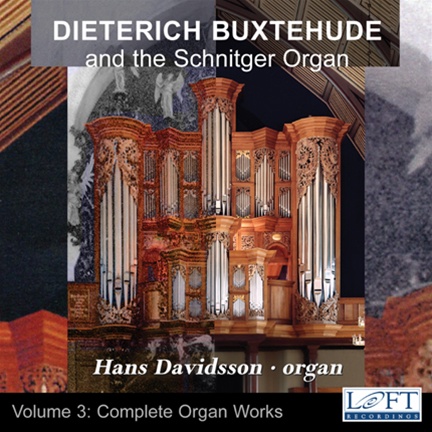
Buy Dieterich Buxtehude and the Schnitger Organ from the Gothic Catalog and save.

"Diderich ‘Hansen’ Buxtehude (1637–1707) was born in Denmark, and was active as an organist, composer, and cultural entrepreneur in Denmark and Sweden as well as in Germany, where he became known as Dieterich Buxtehude. He grew up in Helsingør, Denmark, and served as organist in Helsingborg (now in Sweden) and Helsingør before accepting one of the most prestigious musical positions in North Germany, that of organist at St. Mary’s Church, Lübeck, in 1668. During his nearly forty years of service there he achieved fame not only as an organist but also as the composer and director of a concert series known as the Lübeck Abendmusiken. Although he left an impressive corpus of arias, sacred concertos, and cantatas for voices with instruments as well as two printed editions of sonatas for strings, it is chiefly his organ works that captured the attention of performers both in his day and in our own. His organ music appeals to modern listeners because it is full of the fantasy, variety and unpredictability that characterises seventeenth-century music, yet is rooted in the major-minor tonal system familiar to our ears. The works fall into two broad categories, those based on chorale melodies and those freely composed. He set many chorales as short preludes, with a highly ornamented melody to be played by the right hand on one manual, a two-voice accompaniment for a second manual, and a continuo-like bass for the pedal. Despite their unity of style, they show endless variety in their ornamentation. His extensive chorale fantasias, on the other hand, develop each phrase of the chorale in a contrasting style. His free pedaliter praeludia are the works for which e is best known, demonstrating his virtuosity as both a composer and a performer. The large organ that Buxtehude played in St Mary’s in Lübeck had fifty-four stops on three manuals and pedal. Recent research suggests that it may have been in mean tone, a tuning in which the tonal excursions that Buxtehude included in some of his praeludia would have been difficult to play. Hans Davidsson’s bold undertaking of the recording of Buxtehude’s entire organ repertoire in mean tone gives us startling new insights into how this ‘heavenly harmony’ might have sounded in the seventeenth century. This beautifully produced double-CD is the first in a projected three-volume series from Loft Recordings and is essential listening for anyone interested in early organ music."
—John Pitt, New Classics (UK)
"Hans Davidsson has recently released a recording called ”Dieterich Buxtehude and the Mean-Tone Organ”. It is a double CD and the first of three sets that will cover the complete organ works of Dietrich Buxtehude. It is not merely another recording of the complete organ works of Buxtehude, but a recording with a vision and a pedagogical design.
"The idea is to record Buxtehude on a large organ in mean-tone, something that has never been done before. The reason it hasn’t been done before is that that there has been a belief that the music of Buxtehude has been intended for well-tempered organs – but convenience has probably also played a part. Newer research has shown that the organ works of Buxtehude were written in a context where mean-tone temperament was an important ingredient. A counter-argument based around the existence of pieces in remote keys- such as the preludes in f#-minor and A major – is not sustainable since the keyboard compositions of Buxtehude’s time didn’t have the same function as they began to have around hundred years later in music history. Composing and improvising were still two parts of the same practice, so a composition lived a life that probably consisted of a large number of improvised versions and one or several written down versions (perhaps even in different keys). The written notation of a piece was a tool to develop and spread (to colleagues and students) that organ playing that was mostly improvised.
“Pedagogical design” is a somewhat clumsy way to say that Hans Davidsson’s recording is so much more than a recording. The buyer gets a richly illustrated booklet, and if he or she is not content with the exciting essays there are even more detailed program notes and registration indications of the record label’s website. The program notes are excellent examples of texts that contain a good balance of facts, speculations and explanations of musical choices.
"I suspect a larger ambition behind this very complete production. The aurally and visually magnificent organs, the important role of the organist in both church service s and local musical life and a music making where composition, improvisation and interpretation were different sides of the same practice: all these aspects of the North German Baroque organ art can be made into a story about the golden age of organ art. And that is what Hans Davidsson achieves with rhetorical power in both playing and texts. The story of the golden age makes us question our present but also- paradoxically – enables us to shape our future. Presumably that is the intention, and I think that is excellent.
"This is a double CD that can be recommended in every respect to be bought, listened to, studied and challenged by:
"Buy this record if you are interested in sound recording and are curious about what Erik Sikkema’s USLI-technique means. It is enough to listen to it with just open ears to realize that organs seldom sounds this good on records, you can hear both the room and the details.
"Listen to this music if you, in an increasingly more noisy, more tone deaf and more insensitive world are in need of good examples and inspiring role models to be able to continue your work as a church musician, organist or pedagogue! Here is a story from the golden age of organ art, from the 17th century North Germany where the bourgeois proudly invested in magnificent organs and where the organist was a kind of musical preacher.
"Study this production even if you have heard all earlier and current recordings of Buxtehude’s organ works, and even if you have played them all! There are new details to discover, new relationships to understand and new interpretations to experience. Hans Davidsson has begun a rereading of the musical heritage of Buxtehude; a rereading that surprises, challenges and pleases. It is for example an excellent idea to use the history of David and Goliath as an interpretive pattern for the battered Prelude Fugue and Ciacona in C-major. To play Buxtehude in mean-tone is a risky decision, but here it is so well argued and convincingly done that all you can say is: of course, this is the way it must be. It must be impossible not to be seduced by the lovely principals and flutes of the Örgryte organ.
"Be challenged by this record if you think that music can’t be talked about. It is reasonable that you sometime not speak instead of playing or listening. But there is a rich tradition, at least within what is nowadays called western art music, to talk about music, and to let that speaking and knowledge enrich the interpretation and the listening. Hans Davidsson shows with his interpretation of the Preludium in D-major (BuxWV 139), that there is instrumental music that is so close to speech that even if it doesn’t speak, it can be understood clearly.
"Hans Davidsson’s ”Buxtehude and the Mean-Tone Organ” is a brilliant combination of musicality, fantasy, learning and pedagogy. Buy it! Since both the musicianship and program notes are so rich in information the record should be enjoyed in small doses, but that is a good thing: it lasts longer!"
Hans Hellsten, Swedish Church Music Journal
Professor of organ at the School of Music in Malmö, Sweden
Translation Fredrik Tobin


"It is difficult to know where to begin with these four CDs. This is a monumental recording in all sorts of ways. It is special because of the mean-tone tuning and the effect that this has on the music and the way it sounds. While we cannot be sure how the music would have sounded originally, the Baroque Organ project led by GOArt and sited in the Örgryte nya kyrka has done so much to foster interest in, and knowledge of, organ building at the time. It is good that we now have these recordings so that we can hear for ourselves.
There are some delicious sounds throughout – partly the registers, partly the tuning – often challenging the listener, especially when the choice of stops is not what we might think of today – as for example playing fugues on reed stops in a kind of Grand Jeu. But it is the vast range of colour that is most impressive, including a delightful cymbelstern. The CDs use the ULSI recording technique, which certainly gives the listener a feeling of intimacy and contact with player and instrument and adds much to the overall quality of the recordings.
The second two CD set focusses on music which JS Bach and his circle studied, shared and admired. There is thus an added fascination when listening to these pieces for the insight that they give with regard to later organ music.
Hans Davidsson – such a fine player, especially in this context – is to be congratulated, as are all the team involved. The sleeve notes are full and well produced, though there is also a significant amount of additional material, including notes on each piece and a complete listing of all registrations used at www.gothic-catalog.com. These CDs are most highly recommended, and have to be a star recording of star recordings as far as I am concerned; they are an absolute must to buy." —The Organ (UK)
"Strange and wondrous sounding things happen when you hear early Baroque organ music performed on a mean-tone tempered instrument like the one here. That's because this method of tuning produces pure major thirds, which were all the rage in Dieterich Buxtehude's day (1637-1707) as they were thought to be the musical equivalent of "heavenly harmony." Not only that, but they intensify the contrast between consonances and dissonances in music thereby giving it greater emotional impact. So it's quite likely this is what you would have heard at the prestigious St. Mary's Church in Lubeck, Germany, when the composer was organist there. However, these "heavenly thirds" come at a cost, because pieces in certain keys can sound harsh or even dissonant on mean-tone instruments. So steps must be taken to ameliorate these incompatibilities. The most radical solution is to transpose the work in question to a more listener-friendly key, and in Buxtehude’s day organists did this all the time. Besides transposition though, there are several other ways to accomplish this. For instance, the organ for this recording has additional sub-semitone black keys and pedals just for this purpose (see the excellent album notes for an explanation and picture of them). These are necessitated by the fact that accidentals like d-sharp and e-flat, which are the same identical note and represented by just one black key on a conventionally tuned instrument, must take on slightly different pitches on a mean-tone one in order to minimize the problems mentioned above. Additionally the performer can downplay dissonant notes by shortening their length, camouflaging them with ornaments and/or even opting for leaner registrations that make them less apparent.
The highly versatile and talented soloist here, Hans Davidsson, uses every trick at his disposal to come up with some of the most colorful Baroque music that ever emanated from an organ pipe. As a matter of fact, after you've heard this album, Buxtehude on a conventionally tuned instrument comes off sounding rather drab! The one Davidsson plays here is located in Gothenberg, Sweden and it’s absolutely spectacular. That’s because it’s a modern day synthesis of the finest North German Baroque instruments from such builders as the great Arp Schnitger. Not only that, but this is one of the best sounding recordings of "The Pope of Instruments" to come along in some time. It utilizes Erik Sikkema's new ULSI recording technology, which does for church spaces what Ray Kimber's IsoMike does for the concert hall (see the 17 February 2007 newsletter). Accordingly, audiophiles who love organ music must have this release, and are encouraged to read about ULSI. (click here for details)
Musically, artistically and sonically producer Roger Sherman has a “Triple Crown” winner with this, the first of three albums from Loft Recordings devoted to the composer's complete organ works a la mean-tone. This one contains all of his better known ones, so it's perfect for those wanting a single highlights album. However, a word of warning, after you hear it, you may well find "you can't eat just one!" Those desiring more detailed information about what’s included can find it on the new, beautifully appointed Gothic Web Site."


| |||||||||||||||||||||||||||||||||||||||||||||||||||||||||||||||||||||||||||||||||||||||||||||||||||||||||||||||||||||||||||||||||||||||||||||||||||


