We are pleased to announce that Naxos is now offering global distribution of The Gothic Catalog through Naxos affiliates worldwide including:
Argentina Australia
Austria
Belgium
Bulgaria
Brazil
Canada
Chile
Columbia
Costa Rica
Croatia
Czech Republic
Denmark
El Salvador
ESTONIA
Finland
France
Germany
Guatemala
Greece
Honduras
Hong Kong
Hungary
Iceland
Ireland
Israel
Italy
Japan
Latvia
Lithuania
Malta
Mexico
Netherlands
New Zealand
Norway
Peru
Philippines
Poland
Portugal
Romania
Russia
SLOVAKIA
SLOVENIA
South Africa
South Korea
Spain
Sweden
Switzerland
Taiwan
Turkey
United Kingdom
United States of America
Uruguay
The mission of The Gothic Catalog is to generate enthusiasm and literacy in classical music, particular music for organs and choirs. The Gothic Catalog with Loft Recordings publishes recordings, produces a weekly radio program (The Organ Loft), provides recording services for artists, and offers recordings for sale through http://gothic-catalog.com and a mail order catalog.
The Gothic Catalog:
Loft Recordings was founded in 1999; in 2001, Loft purchased the assets of Gothic Records, a company which had been producing great organ and choral recordings for almost 25 years. Loft established "The Gothic Catalog" as a mail-order webstore where recordings from both companies could be showcased, alongside other recordings from third-party labels. In June 2008, we acquired Clarion Records, a record label which features semi-professional American choirs and a large catalog of world premier choral recordings. And in 2009 we became the exclusive publisher and distributor of recordings from the Washington National Cathedral.
When in our music God is glorified
Ye watchers and ye holy ones
A mighty fortress is our God
Where cross the crowded ways of life
O sacred head, sore wounded
All glory, laud and honor
Abide with me, fast falls the eventide
My shepherd will supply my need
Come, ye thankful people, come
Let all mortal flesh keep silence
Rock of ages, cleft for me
Praise, my soul, the King of heaven
Come, risen Lord
Carillon hymn: St Peter
Eternal Father, strong to save
Amazing grace! how sweet the sound
Holy, holy, holy! Lord God Almighty
Nearer, my God, to thee
Dear Lord and Father of mankind
In Christ there is no East or West
Were you there when they crucified my Lord?
Crown Him with many crowns
Word of God, come down on earth
The Church's one foundation
God of our fathers
Father, in thy gracious keeping
Peal Bells
VOLUME 2
Peal Bells
Jesus, my all, to heaven has gone
Our thanks we give for love and hope
In the bleak midwinter
Creating God, your fingers trace
Rejoice, ye pure in Heart!
Let all the world in every corner sing
Organ solo: Ar hyd y nos
Of the Father's love begotten
Come down, O Love divine
Spirit of God, descend upon my heart
God is love
What wondrous love is this!
All my hope on God is founded
Carillon Solo: Leoni
O God of our divided world
Christ, might Savior
Breathe on me, Breath of God
I vow to thee, my country
The day thou gavest, Lord, is ended
Lord of all hopefulness
O brightness of the immortal Father's face
O praise ye the Lord!
Bagpipe Solo: Hyfrydol
The Organ Loft - March 6, 2011 Pamela Ruiter-Feenstra at Trinity Lutheran; Duruflé Mass 'Cum Jubilo' Webcast and Broadcast Schedule
This week on the Organ Loft, we're featuring music for the end of Epiphany and the beginning of Lent. Pamela Ruiter-Feenstra plays Bach and Improvisations on Lutheran choral themes (at Trinity Lutheran in Lynnwood), followed by Maurice Duruflé’s Mass cum jubilo for men’s voices and organ (Trinity College, Cambridge).
Program
Pamela Ruiter-Feenstra: Improvisation: Dance Suite on “Wie Schön leuchtet der Morgenstern”1
Pamela Ruiter-Feenstra: Improvisation: “O Haupt voll Blut und Wunden”1
Gabriel Fauré: Cantique de Jean Racine1
J. S. Bach: Fantasia and Fugue in a, BWV 9041
J. S. Bach: “Erbarm dich, mein, O Herre Gott” BWV 7211
J. S. Bach: “Fantasia super “Komm, Heiliger Geist” BWV 6511
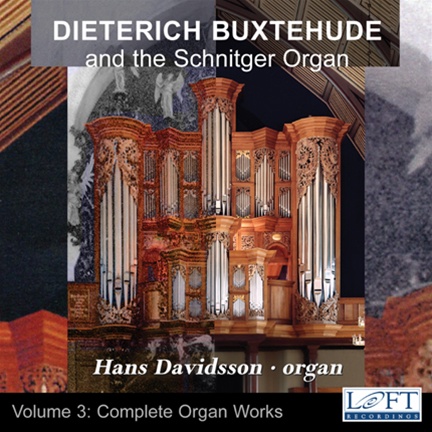
"I bought your registration Dieterich Buxtehude and the Mean-Tone Organ employing the ULSI technique. It’s really fantastic the high level of quality you are able to extrapolate from the true sound of the organ." —Gianni Movia, Italy
"I just heard the Buxtehude. It’s incredible! Wow! The music, performer, organ, room and recording are perfectly matched with the highest quality. The sound of the organ came to the point of the true reproduction of the reality." —Munetaka Yokota, organbuilder
"Buy this album if you are interested in audio technology and are curious about what Erik Sikkema means by ULSI technology!" —Hans Hellsten, Sweden
"Diderich ‘Hansen’ Buxtehude (1637–1707) was born in Denmark, and was active as an organist, composer, and cultural entrepreneur in Denmark and Sweden as well as in Germany, where he became known as Dieterich Buxtehude. He grew up in Helsingør, Denmark, and served as organist in Helsingborg (now in Sweden) and Helsingør before accepting one of the most prestigious musical positions in North Germany, that of organist at St. Mary’s Church, Lübeck, in 1668. During his nearly forty years of service there he achieved fame not only as an organist but also as the composer and director of a concert series known as the Lübeck Abendmusiken. Although he left an impressive corpus of arias, sacred concertos, and cantatas for voices with instruments as well as two printed editions of sonatas for strings, it is chiefly his organ works that captured the attention of performers both in his day and in our own. His organ music appeals to modern listeners because it is full of the fantasy, variety and unpredictability that characterises seventeenth-century music, yet is rooted in the major-minor tonal system familiar to our ears. The works fall into two broad categories, those based on chorale melodies and those freely composed. He set many chorales as short preludes, with a highly ornamented melody to be played by the right hand on one manual, a two-voice accompaniment for a second manual, and a continuo-like bass for the pedal. Despite their unity of style, they show endless variety in their ornamentation. His extensive chorale fantasias, on the other hand, develop each phrase of the chorale in a contrasting style. His free pedaliter praeludia are the works for which e is best known, demonstrating his virtuosity as both a composer and a performer. The large organ that Buxtehude played in St Mary’s in Lübeck had fifty-four stops on three manuals and pedal. Recent research suggests that it may have been in mean tone, a tuning in which the tonal excursions that Buxtehude included in some of his praeludia would have been difficult to play. Hans Davidsson’s bold undertaking of the recording of Buxtehude’s entire organ repertoire in mean tone gives us startling new insights into how this ‘heavenly harmony’ might have sounded in the seventeenth century. This beautifully produced double-CD is the first in a projected three-volume series from Loft Recordings and is essential listening for anyone interested in early organ music."
—John Pitt, New Classics (UK)
"Hans Davidsson has recently released a recording called ”Dieterich Buxtehude and the Mean-Tone Organ”. It is a double CD and the first of three sets that will cover the complete organ works of Dietrich Buxtehude. It is not merely another recording of the complete organ works of Buxtehude, but a recording with a vision and a pedagogical design.
"The idea is to record Buxtehude on a large organ in mean-tone, something that has never been done before. The reason it hasn’t been done before is that that there has been a belief that the music of Buxtehude has been intended for well-tempered organs – but convenience has probably also played a part. Newer research has shown that the organ works of Buxtehude were written in a context where mean-tone temperament was an important ingredient. A counter-argument based around the existence of pieces in remote keys- such as the preludes in f#-minor and A major – is not sustainable since the keyboard compositions of Buxtehude’s time didn’t have the same function as they began to have around hundred years later in music history. Composing and improvising were still two parts of the same practice, so a composition lived a life that probably consisted of a large number of improvised versions and one or several written down versions (perhaps even in different keys). The written notation of a piece was a tool to develop and spread (to colleagues and students) that organ playing that was mostly improvised.
“Pedagogical design” is a somewhat clumsy way to say that Hans Davidsson’s recording is so much more than a recording. The buyer gets a richly illustrated booklet, and if he or she is not content with the exciting essays there are even more detailed program notes and registration indications of the record label’s website. The program notes are excellent examples of texts that contain a good balance of facts, speculations and explanations of musical choices.
"I suspect a larger ambition behind this very complete production. The aurally and visually magnificent organs, the important role of the organist in both church service s and local musical life and a music making where composition, improvisation and interpretation were different sides of the same practice: all these aspects of the North German Baroque organ art can be made into a story about the golden age of organ art. And that is what Hans Davidsson achieves with rhetorical power in both playing and texts. The story of the golden age makes us question our present but also- paradoxically – enables us to shape our future. Presumably that is the intention, and I think that is excellent.
"This is a double CD that can be recommended in every respect to be bought, listened to, studied and challenged by:
"Buy this record if you are interested in sound recording and are curious about what Erik Sikkema’s USLI-technique means. It is enough to listen to it with just open ears to realize that organs seldom sounds this good on records, you can hear both the room and the details.
"Listen to this music if you, in an increasingly more noisy, more tone deaf and more insensitive world are in need of good examples and inspiring role models to be able to continue your work as a church musician, organist or pedagogue! Here is a story from the golden age of organ art, from the 17th century North Germany where the bourgeois proudly invested in magnificent organs and where the organist was a kind of musical preacher.
"Study this production even if you have heard all earlier and current recordings of Buxtehude’s organ works, and even if you have played them all! There are new details to discover, new relationships to understand and new interpretations to experience. Hans Davidsson has begun a rereading of the musical heritage of Buxtehude; a rereading that surprises, challenges and pleases. It is for example an excellent idea to use the history of David and Goliath as an interpretive pattern for the battered Prelude Fugue and Ciacona in C-major. To play Buxtehude in mean-tone is a risky decision, but here it is so well argued and convincingly done that all you can say is: of course, this is the way it must be. It must be impossible not to be seduced by the lovely principals and flutes of the Örgryte organ.
"Be challenged by this record if you think that music can’t be talked about. It is reasonable that you sometime not speak instead of playing or listening. But there is a rich tradition, at least within what is nowadays called western art music, to talk about music, and to let that speaking and knowledge enrich the interpretation and the listening. Hans Davidsson shows with his interpretation of the Preludium in D-major (BuxWV 139), that there is instrumental music that is so close to speech that even if it doesn’t speak, it can be understood clearly.
"Hans Davidsson’s ”Buxtehude and the Mean-Tone Organ” is a brilliant combination of musicality, fantasy, learning and pedagogy. Buy it! Since both the musicianship and program notes are so rich in information the record should be enjoyed in small doses, but that is a good thing: it lasts longer!"
Hans Hellsten, Swedish Church Music Journal
Professor of organ at the School of Music in Malmö, Sweden
Translation Fredrik Tobin
Recent research shows that Buxtehude had only mean-tone organs at his disposal during his life. Although there are many good recordings on well-tempered organs (including some antiques), performing these works on mean-tone instruments requires both a radical re-assessment of traditional performance ideas and a large and extraordinary organ. Hans Davidsson is the ideal performer for this task, and he plays the huge “North German Baroque Organ” of Gothenburg, Sweden. The complete organ works are recorded here in three volumes totaling seven compact discs.
We've been talking about Hans Davidsson and the Complete Organ Works of Buxtehude a lot lately, so today we thought it would be fun to share some videos of Hans Davidsson we came across on YouTube.
This week on the Organ Loft you'll hear selections from “Be Still My Soul”, a recent disc from the choir of All Saints Beverly Hills, and Bach’s Mass in F with the Washington Bach Consort.
Program
Percy Whitlock: "Be Still, My Soul“1
Harold Friedell: "Jesus, so lowly“1
Gabriel Fauré: Cantique de Jean Racine1
J.S. Bach: O Lamm Gottes, unschuldig, S. 6562
F. Melius Christiansen: Lamb of God3
J.S. Bach: Mass in F major, BWV 2334
Recordings Used:
“Be Still, My Soul” Choir of All Saints’ Church, Beverly Hills, CA, Dale Adelmann, conductor, Craig Phillips, organist, Gothic G-49251
“The Leipzig Chorales/J.S. Bach” Christa Rakich, organ; Loft LRCD-1078-79
“Eternity” National Lutheran Choir, David Cherwien, director, NLCA02022 (available from The Gothic Catalog)
“The Bach Masses, v.1” Washington Bach Consort, Reilly Lewis, dir. Loft LRCD-1068

 Australia