Showing posts with label reviews. Show all posts

Monday, March 14, 2011

American Record Guide Reviews Eternal Light

From American Record Guide:

“If you follow the best American academic choirs, this one should be on your must-hear list. Their sound is rich and smooth, their technique is well-nigh faultless, and their spiritual intensity will touch any listener’s soul.”


“One of the nation’s finest vocal ensembles & and they prove it here.”

Eternal Light
East Carolina University Chamber Singers
Daniel Bara, conductor


New music for a capella choir and solo instruments
Four world-premier recordings
Includes the first recording of Egil Hovland’s Agnus Dei (2000)

Gothic Records G-49242
List price: $18.98
Our price: $15.98

The ECU Chamber Singers’ first Gothic recording

One of the best-sounding organ/choral discs we have ever recorded!

The ECU Chamber Singers and organist Janette Fishell are conducted by Daniel Bara
in these monuments of the English choral tradition.
The choir’s sound is greatly enhanced by the sumptuous acoustics of St. Paul’s Episcopal Church in Greenville,
and its large, new Fisk organ.

Britten: Rejoice in the Lamb
Howells: Requiem
Ireland Greater: Love hath no man
and more…

Sound sample of Tu es Petrus (Pearsall)

Gothic Records G-49256
List price: $18.98
Our price: $15.98


Thursday, March 3, 2011

Buxtehude Organ Works Reviews

Here are some more great reviews for Hans Davidsson's Complete Organ Works of Buxtehude collection:

"I bought your registration Dieterich Buxtehude and the Mean-Tone Organ employing the ULSI technique. It’s really fantastic the high level of quality you are able to extrapolate from the true sound of the organ." —Gianni Movia, Italy

"I just heard the Buxtehude. It’s incredible! Wow! The music, performer, organ, room and recording are perfectly matched with the highest quality. The sound of the organ came to the point of the true reproduction of the reality." —Munetaka Yokota, organbuilder

"Buy this album if you are interested in audio technology and are curious about what Erik Sikkema means by ULSI technology!" —Hans Hellsten, Sweden

"Diderich ‘Hansen’ Buxtehude (1637–1707) was born in Denmark, and was active as an organist, composer, and cultural entrepreneur in Denmark and Sweden as well as in Germany, where he became known as Dieterich Buxtehude. He grew up in Helsingør, Denmark, and served as organist in Helsingborg (now in Sweden) and Helsingør before accepting one of the most prestigious musical positions in North Germany, that of organist at St. Mary’s Church, Lübeck, in 1668. During his nearly forty years of service there he achieved fame not only as an organist but also as the composer and director of a concert series known as the Lübeck Abendmusiken. Although he left an impressive corpus of arias, sacred concertos, and cantatas for voices with instruments as well as two printed editions of sonatas for strings, it is chiefly his organ works that captured the attention of performers both in his day and in our own. His organ music appeals to modern listeners because it is full of the fantasy, variety and unpredictability that characterises seventeenth-century music, yet is rooted in the major-minor tonal system familiar to our ears. The works fall into two broad categories, those based on chorale melodies and those freely composed. He set many chorales as short preludes, with a highly ornamented melody to be played by the right hand on one manual, a two-voice accompaniment for a second manual, and a continuo-like bass for the pedal. Despite their unity of style, they show endless variety in their ornamentation. His extensive chorale fantasias, on the other hand, develop each phrase of the chorale in a contrasting style. His free pedaliter praeludia are the works for which e is best known, demonstrating his virtuosity as both a composer and a performer. The large organ that Buxtehude played in St Mary’s in Lübeck had fifty-four stops on three manuals and pedal. Recent research suggests that it may have been in mean tone, a tuning in which the tonal excursions that Buxtehude included in some of his praeludia would have been difficult to play. Hans Davidsson’s bold undertaking of the recording of Buxtehude’s entire organ repertoire in mean tone gives us startling new insights into how this ‘heavenly harmony’ might have sounded in the seventeenth century. This beautifully produced double-CD is the first in a projected three-volume series from Loft Recordings and is essential listening for anyone interested in early organ music."
—John Pitt, New Classics (UK)


"Hans Davidsson has recently released a recording called ”Dieterich Buxtehude and the Mean-Tone Organ”. It is a double CD and the first of three sets that will cover the complete organ works of Dietrich Buxtehude. It is not merely another recording of the complete organ works of Buxtehude, but a recording with a vision and a pedagogical design.

"The idea is to record Buxtehude on a large organ in mean-tone, something that has never been done before. The reason it hasn’t been done before is that that there has been a belief that the music of Buxtehude has been intended for well-tempered organs – but convenience has probably also played a part. Newer research has shown that the organ works of Buxtehude were written in a context where mean-tone temperament was an important ingredient. A counter-argument based around the existence of pieces in remote keys- such as the preludes in f#-minor and A major – is not sustainable since the keyboard compositions of Buxtehude’s time didn’t have the same function as they began to have around hundred years later in music history. Composing and improvising were still two parts of the same practice, so a composition lived a life that probably consisted of a large number of improvised versions and one or several written down versions (perhaps even in different keys). The written notation of a piece was a tool to develop and spread (to colleagues and students) that organ playing that was mostly improvised.

“Pedagogical design” is a somewhat clumsy way to say that Hans Davidsson’s recording is so much more than a recording. The buyer gets a richly illustrated booklet, and if he or she is not content with the exciting essays there are even more detailed program notes and registration indications of the record label’s website. The program notes are excellent examples of texts that contain a good balance of facts, speculations and explanations of musical choices.

"I suspect a larger ambition behind this very complete production. The aurally and visually magnificent organs, the important role of the organist in both church service s and local musical life and a music making where composition, improvisation and interpretation were different sides of the same practice: all these aspects of the North German Baroque organ art can be made into a story about the golden age of organ art. And that is what Hans Davidsson achieves with rhetorical power in both playing and texts. The story of the golden age makes us question our present but also- paradoxically – enables us to shape our future. Presumably that is the intention, and I think that is excellent.

"This is a double CD that can be recommended in every respect to be bought, listened to, studied and challenged by:

"Buy this record if you are interested in sound recording and are curious about what Erik Sikkema’s USLI-technique means. It is enough to listen to it with just open ears to realize that organs seldom sounds this good on records, you can hear both the room and the details.

"Listen to this music if you, in an increasingly more noisy, more tone deaf and more insensitive world are in need of good examples and inspiring role models to be able to continue your work as a church musician, organist or pedagogue! Here is a story from the golden age of organ art, from the 17th century North Germany where the bourgeois proudly invested in magnificent organs and where the organist was a kind of musical preacher.

"Study this production even if you have heard all earlier and current recordings of Buxtehude’s organ works, and even if you have played them all! There are new details to discover, new relationships to understand and new interpretations to experience. Hans Davidsson has begun a rereading of the musical heritage of Buxtehude; a rereading that surprises, challenges and pleases. It is for example an excellent idea to use the history of David and Goliath as an interpretive pattern for the battered Prelude Fugue and Ciacona in C-major. To play Buxtehude in mean-tone is a risky decision, but here it is so well argued and convincingly done that all you can say is: of course, this is the way it must be. It must be impossible not to be seduced by the lovely principals and flutes of the Örgryte organ.

"Be challenged by this record if you think that music can’t be talked about. It is reasonable that you sometime not speak instead of playing or listening. But there is a rich tradition, at least within what is nowadays called western art music, to talk about music, and to let that speaking and knowledge enrich the interpretation and the listening. Hans Davidsson shows with his interpretation of the Preludium in D-major (BuxWV 139), that there is instrumental music that is so close to speech that even if it doesn’t speak, it can be understood clearly.

"Hans Davidsson’s ”Buxtehude and the Mean-Tone Organ” is a brilliant combination of musicality, fantasy, learning and pedagogy. Buy it! Since both the musicianship and program notes are so rich in information the record should be enjoyed in small doses, but that is a good thing: it lasts longer!"

Hans Hellsten, Swedish Church Music Journal
Professor of organ at the School of Music in Malmö, Sweden
Translation Fredrik Tobin


Buxtehude Organ Works—Hans Davidsson (7 CDs total)

Includes:
Volume 1: Buxtehude and the Mean-Tone Organ (2 CDs)
Volume 2: The Bach Perspective (2 CDs)
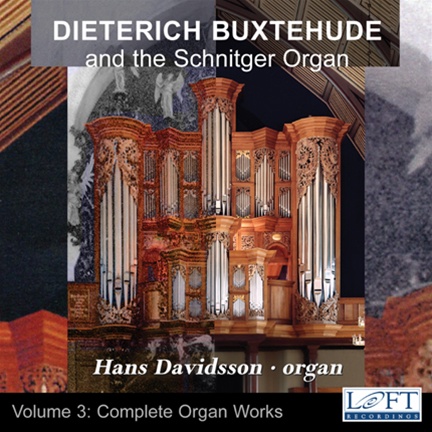
Volume 3: Buxtehude and the Schnitger Organ (3 CDs)

North German Baroque Organ, Gothenburg, Sweden

Recent research shows that Buxtehude had only mean-tone organs at his disposal during his life. Although there are many good recordings on well-tempered organs (including some antiques), performing these works on mean-tone instruments requires both a radical re-assessment of traditional performance ideas and a large and extraordinary organ. Hans Davidsson is the ideal performer for this task, and he plays the huge “North German Baroque Organ” of Gothenburg, Sweden. The complete organ works are recorded here in three volumes totaling seven compact discs.


Wednesday, February 23, 2011

Reviews for the Complete Organ Works of Buxtehude


"Audiophile Best Find" of 2007, "Classical Lost and Found (CLOFO.com) http://www.clofo.com/


"Davidsson is a very musical player with a virtuosic flair well suited to this music. The phrasing in the chorale preludes is exquisitely sensitive. His interpretation of the Passacaglia is one of the best I’ve heard. This is an outstanding recording from every point of view. Bravo!"
—American Record Guide


STAR RECORDING (Record of the month)
(review of both Volumes 1 and 2)

"It is difficult to know where to begin with these four CDs. This is a monumental recording in all sorts of ways. It is special because of the mean-tone tuning and the effect that this has on the music and the way it sounds. While we cannot be sure how the music would have sounded originally, the Baroque Organ project led by GOArt and sited in the Örgryte nya kyrka has done so much to foster interest in, and knowledge of, organ building at the time. It is good that we now have these recordings so that we can hear for ourselves.

There are some delicious sounds throughout – partly the registers, partly the tuning – often challenging the listener, especially when the choice of stops is not what we might think of today – as for example playing fugues on reed stops in a kind of Grand Jeu. But it is the vast range of colour that is most impressive, including a delightful cymbelstern. The CDs use the ULSI recording technique, which certainly gives the listener a feeling of intimacy and contact with player and instrument and adds much to the overall quality of the recordings.

The second two CD set focusses on music which JS Bach and his circle studied, shared and admired. There is thus an added fascination when listening to these pieces for the insight that they give with regard to later organ music.

Hans Davidsson – such a fine player, especially in this context – is to be congratulated, as are all the team involved. The sleeve notes are full and well produced, though there is also a significant amount of additional material, including notes on each piece and a complete listing of all registrations used at www.gothic-catalog.com. These CDs are most highly recommended, and have to be a star recording of star recordings as far as I am concerned; they are an absolute must to buy." —The Organ (UK)

Classical Lost and Found:

"Strange and wondrous sounding things happen when you hear early Baroque organ music performed on a mean-tone tempered instrument like the one here. That's because this method of tuning produces pure major thirds, which were all the rage in Dieterich Buxtehude's day (1637-1707) as they were thought to be the musical equivalent of "heavenly harmony." Not only that, but they intensify the contrast between consonances and dissonances in music thereby giving it greater emotional impact. So it's quite likely this is what you would have heard at the prestigious St. Mary's Church in Lubeck, Germany, when the composer was organist there. However, these "heavenly thirds" come at a cost, because pieces in certain keys can sound harsh or even dissonant on mean-tone instruments. So steps must be taken to ameliorate these incompatibilities. The most radical solution is to transpose the work in question to a more listener-friendly key, and in Buxtehude’s day organists did this all the time. Besides transposition though, there are several other ways to accomplish this. For instance, the organ for this recording has additional sub-semitone black keys and pedals just for this purpose (see the excellent album notes for an explanation and picture of them). These are necessitated by the fact that accidentals like d-sharp and e-flat, which are the same identical note and represented by just one black key on a conventionally tuned instrument, must take on slightly different pitches on a mean-tone one in order to minimize the problems mentioned above. Additionally the performer can downplay dissonant notes by shortening their length, camouflaging them with ornaments and/or even opting for leaner registrations that make them less apparent.

The highly versatile and talented soloist here, Hans Davidsson, uses every trick at his disposal to come up with some of the most colorful Baroque music that ever emanated from an organ pipe. As a matter of fact, after you've heard this album, Buxtehude on a conventionally tuned instrument comes off sounding rather drab! The one Davidsson plays here is located in Gothenberg, Sweden and it’s absolutely spectacular. That’s because it’s a modern day synthesis of the finest North German Baroque instruments from such builders as the great Arp Schnitger. Not only that, but this is one of the best sounding recordings of "The Pope of Instruments" to come along in some time. It utilizes Erik Sikkema's new ULSI recording technology, which does for church spaces what Ray Kimber's IsoMike does for the concert hall (see the 17 February 2007 newsletter). Accordingly, audiophiles who love organ music must have this release, and are encouraged to read about ULSI. (click here for details)

Musically, artistically and sonically producer Roger Sherman has a “Triple Crown” winner with this, the first of three albums from Loft Recordings devoted to the composer's complete organ works a la mean-tone. This one contains all of his better known ones, so it's perfect for those wanting a single highlights album. However, a word of warning, after you hear it, you may well find "you can't eat just one!" Those desiring more detailed information about what’s included can find it on the new, beautifully appointed Gothic Web Site."

-- Bob McQuiston, Classical Lost and Found (CLOFO.com)
www.CLOFO.COM

Buxtehude Organ Works—Hans Davidsson (7 CDs total)

Includes:
Volume 1: Buxtehude and the Mean-Tone Organ (2 CDs)
Volume 2: The Bach Perspective (2 CDs)
Volume 3: Buxtehude and the Schnitger Organ (3 CDs)

North German Baroque Organ, Gothenburg, Sweden

Recent research shows that Buxtehude had only mean-tone organs at his disposal during his life. Although there are many good recordings on well-tempered organs (including some antiques), performing these works on mean-tone instruments requires both a radical re-assessment of traditional performance ideas and a large and extraordinary organ. Hans Davidsson is the ideal performer for this task, and he plays the huge “North German Baroque Organ” of Gothenburg, Sweden. The complete organ works are recorded here in three volumes totaling seven compact discs.


Wednesday, January 5, 2011

How Brightly Shines The Morning Star - Reviews

Yesterday we told you about our new Epiphany album "How Brightly Shines the Morning Star", so today we wanted to share some reviews of this album with you so that you aren't just taking our word for it!

Journal of the Association of Anglican Musicians:

This exhilarating program uses the title chorale as a unifying element and combines favorite repertory with some fine lesser-known music. The opening is a striking introduction by Thomas Joyce to the hymn songs of Thankfulness and Praise, and the other eight hymns receive similarly imaginative treatments. Wie schön leuchtet (How brightly shines) is heard in the Mendelssohn chorus form the unfinished oratorio Christus and as the concluding festive hymn. It also appears in four organ settings: a Buxtehude choral fantasia, contrasting preludes by Helmut Walcha and Ludwig Lenel, and a charming setting by Jan Zwart, entitled in Dutch O Heil’ge Geest dall op ons neer (the words on sneer on the box and in the liner are a misspelling). In addition to our colleague Mel Butler, the organists are Thomas Joyce and Roger W. Sherman (who is also producer and editor); Brian Fairbanks appears as flutist and Joyce Ramée as violist.

The varied anthems include Leo Sowerby’s Now There Lightens upon Us, The Three Kings by Healey Willan, Peter Hallock’s exquisite Baptism of Christ, the Tribus Miraculis of Luca Marenzio and the In splendenti nube of Peter Philips. Of particular interest is the hymn setting of American composer Cary Ratcliff of the text O Light of Light, Love Given Birth, using Laurence Housman’s translation of a 10th-century Latin text.

The choir maintains the exemplary standard of tone, nuance, phrasing and diction that we know from our colleague Peter Hallock’s long tenure at St. Mark’s. The recording is most sympathetic, taking advantage of the superb acoustics of the cathedral. The liner includes notes, biographies, and some texts.

Even if all of your Epiphany music has been planned by the time you read this review, buy this disc now, enjoy hearing it this year and consider some of its useful ideas for next year.

The Living Church:

St. Mark’s Cathedral Choir of Seattle, Wash., reminds us that Epiphanytide is no ordinary time. Its recent recording is a smart collection of choral, hymn, and organ music appropriate for Jan. 6 and the days that follow. This is music, one might say, fit for a king or three. Mendelssohn’s “Behold a Star” from “Jacob Rising” is well paired with the standard hymns such as “We Three Kings,” though in this case with a particularly alluring and exotic introduction. St. Mark’s Cathedral Choir delivers an honest and accessible performance. Few churches are blessed to have a nearly 50-voice, non-professional choir. Choirmaster J. Melvin Butler and his crew allows all the rest of us to hear what the possibilities are.

Sing for Joy radio program newsletter:

There is a rather long-standing "inside" joke among those of use who produce Sing For Joy regarding the fact that there is so little music celebrating the Baptism of Christ. One possible reason for this, we think, is that the feast often falls on the same Sunday as the celebration of Epiphany - and there is so much good music written for the season of Epiphany. This disc is a worthy sampling of some of that great music. And thankfully it also includes anthems celebrating the Baptism of Christ! Featuring many of the great hymns of the season, the choir of St. Mark's contributes solid performances of the repertoire with very clear diction and enthusiastic engagement. The real star of the show here, though, is the Cathedral's Iandmark Flentrop pipe organ. Numerous solo organ selections based on the tunes of the Epiphany season show off the organ's singular voice in the unique acoustical properties of the half-finished Cathedral. This disc is a welcome addition to our collection, and could be to yours as well.


Thursday, December 16, 2010

Christmas at America's First Cathedral Review!

The Baltimore Sun's music blog "Clef Notes & Drama Queens" recently reviewed the Baltimore Choral Arts Society's new Gothic Records release "Christmas at America's First Cathedral".

From "Tim Smith's Clef Notes & Drama Queens":
"...'Christmas at America's First Cathedral' by our very own Baltimore Choral Arts Society (Gothic Records). This is a souvenir of the 2009 concert at the Baltimore Basilica and comes complete with a DVD of the event. The recording, which captures the warm, reverberant acoustics of that historic space beautifully, offers a program that is generous in providing fresh material.

The imaginative and instantly appealing new works by Rosephayne Powell and James Lee III provide welcome additions to Christmas repertoire. And it's refreshing to have some less obvious, season-appropriate selections by Handel (his other great "Hallelujah" Chorus, from "Judas Maccabeus") and Mendelssohn ("Rise Up" from "St. Paul" makes a cool curtain-raiser).
The chorus and orchestra, led by Tom Hall, sound admirably vibrant. So does soprano soloist Janice Chandler-Eteme."

Read the full article here.


Purchase from the Gothic Catalog!

List Price: $18.98
 

Gothic Catalog Price: $15.98 
You save $3.00!


USPS:

Dec. 16 Express Mail International to Asia/Pacific Rim, Australia, New Zealand and Europe
Dec. 19 Express Mail International to Canada
Dec. 19 Global Express Guaranteed to Asia/Pacific Rim, Australia, New Zealand and Europe
Dec. 19 Global Express Guaranteed to Canada
Dec. 20 Priority Mail to USA

United Parcel Service (UPS) will deliver on December 24, 2010:
Dec. 12 UPS Ground (3-10 days, depending on distance)
Dec. 20 UPS 3-day Select
Dec. 21 UPS 2-day
Dec. 22 UPS Next Day


Wednesday, November 10, 2010

What the Press say about Joan Lippincott

As you should know by now, we are celebrating the phenomenal Joan Lippincott this week! So today, we wanted to let you know what critics have to say about this legendary organist.

Concert Quotes:

“Most important perhaps, is her way with rhythm … the mighty Toccata in F had an irresistible and wonderfully humanizing swing about it.” - The New York Times

“Bach’s Canonic Variations on Vom Himmel Hoch displayed an uncommon level of technique, registrational imagination and musical understanding. Bach’s D-minor Toccata and Fugue … she played with the dazzling solidity and simplicity of the laws of the universe.” - Boston Globe

“A large audience gathered last night at the National Shrine of the Immaculate Conception. … Ms. Lippincott rewarded them with a varied program, given with a mixture of consistently high musicianship and disciplined playing.” - The Evening Star

“Almost everything about Joan Lippincott`s organ recital proved first class ... The organist displayed a strong architectonic flair in both programming and performance, a penchant for detail and more than ample technical facility to realize her interpretative goals.” - The Los Angeles Times

2000 Bach Festival, First Congregational Church – “… a balanced wonder of rigorous freedom and grace – the great Bachian paradox of metaphysical abstractions given exuberant musical life.” - The Los Angeles Times

“She is an exacting musician, intense, positive, and forthright.” - Seattle Post-Intelligencer

“Ms. Lippincott’s dazzling recital was … the kind of performance a man is prompted to admiringly call ‘virile.’ The highlight of the afternoon was the performance of the Alain Trois Danses. Ms. Lippincott’s recital was an auspicious opening to the convention.” - Music

“Those who attended the recital can certainly verify why critics have acclaimed Ms. Lippincott as one of America’s outstanding organ virtuosos. The final number was the Prelude and Fugue on BACH of Liszt. It was a tour-de-force and superbly played.”
Worship and Music Notes

“She applied herself with exhilarating effect. … Her stirring performance of the Grande Pièce Symphonique brought the large audience to its feet.” - St. Louis Post-Dispatch

“Lippincott gave the great Toccata in F an extremely fluid touch and the lines sang. I heard new things in the music because of her way of playing it.” - Grand Rapids Press

Recording Review Quotes:

“…a recording of absolute musical success. Joan Lippincott never overwhelms with the sound of the organ, and the Camerata is a splendid musical group. This recording could convert even a person who thinks he does not care for Bach’s music, should such a benighted soul exist anywhere on the planet.” — The Diapason

"Joan Lippincott performs some familiar preludes and fugues by Bach on the Paul Fritts Organ at Notre Dame University. The organ is said to resemble the sort of organ on which Bach would have performed. Ms. Lippincott’s registration, while adhering to the notion that the preludes and fugues were to be played “full plenum” (full organ), are varied and tasteful and rarely overwhelm the music. Her interpretations are those of a seasoned player, and, even if one doesn’t agree with them, they are difficult to disrespect." - The Living Church

View the Joan Lippincott collection on the Gothic Catalog

Thursday, June 24, 2010

Viaticum/Robert Bates Reviews and Interview

Yesterday we introduced you to the Robert Bates album "Viaticum" which consists of his original compositions. So today we thought we would share some reviews of this album as well as an interview with Robert Bates!


Here is a remarkable concert of organ music of the 20th century, in which not a single work suffers from the faults that generally weigh on contemporary music… This selection lets us hear the best of what is being written for organ in recent years. And I include the pieces by Bates himself, whether for solo organ or organ accompanied by synthesizer or pre-recorded organ; it is music that can be listened to again and again with real pleasure verging on the spellbinding.

Bates as a player also deserves plenty of compliments: he plays clearly, precisely, and not without emotion…”

- “Magazine Orgue” (Belgium)

“Viaticum is a recording for organ and narrator, featuring 20th century organ works by Arvo Pärt, Jean Guillou, György Ligeti, Joan Tower, Calvin Hampton, and original works by Robert Bates. The 3-CD set is organized into three programs, describing the life and death journeys of the body, mind and soul. Recorded with 24-bit technology at Stanford Memorial Church, Viaticum utilizes the two organs in the rear gallery (Fisk, 1984 and Murray Harris, 1901), in ensemble with electronic instruments on some pieces. This unusual recording is a sonic spectacular, and presents the organ as it is rarely heard, with an unusual repertoire. Many pieces are recorded here for the first time. For additional information, read the Fanfare reviews (below).”

"Bates is obviously a highly accomplished performer, as one would expect from an organist in such demand. The clarity of his articulation is immaculate, and his choice of the two fine organs at the Stanford Memorial Church was inspired, as both record beautifully."
-BY DAVID DENTON Fanfare Magazine

A View from the Organ Loft: An Interview with Robert Bates

BY DAVID DENTON Fanfare Magazine


"Travel with me and I will supply the Viaticum, the provisions for your journey." This is the opening line of a new trilogy of words and music, Viaticum, by organist and composer Robert Bates, newly recorded and just released on the Loft Recordings label. Extending to almost three hours, the work takes the listener on three separate pilgrimages, each exploring the nature of the universe through the thoughts of philosophers, scientists, and clerics. With so much research having been necessary to collate the intricate details involved in the text, I asked Bates how long he had been involved in creating the work. "Most of it results from reading over the years, and particularly my interest in books on philosophy and modern science. The problem came the other way around, and I had to whittle my original wording down to a length that would balance with the musical content. The work originated with the contents of the third disc, Life after Life, and it was the favorable response to that section in a concert performance that prompted me to extend it to three parts." At that juncture the work had no name, Viaticum, the Latin word for "provisions for a journey," seeming very appropriate once the score had been completed. That third part deals with religion and the traditional journey to everlasting life for those fortunate enough to achieve celestial bliss. Is this the concept of death that Bates believes in? "I have to say that I am not a religious person in the strict sense of the word. I am a person who relates more to philosophy, and the answer to your question is: I don't really know."

Bates was educated at Wayne State University and Southern Methodist University, before moving to France to continue his organ studies with Marie-Claire Alain and improvisation with Daniel Roth. His return to the States took him to Stanford University, where he graduated in musicology, with the emphasis on performing practices and history of music theory. Today he is associate professor of organ and university organist at the Moores School of Music at the University of Houston. "When I left northern California exactly one year ago to come to Houston, I discovered that housing was one-third to one-half the price here as it was there! I was able to buy a wonderful and unusual house in an old Victorian-era section of Houston called the Heights. The name comes from the fact that the area is 20 feet higher than the rest of Houston, so it doesn't flood as often during our famous storms. What we have is a brand-new home made to look like an 1880s firehouse. People come in and say things like, "This is the best restoration I've ever seen"; you should see their faces when I tell them it is 100% new! Best part is that the ceilings are high enough for my very tall Mason and Hamlin reed organ, built around the same time as most of the neighborhood. Houston is a marvelous place for the performing arts, which are very much alive here. People take pride in the arts and are amazingly knowledgeable about them, and those with money give support through museums, opera, education, etc."

During his student days Bates garnered an enviable collection of competition successes, including the Los Angeles prize in 1976, his return there 17 years later as a judge being a particularly happy memory. As a concert organist he was soon in demand around North America and Europe, and it was for a 1998 concert at the Redlands Organ Festival in Southern California that Life after Life had its world premiere. The program was successfully repeated at many venues, and the idea for a much more extensive work took shape. I asked, "Was that inspiration started by the words or the music?" "The whole thing rather evolved, previous music that I had composed suggested the text, and at other times I composed music specifically as a response to an idea from the words. There became an interaction between the two, and at first I just intended adding one further section, and that grew to the idea of three journeys. I hope that the whole will be a journey that will help people to understand more about life."

Though Bates has used the words and thoughts of great philosophers and scientists, in selecting those words there is inevitably a personal input of the ideas and ideals that appear important to Bates. I wanted to return to the third part of Viaticum, which, as a person still searching for a religion, I found the most difficult to accept. "Even if religion were only an invention of humanity," urges Bates, "you can still learn a lot from it without actually believing in it. We can read about mythology and not believe one word of it, but it can still speak to us and help us understand ourselves." I accept his theory, though, on a lighter note, I am not quite sure how that willingness to expose his thought process squares up to his response to "pop" music. "People say that I would like it if I just knew more about it and listened more. But I doubt it. One simply can't avoid lots of exposure to pop music at this time in our history. Jazz I enjoy, but I know little about it. I don't think that it has had much influence on my own music. People from outside the US often assume Americans know all about jazz, but more often than not we don't. I do love some folk music when I hear it-Balinese, Indian, Thai, for example-but I'm certainly no ethnomusicologist. On the other hand, there are obvious influences from the music of other cultures to be found in my own music, mostly via Western composers such as Olivier Messiaen and Jehan Alain, and partly through my personal preferences for scales that have an "exotic" sound. And now that I think of it, I guess I tend to play pieces by other composers that are a bit exotic sounding." His choice of music by other composers for Viaticum certainly shows a very wide taste, with Arvo Pärt, Jean Guillou, György Ligeti, Joan Tower, and Calvin Hampton among the eight composers represented. In total they supply the bulk of the music, though the eight works by Bates are the largest single contribution. Many of his scores include parts for synthesizer and prerecorded organ. "Organists can be rather conservative, and we need a little more invention to our approach. I became involved in computers at Stanford University when I seemed to be surrounded by computer engineers. There is quite a big department at Stanford in the field of electronic music, and that technology is now with us, and ours to use. If we can harness it and use it to good taste in music that we believe in, we can expand the traditions of music. If we don't, others will, and that use may not be to the benefit of classical music. I have used synthesizers with organ, prerecorded tape to layer on top of the organ texture, and generally experimented with the sonorities that are possible. I don't know of other organists who are working in this field, though I am sure there must be a parallel elsewhere. I admit I am not a fan of electronic organs, but what will happen to organs in the future we don't know, so you have to keep an open mind."

In Viaticum Bates also examines the use of visual aids to communicate with the audience. This is not a visual presentation of notes, but a picture, similar to a graph, plotting the movement of the music, and, whether you are a musician or not, you can follow the progress of the work. "The spoken text will create a visual image of the music in the listener's mind. That was one objective. Then they can follow the images drawn out. I find people who know about music are intrigued at the idea, and nonmusicians are surprised that they can follow the music in this manner. It is something that I will now take further." Packaged with the three discs come these graphic "scores" for three of the works, Orpheus and the Winged Creatures, Charon's Oar, and Hades' Realm. "I would say that in the United States the organ itself is not very fashionable, so that any aid to draw people into the performance is a plus. We live in a visual era, where images constantly flash before us, and I find that a lot of people simply do not like sitting and simply listening to music, yet they do enjoy a visual stimulus."

Listening to the works by Bates you would hardly guess the name of his favorite composer. "I like many early composers, such as the great Dietrich Buxtehude, who was such an influence on Bach; the early Spanish composers-Correa de Arauxo is my favorite; early French composers such as François Couperin, and a number of living composers, especially Arvo Pärt. The greatest composer of organ music in the 20th century is clearly Olivier Messiaen, so I play much of his music. Some performers will happily play anything that comes along. I can't afford the time to play everything. But Bach is so far in the lead that it hardly makes sense to mention others. My own music-well, I know it does not sound much like Bach-has taken one major thing from him. You can listen to Bach on many levels. You can just sit and enjoy one of his big organ Toccata and Fugues without knowing anything about the music, or you can investigate every strand as a musicologist. I am not saying my music is in that caliber, but I like to work in several layers, so that it can hold your attention and you can discover more on repeated hearing. I also try to capture that inner logic in Bach's writing. So to that extent there is a similarity."

For Viaticum Bates has used the two organs at the Stanford Memorial Church, and, in common with every organist, he has his favorite instruments. "I do love those two, but I just played for the national convention of the American Guild of Organists on a beautiful new organ built by Paul Fritts at the Pacific Lutheran University in Tacoma, Washington. Historic French and German organs always interest me, and those in Mexico from the 17th century have become a new area of fascination. I sometimes get the feeling during a concert that I'm playing my absolute all-time favorite; the feeling may only last for the duration of the recital, but that is enough. The question is a bit like another I have often been asked: "What is your favorite Bach work?" The answer, of course, is "The one I am playing at the moment." But, on the other hand, it is difficult to feel inspired by a bad organ-and there are far too many of those in this world. In the States we have some marvelous organs being built. I don't think the quality has ever been better, and the level of playing is now very high. But we have been through a period when the number of musicians going into the profession had slumped dramatically, and performers and audiences seemed to lose interest, and you could go to recitals with only 10 or 20 people in the audience. Now we are beginning to hear more organ records on the radio, so that will have a major effect."

That takes us conveniently back to Loft Recordings, the originator of the label, Roger Sherman, a distinguished organist in his own right, having been prompted to start commercial recordings after running the record program The Organ Loft, on the Seattle radio station KING-FM. Starting out with private recordings for broadcast purposes, Sherman found considerable listener interest in the music he was playing over the radio. From little acorns great oak trees grow, goes the saying, and having recorded organ discs for sale in churches, Sherman ventured out in the mid 1990s with Loft Recordings. Today the label has over 30 discs available, Bates already represented by Daquin and the French Noel (LRCD 1004). He is also presently in the process of recording the complete works of Correa d'Arauxo (1583-1654), the first five volumes being played on the previously unrecorded 1690 organ at Oaxaca Cathedral in Mexico.

The entire series of Viaticum was first performed at Stanford University in the spring of 1999, and is Bates's most recent score, all of which involve the organ. "I have been asked to write a vocal work, and in my younger days I did take orchestration classes, though at present I feel most happy writing for the organ. I am presently working on a Book of Sonority, a group of pieces that will be based on one set of pitches and using the different sonorities of the organ to create the work. I suppose that appears a move towards Minimalism, but the intention is to restrict myself a bit more and to concentrate on the characters of each note. It is an abstract concept, and one that you can really only achieve on the organ." Composition still has to find its slot in a busy schedule of teaching and performing, Bates having recently returned from Poland, where he was surprised at the audience interest in organ concerts. "The problem for many in the States is the instinctive relationship they hold between the organ and religion. I would like it to be equally seen as an individual musical instrument." As he does not play any sport, and normally grabs a holiday on his overseas concert tours, how does he relax? "Well I love most Mediterranean food, though my favorites are Indian and Thai. I have developed a very strong liking for Cajun cuisine since arriving here in Houston. Many people, including most Americans, are not aware that Houston has a large Cajun population. They came here from Louisiana and brought their incredible cooking with them, with many spicy seafood dishes. Anyone who likes seafood and spices is bound to love Cajun food." And if he lived to be a centenarian, what reason would he give for his long life? "Good wine" was the short answer.


Robert Bates takes us on three journeys, through the mind, body, and soul. His intention is threefold: First there is the desire to leave listeners with a greater wisdom about themselves and the world around. Second is the hope that the combination of words and music will interact to stimulate our interest in both and, third, a wish that, through the narration and programmatic approach, organ music will become more accessible to a wide variety of people of all ages, especially those interested in new music. The words used in Viaticum are Bates's own, derived from an interest in reading books on philosophy and modern science. He has used them judiciously, the time scale of each section related to the music the words are intended to complement. That music has been sourced from the compositions of Arvo Pärt, Jean Guillou, György Ligeti, Jehan Alain, Jeanne Demessieux, Olivier Messiaen, Joan Tower, and Calvin Hampton. Each journey opens with a Prelude from Pärt's Trivium, with journey's end marked by a complete performance of the work. To these Bates has added eight of his own organ works, many enhanced by the use of synthesizer and prerecorded organ. The tracks taken from the works of other composer, such as Messiaen's "Les Oiseaux et les sources," from the Messe de la Pentecôte, are mostly well known, and were selected to illustrate the spoken text that precedes them. The works by Bates are here receiving their first recording, and we discover a modern musical voice that retains a melodic tonality yet is obviously fascinated by the vast range of sounds possible from the organ. His use of synthesizer is interesting in its augmentation of the keyboard, the most extensive score, Birthday Tribute, based on the name B-A-C-H, being a particularly beautiful creation. Here the synthesizer offers a myriad of percussion and harplike sonorities, the bass end of the organ often creating a dark quality below the tinkling sounds. The influence of Messiaen is always present, and I am sure the great French composer would have been delighted to have constructed such a totally fascinating work.

You can at times question some of the text, the third part, which takes on a journey from this world to the next, relating to the old religious edict that the good go one way and the bad the other. In my interview with the composer, he drew the admission from me that it had made me stop and think, despite my awkward relationship with religion. Like the old cliché "There is no bad publicity," the text does prompt a response, and in so doing has made me once again question my relationship with religion. I suspect it will do the same with others. In the booklet that accompanies the discs, Bates suggests that the thought process should continue far past the obvious. Viaticum is, for instance, full of numerology, but essentially based on the number three, and he suggests that we examine the work for further examples. Many believe that numerology plays an important part in life, and this use of the number three has shaped much that we hear on the disc.

To the more fundamental question "Will I like it?" I would give an enthusiastic yet guarded reply. From a performance point of view it is exemplary. Bates is obviously a highly accomplished performer, as one would expect from an organist in such demand. The clarity of his articulation is immaculate, and his choice of the two fine organs at the Stanford Memorial Church was inspired, as both record beautifully. My reservation is certainly not a personal one, but an expression of those people who find the spoken word on disc an experience they do not relish for repeated hearing, and prefer to have such words printed in an accompanying document. Here that would be totally counterproductive to the basic concept, for after reading them once, the listener would then simply listen to the disc as an organ recital. Fortunately, in Alan Wiemann we have a very pleasing voice as narrator, recorded in a believable perspective with the organ. As a totally perverted further observation, I hope that the music by Bates will not become confined to Viaticum, and will also enjoy a separate life. As I have already indicated, I find Birthday Tribute a very exciting composition, and I would equally commend to you Last Judgement, a score that occupies the same sound world. Indeed the music by Bates often overshadows that by the other illustrious composers, and maybe there will come a time when he decides to compose music for the complete Viaticum.

For enthusiasts of organ-builders, I would add that the two used here are the Fisk instrument installed in 1984, and the Murray M. Harris of 1901. The Fisk, with its four manuals, 73 ranks, and 4,432 pipes, can serve as an attractive Baroque organ, and, with its tuning, it can turn in a very authentic 17th-century French or German sound quality. The earlier instrument has undergone a number of renovations, not least a rebuild in 1981 following the Loma Prieta Earthquake, and now has 65 stops with 3,770 pipes. Both show their adaptability, the Fisk instrument being largely used for the Bates compositions.

Accompanying the three discs are two independent booklets, one of which is devoted to the graphic depiction of the works, which plays a key role in Bates's concept of sound and vision. They are interesting, and should prove a stimulus to nonmusicians. The other gives copious notes on the concept of Viaticum and on the music of Bates. There is a misprint in the timing shown in the booklet for the third disc, but otherwise the documentation is excellent. The sound quality is everything an organ buff would dream of-nicely distanced, wonderfully clear, and, above all, perfectly natural. Sherman has made the point that the synthesizer sounds were recorded together with the organ, and were not added later. The result is a realistic ambiance surrounding both "instruments." Those with an inquisitive mind should simply go out and buy this nicely boxed set, and if you still have reservations about the spoken word, try track 2 and I guess you will get hooked.


Purchase Viaticum by Robert Bates directly from The Gothic Catalog and save!


Tuesday, May 25, 2010

Greater Love: The English Choral and Organ Tradition Reviews

The Gothic Catalog is all about both Choral and Organ music. So it is always fun when we get to combine the two! And today we were inspired from some Twitter users espousing their love for both of these genres (including the combination), and we just had to share some information about and reviews of our 2007 release Greater Love: The English Choral and Organ Tradition.

Greater Love: The English Choral and Organ Tradition
Janette Fishell, organ
East Carolina University Chamber Singers
Daniel Bara, director


Quite possibly the best-sounding organ/choral disc we have ever recorded! The ECU Chamber Singers and organist Janette Fishell are conducted by Daniel Bara in these monuments of the English choral tradition. The choir’s sound is greatly enhanced by the sumptuous acoustics of St. Paul’s Episcopal Church in Greenville, and its large, new Fisk organ.

Listen to a sound sample from the album: Tu es Petrus (Pearsall).

Reviews:


“At St Paul’s Episcopal Church in Greenville, NC, the East Carolina University Chamber Singers met to record this small yet mighty compilation of organ and choral music in the English tradition. The hallowed walls of the well-chosen venue truthfully captured both the tenor and the spirit of such 20th-centry stalwarts as Howells, Tippett and Ireland.

The Interlochen- and Eastman- trained baton of conductor Daniel Bara produces a choral sound that is lovely and clean. The texts are understandable and the viratos are mostly in check—exactly how this music is supposed to sound. St. Paul’s new Fisk organ and the organist, Janette Fishell, are as good as they come.” —The Living Church


“The disc title comes, of course, from the beloved John Ireland anthem, the penultimate selection on this program, and all of the repertory is English. Our colleague Janette begins the recording with a fiery performance of the Howells Psalm Prelude II/3 and accompanies effectively in the rest of the program.

Two major works are the Howells Requiem and Britten’s Rejoice in the Lamb. Both are very well sung, though most of us likely have multiple recordings of these standards in our libraries already. The choir is to be commended for including all of the Five Negro Spirituals from Michael Tippett’s pacifist oratorio A Child of Our Time; the singers are especially effective in these pieces.

The choir negotiates the interweaving textures of Robert Pearsall’s Tu es Petrus with aplomb, and the program concludes with a charming North Country folksong arranged by Philip Wilby. The choral sound is a bit darker than is generally heard in most of this repertory, but mellifluous and nicely blended; for the Tippett selections it is just perfect. All of the soloists are very professional, though the choice of a talented but rather operatic soprano for the Ireland anthem is jarring when the pure sound of an English treble is needed. As always, Roger W. Sherman has made a superb project of the recording, mastering and editing.” —Journal of the Association of Anglican Musicians


Daniel Bara, director of choral activities at East Carolina University at Greenville, North Carolina, acknowledges that the idea for this recording came from a shared affection for 20th-Century English choral music by him and his colleague, Janette Fishell, who is the organist for the program.

She opens with an animated and exuberant performance of the sixth and last of the Psalm-Preludes (Set 2:3) by Herbert Howells (1892-1983). This is followed by his Requiem for unaccompanied voices. It is not a liturgical Requiem-there is no such thing in the 1662 Book of Common Prayer-but a highly personal musical meditation by the composer on the untimely death of his son Michael from spinal meningitis in 1935. The composer suppressed the work until 1980, and since then there have been several recordings. The text is drawn from the offices for the Visitation of the Sick and the Burial of the Dead from the Prayer Book, Psalms 23 and 121 from the Prayer Book Psalter (Coverdale), and the Latin antiphon "Requiem aeternam dona eis..." in two settings placed after the psalms.

The eight-part motet 'Tu Es Petrus' by Robert Lucas Pearsall (1795-1856) is an 1854 reworking to sacred words of a madrigal written in 1840. Sir Michael Tippett (1905-98) included a series of unaccompanied arrangements of traditional spirituals in his oratorio A Child of Our Time on the model of JS Bach's use of Lutheran chorales in his oratorios. The spirituals are often sung by themselves as a suite. Rejoice in the Lamb by Benjamin Britten (1913-76) was commissioned in 1943 for St. Matthew's Church, Northampton, by the church's vicar Walter Hussey, one of the most enterprising patrons of religious art of his time. It has since become a classic. 'Greater Love Hath No Man' by John Ireland (1879-1962) dates from 1912 and is one of the staples of the English cathedral repertory. The program concludes with an arrangement for unaccompanied voices by Philip Wilby (b 1949), current professor of composition at the University of Leeds, of the northern English folk song 'Marianne'. It is a tender and quiet song of love and loss.

The East Carolina University Chamber Singers is the cream of the school's four choral ensembles-mainly undergraduate music majors. For this recording there are 39 singers (10-10-10-9). The choral tone is extraordinarily fine: warm, solid, well blended, and superbly disciplined. These qualities are enhanced by the friendly acoustic of St. Paul's Episcopal Church, Greenville. I am inclined to think that the freshness and purity of sound we hear on this recording can only be obtained from well-trained young voices. Their diction is not affectedly British, but neither is it incongruously American. Daniel Bara directs performances that are thoughtful and sensitive, with remarkable care over phrasing and nuance.

There are many fine recordings of the Howells Requiem and Britten's Rejoice in the Lamb, but I believe this one can stand with the best of them. The undergraduate soloists have secure and agreeable tone; but in some cases, most noticeably in Britten, they are not able to take the longer phrases in a single breath. This is a minor quibble and should not deter anyone. The organ is a recently completed Fisk (Opus 126) with all the warmth and gravity needed for the romantic heft of Ireland's 'Greater Love Hath No Man' and the palettte of colors for Britten's Rejoice in the Lamb. — American Record Guide


Purchase this album from http://gothic-catalog.com!


Thursday, April 29, 2010

Organ Greats From The Great Organ - Review and Video

Yesterday we featured our new release "Organ Greats from the Great Organ" featuring Erik Wm. Suter on the Washington National Catheral organ. So today we wanted to share some listener feedback and share a video that uses a track from the album.

Best washington national cathedral Organ CD - April 16, 2010
Reviewer: Nathan Roehl from Janesville, WI United States

This is the best Organ CD that I have of his [Erik Wm. Suter] collection. My favorite is Suter's own Amazing Grace. Erik Plays this beautiful hymn with his own arrangement. He is truly a wonderful Organist and this cd is a must have for your collection.

Master Tallis's Testament by Herbert Howells


Purchase Organ Greats from the Great Organ directly from Gothic-Catalog.com and save!

Thursday, April 15, 2010

A Grand Celebration - New Review

Today we wanted to share a great review of "A Grand Celebration" from "Classical Lost and Found". We'll excerpt a bit of it here and give you the link to the full review on CLOFO.com. The review is found in their Audiophile Selections page.

Grand Celebration (Macy's 150th; Dupré, Elgar & Jongen); Conte/Wana Org/Milanov/Phil O [Gothic]
AUDIOPHILE (1 CD)

-- Bob McQuiston, Classical Lost and Found (CLOFO.com, Y100321)


This blockbuster release marks the completion of another chapter in the colorful history of the Wanamaker Organ....

...Billed as "A Grand Celebration," this album certainly captures the excitement associated with this once in a lifetime concert. Organist Peter Richard Conte demonstrates his total command of this windblown behemoth both from the registration as well as technical standpoints with some hand and footwork that would turn an octopus green with envy. In the first two selections, which are more solo pieces, he uses his phenomenal virtuosity never just for show, but only to serve the music. In the Elgar he gooses up the organ part just enough to make this one of the most thrilling performances of it you'll ever hear.

That's also due in no small part to the spirited playing of the Philadelphia Orchestra under its associate conductor, Rossen Milanov. Their reading of the Dupré is equally effective, as is most of the Jongen. However those who cut their teeth on the groundbreaking performance of the latter with Virgil Fox (1912-1980) may find parts of the first movement a tad subdued here. Also there are some brief queasy-sounding horn passages in the lento [track-4, beginning at 11:23], but other than that everything proceeds swimmingly.

As far as recordings of live performances go without benefit of touch-up sessions to get rid of occasional coughs (two noted) and applause (after each selection), these must rank with the most impressive ever done. The soundstage is stupendous, and while the combined organ and orchestra may at times seem a bit congested, this would probably be true under any circumstances with forces of this magnitude. That said, the overall balance is simply superb, and the low frequency response remains unbelievably immaculate despite all those organ pedal points (see above) plus some heavy-duty bass drum activity in the Elgar.

Read the review in its entirety at CLOFO.com

And make sure to get your copy of A Grand Celebration today from The Gothic Catalog

Monday, December 21, 2009

Dr. Christmas Reviews/Teaser

Today we thought we would share a short review of two of our Christmas albums with the Washington National Cathedral Choirs. More important than the actual reviews though, is the fact that they were included in the "Dr. Christmas" "Nice List" during his annual CD review!


THE DR. CHRISTMAS RADIO SHOW
Every year since 1989, in the week or so before Christmas, UW Oshkosh sociology professor Dr. Gerry Grzyb has become "Dr. Christmas", bringing his astonishing array of holiday music to the airwaves of WRST-FM. Sizeable samples of over 2000 Christmas CDs have been played (there are 7000 in his collection!), with 172 added in 2008 alone. The diversity of the program lies in the fact that there is almost no genre of Christmas music that Dr. Christmas won't play, the one major exception being chlildren's music since it is obviously made for a much younger audience. Dr. C. likes it all, and plays it all, and the playlists provide ample evidence of that.


ABOUT DR. CHRISTMAS
The good doctor has been honored in a number of ways.
Kyle Munson, longtime music critic for the Des Moines Register, wrote that he was “perhaps the nation’s foremost authority on Christmas music."

In recognition of his commitment to independent music, the Association For Independent Music (now defunct) named him one of the five judges in the Seasonal Music category for its Indie Awards (which were the independent music version of the Grammy).

A variety of musicians cite his reviews of their CDs that appeared in the Appleton Post Crescent on their websites.

His show has been written about in newspapers from Morro Bay, CA to Erie, PA, and it was listed as one of the distinctive ways people celebrate Christmas in the Sueddeutsche Zeitung, Munich's largest quality paper (roughly the equivalent of our New York Times).

In 2008 he was featured on WNYC, the public radio station in New York City. He took part in a debate about Christmas music as part of WNYC’s Soundcheck program.

Dr. Christmas is also heard on WRST's web stream. Last year, he had listeners around the country; click here for a map of them all! Stream listeners were also recorded in Toronto and its metro area, Dublin, Ireland, and even Hong Kong, China!


So here is Dr. Christmas' short blurb on our albums:

An equally big sound emanates from the multiple choirs, organ, orchestra, and brass ensemble assembled for “Hear the Christmas Angels” at the Washington National Cathedral. The fare is mostly familiar arrangements of favorite carols, including five from modern carolmeister John Rutter. “Sing In Exultation”, featuring the Cathedral Choirs of Men and Girls and of Men and Boys, aims to provide a musical tour of carols as well as the different acoustical spaces of that same D.C. landmark. There’s plenty of musical diversity here, including instrumental and organ pieces that make for a welcome freshness....Click to Read the full list of Christmas Reviews


It's an honor to be included in a list full of top-notch ensembles and labels.

Here's a quick teaser - We will be featuring select samples and information on these two albums plus one more throughout this week!

Wednesday, November 18, 2009

Thanksgiving Music!!!

Though we already did our first Christmas commercial here yesterday, we know that there is a major holiday coming up before December 25th! And, we have music for it!!! By now you should know about our two releases from Garrison Keillor and VocalEssence, but if you don't please click Here, Here, Here, Here, and Here!

Here are what ordinary people are saying about these wonderful Thanksgiving releases:

Over the River & Through the Woods:

"Wonderful classic recording to start your holiday season. Excellent choice for Thanksgiving and into Christmas. If you like Prairie Home Companion than you will enjoy the feel of this recording." - Greg Russell on Amazon.com

Hymn to Potatoes:

"This CD pulls together Garrison Keiler's gentle humour and good Christian hymnology, well performed by an excellent choir, with an added touch of fun that makes it a delight to listen to - just as it is to listen to a session of Prairie Home Companion. It makes me feel at home, and it's also inspirational. Great recording!" - Martin Collin from Amazon.com

"What a wonderful 2 CD collection: good music, good humor... if you like a Prairie Home Companion and choral music, this is a winner." - AmazonAddict

Friday, October 23, 2009

A Back-Catalog Review - Buxtehude and the Mean Tone Organ

Today we wanted to share some reviews with you from an organ release in our back-catalog. The release is from 2007, and there are Three volumes with Hans Davidsson on the organ.


"Audiophile Best Find" of 2007, "Classical Lost and Found (CLOFO.com) http://www.clofo.com/


Davidsson is a very musical player with a virtuosic flair well suited to this music. The phrasing in the chorale preludes is exquisitely sensitive. His interpretation of the Passacaglia is one of the best I’ve heard. This is an outstanding recording from every point of view. Bravo!
—American Record Guide


STAR RECORDING (Record of the month)
(review of both Volumes 1 and 2)

It is difficult to know where to begin with these four CDs. This is a monumental recording in all sorts of ways. It is special because of the mean-tone tuning and the effect that this has on the music and the way it sounds. While we cannot be sure how the music would have sounded originally, the Baroque Organ project led by GOArt and sited in the Örgryte nya kyrka has done so much to foster interest in, and knowledge of, organ building at the time. It is good that we now have these recordings so that we can hear for ourselves.

There are some delicious sounds throughout – partly the registers, partly the tuning – often challenging the listener, especially when the choice of stops is not what we might think of today – as for example playing fugues on reed stops in a kind of Grand Jeu. But it is the vast range of colour that is most impressive, including a delightful cymbelstern. The CDs use the ULSI recording technique, which certainly gives the listener a feeling of intimacy and contact with player and instrument and adds much to the overall quality of the recordings.

The second two CD set focusses on music which JS Bach and his circle studied, shared and admired. There is thus an added fascination when listening to these pieces for the insight that they give with regard to later organ music.

Hans Davidsson – such a fine player, especially in this context – is to be congratulated, as are all the team involved. The sleeve notes are full and well produced, though there is also a significant amount of additional material, including notes on each piece and a complete listing of all registrations used at www.gothic-catalog.com (click on the ORGAN REGISTRATIONS tab above...). These CDs are most highly recommended, and have to be a star recording of star recordings as far as I am concerned; they are an absolute must to buy.

—The Organ (UK)

Strange and wondrous sounding things happen when you hear early Baroque organ music performed on a mean-tone tempered instrument like the one here. That's because this method of tuning produces pure major thirds, which were all the rage in Dieterich Buxtehude's day (1637-1707) as they were thought to be the musical equivalent of "heavenly harmony." Not only that, but they intensify the contrast between consonances and dissonances in music thereby giving it greater emotional impact. So it's quite likely this is what you would have heard at the prestigious St. Mary's Church in Lubeck, Germany, when the composer was organist there. However, these "heavenly thirds" come at a cost, because pieces in certain keys can sound harsh or even dissonant on mean-tone instruments. So steps must be taken to ameliorate these incompatibilities. The most radical solution is to transpose the work in question to a more listener-friendly key, and in Buxtehude’s day organists did this all the time. Besides transposition though, there are several other ways to accomplish this. For instance, the organ for this recording has additional sub-semitone black keys and pedals just for this purpose (see the excellent album notes for an explanation and picture of them). These are necessitated by the fact that accidentals like d-sharp and e-flat, which are the same identical note and represented by just one black key on a conventionally tuned instrument, must take on slightly different pitches on a mean-tone one in order to minimize the problems mentioned above. Additionally the performer can downplay dissonant notes by shortening their length, camouflaging them with ornaments and/or even opting for leaner registrations that make them less apparent.

The highly versatile and talented soloist here, Hans Davidsson, uses every trick at his disposal to come up with some of the most colorful Baroque music that ever emanated from an organ pipe. As a matter of fact, after you've heard this album, Buxtehude on a conventionally tuned instrument comes off sounding rather drab! The one Davidsson plays here is located in Gothenberg, Sweden and it’s absolutely spectacular. That’s because it’s a modern day synthesis of the finest North German Baroque instruments from such builders as the great Arp Schnitger. Not only that, but this is one of the best sounding recordings of "The Pope of Instruments" to come along in some time. It utilizes Erik Sikkema's new ULSI recording technology, which does for church spaces what Ray Kimber's IsoMike does for the concert hall (see the 17 February 2007 newsletter). Accordingly, audiophiles who love organ music must have this release, and are encouraged to read about ULSI. (click here for details)

Musically, artistically and sonically producer Roger Sherman has a “Triple Crown” winner with this, the first of three albums from Loft Recordings devoted to the composer's complete organ works a la mean-tone. This one contains all of his better known ones, so it's perfect for those wanting a single highlights album. However, a word of warning, after you hear it, you may well find "you can't eat just one!" Those desiring more detailed information about what’s included can find it on the new, beautifully appointed Gothic Web Site.

-- Bob McQuiston, Classical Lost and Found (CLOFO.com)
www.CLOFO.COM


Diderich ‘Hansen’ Buxtehude (1637–1707) was born in Denmark, and was active as an organist, composer, and cultural entrepreneur in Denmark and Sweden as well as in Germany, where he became known as Dieterich Buxtehude. He grew up in Helsingør, Denmark, and served as organist in Helsingborg (now in Sweden) and Helsingør before accepting one of the most prestigious musical positions in North Germany, that of organist at St. Mary’s Church, Lübeck, in 1668. During his nearly forty years of service there he achieved fame not only as an organist but also as the composer and director of a concert series known as the Lübeck Abendmusiken. Although he left an impressive corpus of arias, sacred concertos, and cantatas for voices with instruments as well as two printed editions of sonatas for strings, it is chiefly his organ works that captured the attention of performers both in his day and in our own. His organ music appeals to modern listeners because it is full of the fantasy, variety and unpredictability that characterises seventeenth-century music, yet is rooted in the major-minor tonal system familiar to our ears. The works fall into two broad categories, those based on chorale melodies and those freely composed. He set many chorales as short preludes, with a highly ornamented melody to be played by the right hand on one manual, a two-voice accompaniment for a second manual, and a continuo-like bass for the pedal. Despite their unity of style, they show endless variety in their ornamentation. His extensive chorale fantasias, on the other hand, develop each phrase of the chorale in a contrasting style. His free pedaliter praeludia are the works for which e is best known, demonstrating his virtuosity as both a composer and a performer. The large organ that Buxtehude played in St Mary’s in Lübeck had fifty-four stops on three manuals and pedal. Recent research suggests that it may have been in mean tone, a tuning in which the tonal excursions that Buxtehude included in some of his praeludia would have been difficult to play. Hans Davidsson’s bold undertaking of the recording of Buxtehude’s entire organ repertoire in mean tone gives us startling new insights into how this ‘heavenly harmony’ might have sounded in the seventeenth century. This beautifully produced double-CD is the first in a projected three-volume series from Loft Recordings and is essential listening for anyone interested in early organ music.

-- John Pitt, New Classics (UK)
New-Classics


Hans Davidsson has recently released a recording called ”Dieterich Buxtehude and the Mean-Tone Organ”. It is a double CD and the first of three sets that will cover the complete organ works of Dietrich Buxtehude. It is not merely another recording of the complete organ works of Buxtehude, but a recording with a vision and a pedagogical design.


The idea is to record Buxtehude on a large organ in mean-tone, something that has never been done before. The reason it hasn’t been done before is that that there has been a belief that the music of Buxtehude has been intended for well-tempered organs – but convenience has probably also played a part. Newer research has shown that the organ works of Buxtehude were written in a context where mean-tone temperament was an important ingredient. A counter-argument based around the existence of pieces in remote keys- such as the preludes in f#-minor and A major – is not sustainable since the keyboard compositions of Buxtehude’s time didn’t have the same function as they began to have around hundred years later in music history. Composing and improvising were still two parts of the same practice, so a composition lived a life that probably consisted of a large number of improvised versions and one or several written down versions (perhaps even in different keys). The written notation of a piece was a tool to develop and spread (to colleagues and students) that organ playing that was mostly improvised.


“Pedagogical design” is a somewhat clumsy way to say that Hans Davidsson’s recording is so much more than a recording. The buyer gets a richly illustrated booklet, and if he or she is not content with the exciting essays there are even more detailed program notes and registration indications of the record label’s website. The program notes are excellent examples of texts that contain a good balance of facts, speculations and explanations of musical choices.


I suspect a larger ambition behind this very complete production. The aurally and visually magnificent organs, the important role of the organist in both church service s and local musical life and a music making where composition, improvisation and interpretation were different sides of the same practice: all these aspects of the North German Baroque organ art can be made into a story about the golden age of organ art. And that is what Hans Davidsson achieves with rhetorical power in both playing and texts. The story of the golden age makes us question our present but also- paradoxically – enables us to shape our future. Presumably that is the intention, and I think that is excellent.


This is a double CD that can be recommended in every respect to be bought, listened to, studied and challenged by:


Buy this record if you are interested in sound recording and are curious about what Erik Sikkema’s USLI-technique means. It is enough to listen to it with just open ears to realize that organs seldom sounds this good on records, you can hear both the room and the details.


Listen to this music if you, in an increasingly more noisy, more tone deaf and more insensitive world are in need of good examples and inspiring role models to be able to continue your work as a church musician, organist or pedagogue! Here is a story from the golden age of organ art, from the 17th century North Germany where the bourgeois proudly invested in magnificent organs and where the organist was a kind of musical preacher.


Study this production even if you have heard all earlier and current recordings of Buxtehude’s organ works, and even if you have played them all! There are new details to discover, new relationships to understand and new interpretations to experience. Hans Davidsson has begun a rereading of the musical heritage of Buxtehude; a rereading that surprises, challenges and pleases. It is for example an excellent idea to use the history of David and Goliath as an interpretive pattern for the battered Prelude Fugue and Ciacona in C-major. To play Buxtehude in mean-tone is a risky decision, but here it is so well argued and convincingly done that all you can say is: of course, this is the way it must be. It must be impossible not to be seduced by the lovely principals and flutes of the Örgryte organ.


Be challenged by this record if you think that music can’t be talked about. It is reasonable that you sometime not speak instead of playing or listening. But there is a rich tradition, at least within what is nowadays called western art music, to talk about music, and to let that speaking and knowledge enrich the interpretation and the listening. Hans Davidsson shows with his interpretation of the Preludium in D-major (BuxWV 139), that there is instrumental music that is so close to speech that even if it doesn’t speak, it can be understood clearly.


Hans Davidsson’s ”Buxtehude and the Mean-Tone Organ” is a brilliant combination of musicality, fantasy, learning and pedagogy. Buy it! Since both the musicianship and program notes are so rich in information the record should be enjoyed in small doses, but that is a good thing: it lasts longer!


Hans Hellsten, Swedish Church Music Journal
Professor of organ at the School of Music in Malmö, Sweden
Translation Fredrik Tobin

Köp den här skivan, ni som är intresserade av ljudteknik och är nyfikna på vad Erik Sikkemas så kallade ULSI-teknik innebär! Det räcker dock med ett par öppna öron för att upptäcka att så här bra låter orglar sällan på skiva, här hörs både rum och detalj.
—Hans Hellsten, Sweden


I bought your registration Dieterich Buxtehude and the Mean-Tone Organ employing the ULSI technique. It’s really fantastic the high level of quality you are able to extrapolate from the true sound of the organ.
—Gianni Movia, Italy


I just heard the Buxtehude. It’s incredible! Wow! The music, performer, organ, room and recording are perfectly matched with the highest quality. The sound of the organ came to the point of the true reproduction of the reality.

—Munetaka Yokota, organbuilder

Monday, September 28, 2009

What Others are Saying about Kimberly Marshall

Check out what others are saying about organist Kimberly Marshall!

Concert Reviews

“Splendid artistry…an extraordinary musician”
The Diapason

“Technique as smooth as silk… a truly outstanding performer”
The West Australian

“Her technique was spectacular…the climax to the Duruflé opus was built marvelously, ending in the sort of flourish on which organ competition awards are won.” The Richmond News

“A great lady of the organ” Dernières Nouvelles de Colmar

Marshall’s historical fingerings and precise ornamentation appeared effortless. By carefully selecting virtuosic, well-constructed samplings of the repertoire, Marshall was able to offer an imaginative and colourful program. Wolff’s [Canadian organ builder] singing principals and Marshall’s beautifully shaped phrases and tastefully wrought registrations combined to bring out the divine in Bach… Unlike other experiences with early music on historically fashioned instruments, this brilliant program on a fabulous instrument left one wanting more.
The American Organist, November 2001


Recording Reviews

For Bach Encounters Buxtehude

Nowadays to be an organist who is both historically erudite in style and plays musically is a rarity; in that profession the two characteristics have come to be mutually contradictory. Prof. Marshall seems to be one of those rarities, based on this fine recording.

She performs these North German works with discerning musical instincts, great fingers, imagination, superb rhythm, color consciousness, and perhaps most remarkable, a distinct musical personality of her own. American Record Guide, 2003

For Sienese Splendor
Marshall is a wonderful player, bringing the music to life as though it had been composed only yesterday.

American Record Guide, Jan/Feb 2003


For Divine Euterpe
This CD bursts its way back onto the market with all the aplomb you would expect from an artist and a scholar as considerable as Kimberly Marshall…

The Organists’ Review, 2002


For Great European Organs, No. 11
This programme is a sensitive mixture of the poetic and the grand. The American organist Kimberly Marshall shows herself possessed of a depth of feeling and imagination which, allied to a fist-class technique, produce wonderfully communicative playing.

The Organists’ Review, 1989