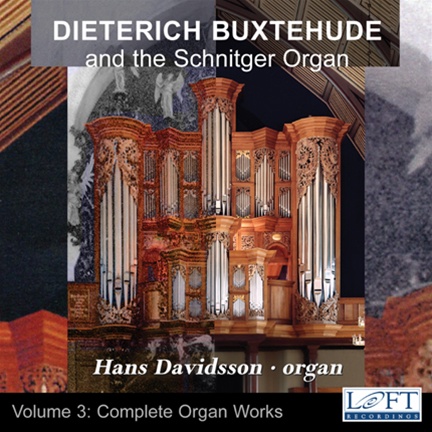
Buy Dieterich Buxtehude and the Schnitger Organ from the Gothic Catalog and save.


"It is difficult to know where to begin with these four CDs. This is a monumental recording in all sorts of ways. It is special because of the mean-tone tuning and the effect that this has on the music and the way it sounds. While we cannot be sure how the music would have sounded originally, the Baroque Organ project led by GOArt and sited in the Örgryte nya kyrka has done so much to foster interest in, and knowledge of, organ building at the time. It is good that we now have these recordings so that we can hear for ourselves.
There are some delicious sounds throughout – partly the registers, partly the tuning – often challenging the listener, especially when the choice of stops is not what we might think of today – as for example playing fugues on reed stops in a kind of Grand Jeu. But it is the vast range of colour that is most impressive, including a delightful cymbelstern. The CDs use the ULSI recording technique, which certainly gives the listener a feeling of intimacy and contact with player and instrument and adds much to the overall quality of the recordings.
The second two CD set focusses on music which JS Bach and his circle studied, shared and admired. There is thus an added fascination when listening to these pieces for the insight that they give with regard to later organ music.
Hans Davidsson – such a fine player, especially in this context – is to be congratulated, as are all the team involved. The sleeve notes are full and well produced, though there is also a significant amount of additional material, including notes on each piece and a complete listing of all registrations used at www.gothic-catalog.com. These CDs are most highly recommended, and have to be a star recording of star recordings as far as I am concerned; they are an absolute must to buy." —The Organ (UK)
"Strange and wondrous sounding things happen when you hear early Baroque organ music performed on a mean-tone tempered instrument like the one here. That's because this method of tuning produces pure major thirds, which were all the rage in Dieterich Buxtehude's day (1637-1707) as they were thought to be the musical equivalent of "heavenly harmony." Not only that, but they intensify the contrast between consonances and dissonances in music thereby giving it greater emotional impact. So it's quite likely this is what you would have heard at the prestigious St. Mary's Church in Lubeck, Germany, when the composer was organist there. However, these "heavenly thirds" come at a cost, because pieces in certain keys can sound harsh or even dissonant on mean-tone instruments. So steps must be taken to ameliorate these incompatibilities. The most radical solution is to transpose the work in question to a more listener-friendly key, and in Buxtehude’s day organists did this all the time. Besides transposition though, there are several other ways to accomplish this. For instance, the organ for this recording has additional sub-semitone black keys and pedals just for this purpose (see the excellent album notes for an explanation and picture of them). These are necessitated by the fact that accidentals like d-sharp and e-flat, which are the same identical note and represented by just one black key on a conventionally tuned instrument, must take on slightly different pitches on a mean-tone one in order to minimize the problems mentioned above. Additionally the performer can downplay dissonant notes by shortening their length, camouflaging them with ornaments and/or even opting for leaner registrations that make them less apparent.
The highly versatile and talented soloist here, Hans Davidsson, uses every trick at his disposal to come up with some of the most colorful Baroque music that ever emanated from an organ pipe. As a matter of fact, after you've heard this album, Buxtehude on a conventionally tuned instrument comes off sounding rather drab! The one Davidsson plays here is located in Gothenberg, Sweden and it’s absolutely spectacular. That’s because it’s a modern day synthesis of the finest North German Baroque instruments from such builders as the great Arp Schnitger. Not only that, but this is one of the best sounding recordings of "The Pope of Instruments" to come along in some time. It utilizes Erik Sikkema's new ULSI recording technology, which does for church spaces what Ray Kimber's IsoMike does for the concert hall (see the 17 February 2007 newsletter). Accordingly, audiophiles who love organ music must have this release, and are encouraged to read about ULSI. (click here for details)
Musically, artistically and sonically producer Roger Sherman has a “Triple Crown” winner with this, the first of three albums from Loft Recordings devoted to the composer's complete organ works a la mean-tone. This one contains all of his better known ones, so it's perfect for those wanting a single highlights album. However, a word of warning, after you hear it, you may well find "you can't eat just one!" Those desiring more detailed information about what’s included can find it on the new, beautifully appointed Gothic Web Site."


 Today we thought we would share an article written by organist Hans Davidsson entitled "An Imaginary Conversation between Buxtehude and Schitger." As you should know Hans Davidson has been working on the Complete Organ Works of Buxtehude, and Volume 3 was recently released. Research has found that BBuxtehude's visit with Arp Schnitger in Hamburg in 1687 began an association that lasted for many years and resulted in the building of the four-manual organ at the Cathedral in Lùbeck, as well as modifications to the organ at Saint Marien. Hans Davidsson explores the encounter between Buxtehude and Schnitger using the four-manual organ in Gothenburg, Sweden in this final volume of the complete works of Buxtehude.
An Imaginary Conversation between Buxtehude and Schnitger during the 1687 visit to Hamburg
Dieterich Buxtehude and Arp Schnitger:
The Visit to Hamburg in 1687
“Yes, after I meet with the church council next week you will be informed of when you can expect an invitation. I know you are very busy in the months to come, but I look forward to seeing you in Lübeck as soon as time and God allows! We have much to accomplish and to discuss, yes?”
The bright voice of the lively, middle-aged man turned to laughter. He energetically shook the hand of his somewhat taller and younger friend, entered the coach, turned around, waving and smiling warmly as he took his seat next to an elderly lady.
“So, you have visited with our young master organbuilder Arp Schnitger”, she said, not without curiosity, as she attempted to give some more space to her fellow passenger, who was attempting to maneuver a viola da gamba case between them.
“My name is Frau Schmidt, and I am the wife of one of the church elders at St. Nichola’s, the congregation where Mr. Schnitger has been building for the last five years. It will be the largest organ that ever was built in our city, perhaps even in the world! Did you see the magnificent façade? Did you hear some of the completed voices? I gather you’re a musician?”
“Indeed, I am,” he said with another laugh and another futile attempt to make the gamba take up less room in the cramped coach. “My name is Dieterich Buxtehude. I am Organist and Werkmeister in St. Marien in Lübeck, and indeed you are right, the new organ with its four manuals and pedal and sixty-seven stops is the largest organ in anywhere in Christendom.”
Suddenly, the coach started to move, and Mr. Buxtehude looked out through the window and waved a final farewell to his host.
“Well, I am glad that you did not bring the whole organ with you,” said Frau Schmidt, now beginning to chuckle herself.
As they traveled along the Gänsemarkt and northwest out of the city, Dieterich Buxtehude started to gather his thoughts. Since he left Lübeck last Monday, he had found much time to think, and he had learned even more in his four days in Hamburg. “The visit had been most valuable, and indeed inspiring. Not only stimulating visits to instruments, but pleasant music making at the home of my old friend and musical brother, Jan Adam Reincken with some of his other friends, and, of course, good food and fine French wine!”
Buxtehude had been relieved that the church council in Lübeck sent him to visit before the St. Nichola’s organ was finished. “You learn so much about the organ builder, his craft, philosophy, the quality of his business and his workers when you see the installation in progress,” he said almost to himself. “And most of the flue stops and some reeds were already playable.”
The new organ was clearly going to be a masterpiece. Mr. Schnitger had developed the concept brilliantly, and he and his team were completely capable of building this enormous instrument. Buxtehude was convinced that Hamburg and northern Germany had not seen an organbuilder of this potential and caliber since the days of Gottfried Fritzsche, or perhaps Friedrich Stellwagen from Lübeck, who built the two marvelous organs in his own church, and worked on all the other organs in the city too. In fact, it was his late teacher Scheidemann who had brought Stellwagen to Hamburg to carry out the large rebuilding of the organ in St. Katharinen in the 1640s. “How much I enjoyed playing this beautiful organ during my apprentice years in Hamburg!” he smiled to himself, “and dreamed of once becoming the organist of a great instrument brought to life by this master. Well, for twenty years, I have had the good fortunate to play two of them!” Frau Schmidt, seeing her companion beginning to mumble asked a pointed question of her companion: “Herr Buxtehude, if your instruments are so grand, why are you considering a new organ? I follow music keenly, you will not lose me and we have much time before us.”
Buxtehude brightened and began to speak animatedly to his travelling companion. “At the time when I arrived in Lübeck, almost twenty years ago, the large organ in St Jacobi was substantially renovated by Joachim Richborn but since then nothing has been done. Now it is absolutely necessary to do something about the organs in Lübeck, not only in St Marien, but in several churches, and the Dom needed a new organ. And this time it my responsibility to see to it that the famous instruments of Lübeck will be revived and renewed by the best builder of our time. Mr. Schnitger already has an indisputable reputation as a very capable and gifted builder, as you well know. His instrument in Stade is already almost fifteen years old. He has substantial experience. The impression of the last three days of your new organ at St. Nicholas, and my time with the builder himself has convinced me that Arp Schnitger is the man for the organs in our city. I have made up my mind. I will bring him to Lübeck for a longer visit to examine and study all the organs of our city, and we will develop a plan that could be pursued with the representatives of the church and city councils.”
His entrepreneurial soul shivered with excitement. He sensed an unusual opportunity. However, also a considerable challenge... They needed a vision and a joint collaborative effort of a unique kind that had most likely not been undertaken in a long time.
“Would you like a piece of chocolate,” Frau Schmidt said awaking him from his second lapse into silence.
“Yes, thank you very much,” Buxtehude said with a gentle smile. And, as the conversation unfolded, his mind started to develop the scope and strategy for a long-term plan, an organ initiative that would again equip his city with well-working state-of the-art instruments.
—Hans Davidsson
