
Showing posts with label The Wanamaker Organ. Show all posts
Showing posts with label The Wanamaker Organ. Show all posts
Wednesday, November 3, 2010
Peter Richard Conte and the Wanamaker Organ Take Part in a "Random Act of Culture"
On October 30th, the Wanamaker Organ and organist Peter Richard Conte joined with the Opera Company of Philadelphia and 28 other organizations to present a "Random Act of Culture" in the Philadelphia Macy's store. Peter Richard Conte played the organ and led over 650 voices in the "Hallelujah Chorus" from Handel's Messiah! Though most of the bottom of the store was filled with the Choristers, there were plenty of shoppers that were quite startled and then incredibly surprised at the sudden outburst of singing. The event was extremely moving, and in the video you can even see some tear-filled-eyes as well as some of the shoppers joining in on the singing! What a wonderful combination of what we (The Gothic Catalog) stand for — choral and organ music! We are very proud to have fantastic recordings of this organ and organist! Check out the video here:

Wednesday, May 5, 2010
What do Frederick Swann and Peter Richard Conte have in Common?
What do Frederick Swann and Peter Richard Conte have in common? Well, they've both played the Wanamaker Organ, and they both have recordings with The Gothic Catalog! We recently recorded Peter Richard Conte on the Wanamaker Organ with the Philadelphia Orchestra on the album "A Grand Celebration/The Philadelphia Orchestra live with the Wanamaker Organ" and have many more Wanamaker Organ recordings with Peter Richard Conte!
And today we came across a fun YouTube video that we wanted to share of our artist Frederick Swann performing on the Wanamaker Organ!
Speaking of Frederick Swann...if you will recall, we informed you about some re-releases on Monday, and of those re-releases, Frederick Swann was the artist on FVE of them! So make sure you get these recordings of Mr. Swann before we go out of stock again.
The Mystic Organ
The Riverside Years/Swann
Frederick Swann in Hawaii, v.1
Frederick Swann Plays Two Organs by Reuter
The Riverside Years, v.2 (The Choir)
Thursday, April 15, 2010
A Grand Celebration - New Review

Grand Celebration (Macy's 150th; Dupré, Elgar & Jongen); Conte/Wana Org/Milanov/Phil O [Gothic]
AUDIOPHILE (1 CD)
-- Bob McQuiston, Classical Lost and Found (CLOFO.com, Y100321)
This blockbuster release marks the completion of another chapter in the colorful history of the Wanamaker Organ....
...Billed as "A Grand Celebration," this album certainly captures the excitement associated with this once in a lifetime concert. Organist Peter Richard Conte demonstrates his total command of this windblown behemoth both from the registration as well as technical standpoints with some hand and footwork that would turn an octopus green with envy. In the first two selections, which are more solo pieces, he uses his phenomenal virtuosity never just for show, but only to serve the music. In the Elgar he gooses up the organ part just enough to make this one of the most thrilling performances of it you'll ever hear.
That's also due in no small part to the spirited playing of the Philadelphia Orchestra under its associate conductor, Rossen Milanov. Their reading of the Dupré is equally effective, as is most of the Jongen. However those who cut their teeth on the groundbreaking performance of the latter with Virgil Fox (1912-1980) may find parts of the first movement a tad subdued here. Also there are some brief queasy-sounding horn passages in the lento [track-4, beginning at 11:23], but other than that everything proceeds swimmingly.
As far as recordings of live performances go without benefit of touch-up sessions to get rid of occasional coughs (two noted) and applause (after each selection), these must rank with the most impressive ever done. The soundstage is stupendous, and while the combined organ and orchestra may at times seem a bit congested, this would probably be true under any circumstances with forces of this magnitude. That said, the overall balance is simply superb, and the low frequency response remains unbelievably immaculate despite all those organ pedal points (see above) plus some heavy-duty bass drum activity in the Elgar.
Read the review in its entirety at CLOFO.com
And make sure to get your copy of A Grand Celebration today from The Gothic Catalog
Friday, February 26, 2010
The Organ Loft - Path of Miracles and Dupré’s Passion Symphony

Path of Miracles and Dupré’s Passion Symphony
Webcast and Broadcast Schedule
Path of Miracles and Dupré’s Passion Symphony
1. Joby Talbot: “Path of Miracles”:
Movement 4. Santiago
2. Marcel Dupré: Symphonie-Passion, op. 23
Movement 4. Ressurection
3. John Stainer: “God So Loved the World”
Listen Online:
KING-FM Seattle's Classical Choice — Sundays at 10:00 PM
OREGON: KWAX-FM and the University of Oregon radio network — Sundays at 8:00 AM and 6:00 PM
Recordings Used:
 1. “Joby Talbot: Path of Miracles” Tenebrae directed by Nigel Short, Signum SIGCD078
 2. “The Wanamaker Legacy” Peter Richard Conte, organ, Gothic G 49240
 3. “Eternity” National Lutheran Choir, David Cherwien, Music Director NLCA02022 (available from The Gothic Catalog)
Tuesday, January 19, 2010
Symphonie Concertante - New York Times review
 We wanted to share this review and write-up of the performance that is found on our new release "A Grand Celebration: The Philadelphia Orchestra live with the Wanamaker Organ":
Amid Shoes and Jewels, a Mighty, Mighty Sound
By VIVIEN SCHWEITZER
Published: September 28, 2008
PHILADELPHIA — The organist Virgil Fox once compared playing the Wanamaker organ, said to be the largest playable instrument in the world, to being a child in a toy store. “You have to have many arms, many hands and many brains,” he said.
The Wanamaker’s golden pipes cascade across a second-floor wall of the ornate Grand Court of Macy’s Center City here, hovering like a giant wingspan above a first-floor statue of an eagle. On Saturday, with an audience tucked between displays of shoes and jewelry, Rossen Milanov conducted the Philadelphia Orchestra and the organist Peter Richard Conte in Joseph Jongen’s “Symphonie Concertante,” a performance postponed for 80 years.
The concert was presented by Macy’s and the Friends of the Wanamaker Organ, which has a repair shop in the building...Click to continue reading this review

Wednesday, January 13, 2010
A Grand Celebration - The Wanamaker Organ LIVE
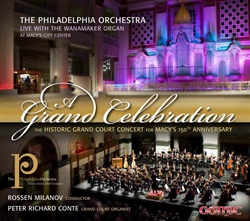 A Grand Celebration
The Philadelphia Orchestra live with The Wanamaker Organ at Macy’s Center City
Rossen Milanov, Conductor
Peter Richard Conte, Grand Court Organist
After a wait of over eighty years, the vast tonal palette of The Philadelphia Orchestra is joined, once more, with the world’s greatest symphonic pipe organ for this historic concert! Recorded live, September 27, 2008. Includes Joseph Jongen's Symphonie concertante, which was commissioned for the Wanamaker organ and the Phildelphia Orchestra in the 1920's, but never performed together until this "Grand Celebration".
Program:
Marcel Dupré: Cortege and Litany
Jongen: Symphonie concertante
Allegro molto moderato
Divertimento: Molto vivo
Lento misterioso—Appassionato—Tempo I
Toccata (Moto perpetuo): Allegro moderato
Elgar: Pomp and Circumstance, Military March in D major, Op. 39, No. 1
Cortege and Litany, Op. 19, No. 2, for organ and orchestra — Marcel Dupré
Marcel Dupré, the foremost French organist-composer of the mid-20th century, received international acclaim from American concert tours sponsored by the Wanamaker department stores in Philadelphia and New York. In the Grand Court in Philadelphia in 1922 Dupré spontaneously improvised a full symphony from submitted themes on the life of Christ at the Wanamaker Organ. It was subsequently written down as his Symphony-Passion. Another work from Dupré’s American period is the Cortege and Litany. It has a complicated history and exists in several versions. It originally formed part of a suite of incidental music that Dupré composed for a Paris play, and was conceived in terms of a chamber orchestra. The composer also made an arrangement for piano, and when his American concert agent, Wanamaker Stores music director Alexander Russell, heard it, he persuaded Dupré to make two more arrangements—one for organ solo and this one for organ and symphony orchestra. The first performance of this organ- orchestra version, Op. 19, No. 2, was given on February 11, 1925, in the New York Wanamaker Auditorium by Henry Hadley and 70 men from the New York Philharmonic. From a plaintive beginning the work builds with prayer-like petition—tightly weaving two themes at a climax that culminates in a torrent of fiery chords.
—Ray Biswanger
Symphonie concertante, Op. 81, for organ and orchestra — Joseph Jongen
Joseph Jongen used to refer to his Symphonie Concertante fororgan and orchestra as “that unfortunate work.” True enough, it did run into a number of obstacles on the way to its unveiling. Commissioned in 1926 by Philadelphia department store owner Rodman Wanamaker, the work was intended for the inauguration of the newly enlarged Wanamaker Organ, which had become an enormous instrument with 28,482 pipes and 461 ranks, since itsinstallation in the store in 1911. Jongen was set to travel to Philadelphia in the early part of 1928 to play the premiere, but he postponed his trip with the passing of his father in the fall of 1927. Delays in the enlargement project pushed the premiere back again, this time to the end of 1928, but the planned concert was scrapped altogether after Mr. Wanamaker’s unexpected death that March. Instead, the Symphonie Concertante had its premiere in Brussels later the same year; the American premiere finally took place at Carnegie Hall in 1935. Fortunate to have survived its difficult birth, the Symphonie Concertante is now considered one of the greatest works for organ and orchestra of the 20th century.
For the Symphonie, begun in 1926, Jongen calls on singing melodies and traditional forms, offers immediate emotional gratification, and requires an organist of almost superhuman capabilities. As Jongen’s friend Eugène Ysaÿe pointed out, the Symphonie Concertante might better be called a symphony for two orchestras, since “the role you assign to the King of Instruments and its abundant resources ... is not limited or restricted; it is clearly a second orchestra that enriches the first.” At 35 minutes of almost non-stop, rigorous playing, this “second orchestra” can be manifested only by a veritable Jedi Master of the organ, one who has the brawn, stamina, and grace—in a word, the force—to stand up to the thickly scored orchestra and make the King of Instruments dance.
The sprightly opening movement defies the organ’s potentially overwhelming strength with a richly textured yet weightless jaunt through a fugal figure begun in the orchestra. About this opening Jongen wrote: “Unlike many composers who have recourse to fugues at the end of their work, the present composer has introduced a fugue at the very beginning.” And to great effect: The sonata-form movement is a conversation between two giants, alternating and combining themes. It closes with a surprisingly understated, quietly lyrical chord and pedal note.
The second movement begins as a scherzo with a quick, almost improvisatory passage for organ. This alternates with slower, more expressive music throughout, with a 7/4 meter that gives the movement a delightfully impish awkwardness, like twisted carousel music. This theme is transformed into a solemn song, and folds in hints of the first movement’s opening fugal statements. After a great swell in the orchestra and a journey for the scherzo theme through a range of orchestral colors, this movement, too, ends quietly: organ, harp, and flute in arpeggiated dialogue, culminating with a delicate triangle stroke conjoined to the final organ pedal.
For the third and longest movement, Jongen said that he wanted “organ and orchestra to realize the best union possible” through a close interplay of instrumental colors. It begins with a sexy flute solo whose color rolls out into harp, woodwinds, and finally strings. Luminous calm builds ever so slowly toward a dark, passionate climax with an explosion of brass and organ. The mysterious sparkle of organ, harp, woodwinds, and strings returns, and the movement wanes again into peace.
The tranquility of the slow movement is shattered by the brilliant Toccata finale. It’s the testosterone-driven showpiece for both orchestras, the gratification that has been so sweetly delayed for the first three movements. Written in the style of the great French toccatas of Widor and Vierne, the grueling and radiant moto perpetuo organ part carries the movement through a series of increasingly intense climaxes. Urgent calls and responses between organ and orchestra, particularly brass, ascend to a forceful coda, which blazes to the end.
In this performance, the work is played for the first time on the organ Joseph Jongen envisaged as he created the piece.
—Meg Ryan
Pomp and Circumstance, Military March in D major, Op. 39, No. 1 — Edward Elgar
Elgar’s best-known work is neither the “Enigma” Variations of 1899 nor the Cockaigne Overture of two years later. Everyone who has graduated from high school or college is familiar with the melody that forms the Trio of his first Pomp and Circumstance March, composed in 1901. Many of us, in fact, have heard the tune hundreds of times, unaware of its composer or its source. Certainly no one would deny its catchiness. Elgar, too, knew that he had a hit on his hands as soon as he had written it. “I’ve got a tune that will knock ‘em—knock ‘em flat!” he wrote to a friend. Later in life he referred to the melody as “a tune that comes once in a lifetime,” expressing regret that he had not made use of it in a more substantial work such as a symphony or an oratorio. Nevertheless the Pomp and Circumstance No. 1 was a huge success at its premiere in Liverpool on October 19, 1901, under the baton of Alfred Rodewald. “Your splendid marches were the greatest success I have ever witnessed over a novelty at any concert,” wrote his friend, August Jaeger.
Elgar did manage to reuse the melody once, in 1901. Having been told that Edward VII, who was scheduled to be crowned in June 1902, had heard the March and liked the Trio very much, Elgar set the tune to the hymn “Land of Hope and Glory,” which formed a part of the Coronation Ode he composed for that occasion. In this form, the melody went on to become a favorite accompaniment for formal processions—first in England, and then in the U.S.
The D-major Pomp and Circumstance is one of five marches composed between 1901 and 1930 and later published as a single opus. Stately and perfectly suited to processionals, each of these consists of several sections of contrasting character. The D-major March begins with a fiery, chromatic introduction that leads into the vigorous main theme in D major, scored for full orchestra. The G-major tune that we all know is heard in the subsequent section, which forms the Trio of a scherzo-like structure. The climax is built through a return of the opening material, but before the march is concluded the Trio returns once more, in cymbal-crashing, drum-beating splendor.
—Paul J. Horsley
Monday, January 11, 2010
The Organ Loft - The Wanamaker Organ and the Philadelphia Orchestra
 On Friday we told you about Roger Sherman's radio program The Organ Loft. And in case you missed its airing yesterday, we thought we would give you a short taste of what you missed. Sunday night's program was titled "The Wanamaker Organ and the Philadelphia Orchestra." The sample you are about to listen to, comes from the first segment of the show, and features the music of Joseph Jongen and his "Symphonie concertante, Op 81."
Wednesday, January 6, 2010
January Releases - Part 1
A Grand Celebration
The Philadelphia Orchestra live with The Wanamaker Organ at Macy’s City Center
Rossen Milanov, Conductor
Peter Richard Conte, Grand Court Organist
After a wait of over eighty years, the vast tonal palette of The Philadelphia Orchestra is joined, once more, with the world’s greatest symphonic pipe organ for this historic concert! Recorded live, September 27, 2008.
Friday, December 18, 2009
Wanamaker Organ and the Philadelphia Brass Ensemble
 Since our recent Christmas release Christmas in the Grand Tradition features both Peter Richard Conte on the Wanamaker Organ and the Philadelphia Brass Ensemble, we thought we would give you a hint to what they sound like when playing together! Here is a video of the PBE & Mr. Conte as well as a chorus performing America the Beautiful during "Wanamaker Organ Day 2009!"
Click to purchase Christmas in the Grand Tradition
Thursday, December 17, 2009
Wanamaker Organ and Peter Richard Conte
One of our Christmas albums this year is Christmas in the Grand Tradition and features the organist Peter Richard Conte on the Wanamaker Organ. So today we thought we would share this video of Peter Richard Conte being interviewed by CBS about the Wanamaker Organ:
Monday, December 14, 2009
Christmas in the Grand Tradition

A new recording on the Wanamaker Grand Court Organ. Under the dazzling finger of organist Peter Richard Conte, the world’s largest instrument teams up with the Philadelphia Brass in this program of Christmas favorites. Selections include Bring a Torch, Jeannette Isabella, O Tannenbaum, Silent Night, For unto us a Child is Born, and many others.
Peter Richard Conte is the Grand Court Organist of the Wanamaker Organ in Macy's, Center City, Philadelphia. Appointed in 1989, he is the fourth person to hold that title since the organ was first played in 1911. As Choirmaster and Organist of St. Clement's Church, Philadelphia, Conte also directs an eighteen-voice professional choir in the Anglo-Catholic musical tradition.
Previous recordings by Conte on the Wanamaker include Midnight in the Grand Court, Magic!, and The Wanamaker Legacy. Conte appears under the management of Phillip Truckenbrod Concert Artists.
Formed in 1988, Philadelphia Brass is on the roster of Pennsylvania performing Artists on tour, and was sponsored by the U.S. State Department in a recent tour to Bolivia. Repertoire is chosen from an array of classical and popular music, including new works commissioned by Philadelphia Brass with composers Daniel Pinkham, David Diamond, J.A.C. Redford, Larry Lipkis, and Dick Hyman.
The ensemble consists of Brian Kuszyk (trumpet), Scott Mendoker (tuba), Lawrence Wright (trumpet), Anthony Cecere (horn), and Robert Gale (trombone). Previous recordings include Eternity Shut In A Span.
Subscribe to:
Posts (Atom)