Showing posts with label Organ. Show all posts

Wednesday, February 24, 2010

Recording Projects


We are currently working on two very exciting new organ recordings!

On the first album we're working on, we've got a star-studded lineup. We'll have Hans Davidsson, William Porter, and David Higgs all on one album! The second album will feature the extremely talented Joan Lippincott playing Bach's Art of Fugue.

So what organ inspired us for these two amazing projects? The new Eastman Italian Baroque, Craighead-Saunders Organ. It is a copy of an 18th century instrument in Vilnius built by Italian, Casparini, whose work was well-known by J.S. Bach! In other words, it is currently the MOST AUTHENTIC Bach Organ in the U.S.!

The Craighead-Saunders Organ was built for Christ Church as a research project by a joint venture of American and international organ builders. The Episcopal Diocese of Rochester is the main partner and co-sponsor of the project, which involves collaboration with the Lithuanian Ministry of Culture and Göteborg Organ Art Center in Sweden. The organ, which is named after two legendary Eastman organ professors David Craighead and Russell Saunders, was installed in Christ Church with the simultaneous restoration of the original organ in Vilnius, Lithuania.

The original organ, found in the Church of the Dominicans (Holy Ghost Church) in Vilnius, was fortunately well preserved in a region afflicted by years of war and conflict. It is the only remaining example of a large organ created by Adam Gottlob Casparini and considered to be one of the most valuable musical artifacts of its time in Europe today.

Monday, February 15, 2010

President's Day Marches

What do you think of on President's Day? We think of Marches and and parades! So to celebrate, we are featuring Douglas Major as he takes you on a marching tour of the grand Skinner organ of Washington National Cathedral in his album Marches!

Douglas Major, organist
Washington National Cathedral
Marches


From Sousa to Bach, here are some of the most famous, and most stirring marches ever written, played on a large organ in a Gothic acoustic cathedral.

Sousa: Stars & Stripes Forever
Sousa: Washington Post March
Mendelssohn: Bridal March
C.P.E. Bach: March
Karg-Elert: Marche Triomphale
Lloyd Webber: Solemn Procession
Parry: Bridal March
Clarke: Prince of Denmark's March
Walton: Crown Imperial
Marcello: Psalm XIX
J. S. Bach: March (Cantata 208)
Haydn: March
Grieg: Triumphal March
Arnatt: Fanfare for Organ

For more information on this release and more visit The Gothic Catalog

Wednesday, January 13, 2010

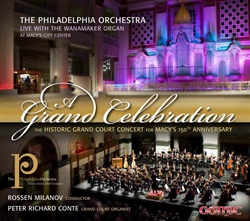
A Grand Celebration - The Wanamaker Organ LIVE

A Grand Celebration

The Philadelphia Orchestra live with The Wanamaker Organ at Macy’s Center City
Rossen Milanov, Conductor
Peter Richard Conte, Grand Court Organist

After a wait of over eighty years, the vast tonal palette of The Philadelphia Orchestra is joined, once more, with the world’s greatest symphonic pipe organ for this historic concert! Recorded live, September 27, 2008. Includes Joseph Jongen's Symphonie concertante, which was commissioned for the Wanamaker organ and the Phildelphia Orchestra in the 1920's, but never performed together until this "Grand Celebration".

Program:

Marcel Dupré: Cortege and Litany

Jongen: Symphonie concertante
Allegro molto moderato
Divertimento: Molto vivo
Lento misterioso—Appassionato—Tempo I
Toccata (Moto perpetuo): Allegro moderato

Elgar: Pomp and Circumstance, Military March in D major, Op. 39, No. 1


Cortege and Litany, Op. 19, No. 2, for organ and orchestra — Marcel Dupré

Marcel Dupré, the foremost French organist-composer of the mid-20th century, received international acclaim from American concert tours sponsored by the Wanamaker department stores in Philadelphia and New York. In the Grand Court in Philadelphia in 1922 Dupré spontaneously improvised a full symphony from submitted themes on the life of Christ at the Wanamaker Organ. It was subsequently written down as his Symphony-Passion. Another work from Dupré’s American period is the Cortege and Litany. It has a complicated history and exists in several versions. It originally formed part of a suite of incidental music that Dupré composed for a Paris play, and was conceived in terms of a chamber orchestra. The composer also made an arrangement for piano, and when his American concert agent, Wanamaker Stores music director Alexander Russell, heard it, he persuaded Dupré to make two more arrangements—one for organ solo and this one for organ and symphony orchestra. The first performance of this organ- orchestra version, Op. 19, No. 2, was given on February 11, 1925, in the New York Wanamaker Auditorium by Henry Hadley and 70 men from the New York Philharmonic. From a plaintive beginning the work builds with prayer-like petition—tightly weaving two themes at a climax that culminates in a torrent of fiery chords.

—Ray Biswanger


Symphonie concertante, Op. 81, for organ and orchestra — Joseph Jongen

Joseph Jongen used to refer to his Symphonie Concertante fororgan and orchestra as “that unfortunate work.” True enough, it did run into a number of obstacles on the way to its unveiling. Commissioned in 1926 by Philadelphia department store owner Rodman Wanamaker, the work was intended for the inauguration of the newly enlarged Wanamaker Organ, which had become an enormous instrument with 28,482 pipes and 461 ranks, since itsinstallation in the store in 1911. Jongen was set to travel to Philadelphia in the early part of 1928 to play the premiere, but he postponed his trip with the passing of his father in the fall of 1927. Delays in the enlargement project pushed the premiere back again, this time to the end of 1928, but the planned concert was scrapped altogether after Mr. Wanamaker’s unexpected death that March. Instead, the Symphonie Concertante had its premiere in Brussels later the same year; the American premiere finally took place at Carnegie Hall in 1935. Fortunate to have survived its difficult birth, the Symphonie Concertante is now considered one of the greatest works for organ and orchestra of the 20th century.

For the Symphonie, begun in 1926, Jongen calls on singing melodies and traditional forms, offers immediate emotional gratification, and requires an organist of almost superhuman capabilities. As Jongen’s friend Eugène Ysaÿe pointed out, the Symphonie Concertante might better be called a symphony for two orchestras, since “the role you assign to the King of Instruments and its abundant resources ... is not limited or restricted; it is clearly a second orchestra that enriches the first.” At 35 minutes of almost non-stop, rigorous playing, this “second orchestra” can be manifested only by a veritable Jedi Master of the organ, one who has the brawn, stamina, and grace—in a word, the force—to stand up to the thickly scored orchestra and make the King of Instruments dance.

The sprightly opening movement defies the organ’s potentially overwhelming strength with a richly textured yet weightless jaunt through a fugal figure begun in the orchestra. About this opening Jongen wrote: “Unlike many composers who have recourse to fugues at the end of their work, the present composer has introduced a fugue at the very beginning.” And to great effect: The sonata-form movement is a conversation between two giants, alternating and combining themes. It closes with a surprisingly understated, quietly lyrical chord and pedal note.

The second movement begins as a scherzo with a quick, almost improvisatory passage for organ. This alternates with slower, more expressive music throughout, with a 7/4 meter that gives the movement a delightfully impish awkwardness, like twisted carousel music. This theme is transformed into a solemn song, and folds in hints of the first movement’s opening fugal statements. After a great swell in the orchestra and a journey for the scherzo theme through a range of orchestral colors, this movement, too, ends quietly: organ, harp, and flute in arpeggiated dialogue, culminating with a delicate triangle stroke conjoined to the final organ pedal.

For the third and longest movement, Jongen said that he wanted “organ and orchestra to realize the best union possible” through a close interplay of instrumental colors. It begins with a sexy flute solo whose color rolls out into harp, woodwinds, and finally strings. Luminous calm builds ever so slowly toward a dark, passionate climax with an explosion of brass and organ. The mysterious sparkle of organ, harp, woodwinds, and strings returns, and the movement wanes again into peace.

The tranquility of the slow movement is shattered by the brilliant Toccata finale. It’s the testosterone-driven showpiece for both orchestras, the gratification that has been so sweetly delayed for the first three movements. Written in the style of the great French toccatas of Widor and Vierne, the grueling and radiant moto perpetuo organ part carries the movement through a series of increasingly intense climaxes. Urgent calls and responses between organ and orchestra, particularly brass, ascend to a forceful coda, which blazes to the end.

In this performance, the work is played for the first time on the organ Joseph Jongen envisaged as he created the piece.

—Meg Ryan

Pomp and Circumstance, Military March in D major, Op. 39, No. 1 — Edward Elgar

Elgar’s best-known work is neither the “Enigma” Variations of 1899 nor the Cockaigne Overture of two years later. Everyone who has graduated from high school or college is familiar with the melody that forms the Trio of his first Pomp and Circumstance March, composed in 1901. Many of us, in fact, have heard the tune hundreds of times, unaware of its composer or its source. Certainly no one would deny its catchiness. Elgar, too, knew that he had a hit on his hands as soon as he had written it. “I’ve got a tune that will knock ‘em—knock ‘em flat!” he wrote to a friend. Later in life he referred to the melody as “a tune that comes once in a lifetime,” expressing regret that he had not made use of it in a more substantial work such as a symphony or an oratorio. Nevertheless the Pomp and Circumstance No. 1 was a huge success at its premiere in Liverpool on October 19, 1901, under the baton of Alfred Rodewald. “Your splendid marches were the greatest success I have ever witnessed over a novelty at any concert,” wrote his friend, August Jaeger.

Elgar did manage to reuse the melody once, in 1901. Having been told that Edward VII, who was scheduled to be crowned in June 1902, had heard the March and liked the Trio very much, Elgar set the tune to the hymn “Land of Hope and Glory,” which formed a part of the Coronation Ode he composed for that occasion. In this form, the melody went on to become a favorite accompaniment for formal processions—first in England, and then in the U.S.

The D-major Pomp and Circumstance is one of five marches composed between 1901 and 1930 and later published as a single opus. Stately and perfectly suited to processionals, each of these consists of several sections of contrasting character. The D-major March begins with a fiery, chromatic introduction that leads into the vigorous main theme in D major, scored for full orchestra. The G-major tune that we all know is heard in the subsequent section, which forms the Trio of a scherzo-like structure. The climax is built through a return of the opening material, but before the march is concluded the Trio returns once more, in cymbal-crashing, drum-beating splendor.

—Paul J. Horsley

Thursday, December 17, 2009

Wanamaker Organ and Peter Richard Conte

One of our Christmas albums this year is Christmas in the Grand Tradition and features the organist Peter Richard Conte on the Wanamaker Organ. So today we thought we would share this video of Peter Richard Conte being interviewed by CBS about the Wanamaker Organ:

Monday, November 16, 2009

Pipedreams Features Buxtehude


Today we wanted to share with you the NPR/American Public Media program "Pipedreams" (a weekly organ music radio program) from May 11, 2009 which features some historical information about, and music by Dieterich Buxtehude, and features two tracks from our very own Hans Davidsson recordings of the Complete Works of Buxtehude.

Hour 1: Track 3 is BUXTEHUDE: Canzona in C, BuxWV 166 –Hans Davidsson (2000 GoART Replica/Örgryte nya kyrka [Örgryte New Church], Göteborg, Sweden) Loft 1092/3

Friday, November 13, 2009

What is Mean-tone Temperament?

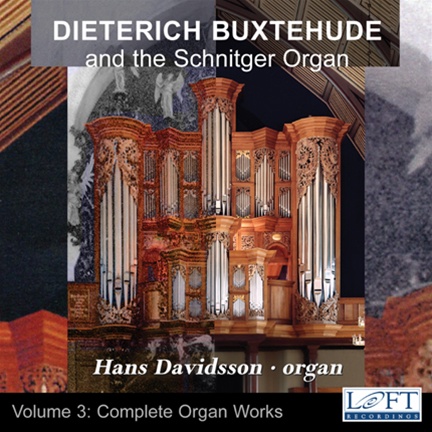
Hans Davidsson's latest album of Buxtehude works on the Schitger Organ features Mean-Tone Temperament, so we thought we would share an explanation of what that means.


A Question of Temperament

Temperaments have an enormous impact of the sound and interpretation of music, particularly music for keyboards. As the name implies, temperaments describe ways in which pitches are tempered, or mis-tuned so that the instrument can be used to play music in a wider variety of keys.

More specifically, temperaments deal with some specific mathematical problems which prevent a keyboard instrument from ever being perfectly in tune with itself. A temperament which has perfectly tuned fifths cannot also have perfectly tuned major thirds, for example. Some fifths must be “narrowed” (made flat) to allow for better major thirds, or the thirds have to be widened (made sharp) to allow for better fifths. Some temperaments favor fifths, and others favor purely tuned major thirds. In either case, some intervals must be “tempered”, hence the term “temperament.”

In equal temperament, used commonly for pianos today, all fifths are equally narrowed (made flat) by a small amount, and all major thirds are equally wide (made sharp) but by a larger amount. The approach of tempering fifths equally is a characteristic of mean-tone temperament, which uses the term “mean” to indicate averaging, or equalizing. Equal temperament is rather bland and rather useful for the same reason: all keys sound alike, and every chord of every key is equally out of tune. We’ve gotten used to it!

Tempering of a series of fifths by equal amounts can be applied to a subset of all the fifths. In the case of quarter-comma mean tone temperament, the most commonly-used fifths, which outline the triads of C, D, F, and G, are equally narrowed. In fact, they are narrowed enough so that the major thirds of these triads (E in C-major, for example) can be tuned pure. The remaining pitches in the octave are tuned as pure thirds as well, creating a temperament which strongly favors the sound of a purely tuned third.

When a pure third is played on a large organ, many pitches of many pipe ranks reinforce the harmonic series of many other pipes, and the resulting sound is harmonious in a way that is unique to modern ears. The effect of reinforcing specific harmonics exactly causes a change in the perceived timbre of the sound. The organ, which naturally sustains pitches at the same intensity and volume, amplifies the effect and sonic impact of these reinforced harmonics. The power of this “harmonious” sound, with the physics and the mathematics behind it, determined many ideas about cosmology and spirituality, which are often represented in the composition of the music itself. Although cosmology and composition might seem to be abstract concepts, the change in the nature of organ sound can be readily experienced by the average listener.

Other characteristics

Mean tone gives composers devices for creating expressive works that are inexorably tied to the temperament. For example, on quarter-comma mean tone organs, there are two different sizes of half-step intervals. The interval of F to F# is small, and the interval between A and B-flat is larger. Special effects can be created by crafting a musical theme which ascends or descends through the scale chromatically, shifting back and forth between large and small minor seconds.

The use a sharp accidental or flat accidental in the score can also assert a significant effect in the harmonic progression---effects which simply do not exist on a modern equal-tempered instrument. The extensive use of chromatic pitches on a mean tone organ can give the composer or improviser tools for truly bizarre, and shocking chord progressions, or ones that are strangely beautiful.

Limitations with quarter-comma mean tone temperaments

The most significant problem with quarter-comma meantone is the limitation imposed by the number of keys per octave. Each sharp key (as in “the black notes of a standard piano”) is tuned to be either a sharp (ie. A-sharp) or a flat (B-flat), then it cannot be used for both. One would like to have access to pure versions of both pitches so that when the music calls for an A-sharp, you can play one, and when the music calls for a B-flat, you can play that as well.

For a period of time, this problem was addressed through the use of subsemitones – a second set of raised keys that were higher than the standard sharps, and placed slightly rearward (away from the organist). Through the use of subsemitone keys, additional pitches can be available, making a mean tone organ playable in more keys. However, additional keys on the manuals and pedals of the organ requires many more pipes, and considerably increased complexity for the organist.

Friday, October 23, 2009

A Back-Catalog Review - Buxtehude and the Mean Tone Organ

Today we wanted to share some reviews with you from an organ release in our back-catalog. The release is from 2007, and there are Three volumes with Hans Davidsson on the organ.


"Audiophile Best Find" of 2007, "Classical Lost and Found (CLOFO.com) http://www.clofo.com/


Davidsson is a very musical player with a virtuosic flair well suited to this music. The phrasing in the chorale preludes is exquisitely sensitive. His interpretation of the Passacaglia is one of the best I’ve heard. This is an outstanding recording from every point of view. Bravo!
—American Record Guide


STAR RECORDING (Record of the month)
(review of both Volumes 1 and 2)

It is difficult to know where to begin with these four CDs. This is a monumental recording in all sorts of ways. It is special because of the mean-tone tuning and the effect that this has on the music and the way it sounds. While we cannot be sure how the music would have sounded originally, the Baroque Organ project led by GOArt and sited in the Örgryte nya kyrka has done so much to foster interest in, and knowledge of, organ building at the time. It is good that we now have these recordings so that we can hear for ourselves.

There are some delicious sounds throughout – partly the registers, partly the tuning – often challenging the listener, especially when the choice of stops is not what we might think of today – as for example playing fugues on reed stops in a kind of Grand Jeu. But it is the vast range of colour that is most impressive, including a delightful cymbelstern. The CDs use the ULSI recording technique, which certainly gives the listener a feeling of intimacy and contact with player and instrument and adds much to the overall quality of the recordings.

The second two CD set focusses on music which JS Bach and his circle studied, shared and admired. There is thus an added fascination when listening to these pieces for the insight that they give with regard to later organ music.

Hans Davidsson – such a fine player, especially in this context – is to be congratulated, as are all the team involved. The sleeve notes are full and well produced, though there is also a significant amount of additional material, including notes on each piece and a complete listing of all registrations used at www.gothic-catalog.com (click on the ORGAN REGISTRATIONS tab above...). These CDs are most highly recommended, and have to be a star recording of star recordings as far as I am concerned; they are an absolute must to buy.

—The Organ (UK)

Strange and wondrous sounding things happen when you hear early Baroque organ music performed on a mean-tone tempered instrument like the one here. That's because this method of tuning produces pure major thirds, which were all the rage in Dieterich Buxtehude's day (1637-1707) as they were thought to be the musical equivalent of "heavenly harmony." Not only that, but they intensify the contrast between consonances and dissonances in music thereby giving it greater emotional impact. So it's quite likely this is what you would have heard at the prestigious St. Mary's Church in Lubeck, Germany, when the composer was organist there. However, these "heavenly thirds" come at a cost, because pieces in certain keys can sound harsh or even dissonant on mean-tone instruments. So steps must be taken to ameliorate these incompatibilities. The most radical solution is to transpose the work in question to a more listener-friendly key, and in Buxtehude’s day organists did this all the time. Besides transposition though, there are several other ways to accomplish this. For instance, the organ for this recording has additional sub-semitone black keys and pedals just for this purpose (see the excellent album notes for an explanation and picture of them). These are necessitated by the fact that accidentals like d-sharp and e-flat, which are the same identical note and represented by just one black key on a conventionally tuned instrument, must take on slightly different pitches on a mean-tone one in order to minimize the problems mentioned above. Additionally the performer can downplay dissonant notes by shortening their length, camouflaging them with ornaments and/or even opting for leaner registrations that make them less apparent.

The highly versatile and talented soloist here, Hans Davidsson, uses every trick at his disposal to come up with some of the most colorful Baroque music that ever emanated from an organ pipe. As a matter of fact, after you've heard this album, Buxtehude on a conventionally tuned instrument comes off sounding rather drab! The one Davidsson plays here is located in Gothenberg, Sweden and it’s absolutely spectacular. That’s because it’s a modern day synthesis of the finest North German Baroque instruments from such builders as the great Arp Schnitger. Not only that, but this is one of the best sounding recordings of "The Pope of Instruments" to come along in some time. It utilizes Erik Sikkema's new ULSI recording technology, which does for church spaces what Ray Kimber's IsoMike does for the concert hall (see the 17 February 2007 newsletter). Accordingly, audiophiles who love organ music must have this release, and are encouraged to read about ULSI. (click here for details)

Musically, artistically and sonically producer Roger Sherman has a “Triple Crown” winner with this, the first of three albums from Loft Recordings devoted to the composer's complete organ works a la mean-tone. This one contains all of his better known ones, so it's perfect for those wanting a single highlights album. However, a word of warning, after you hear it, you may well find "you can't eat just one!" Those desiring more detailed information about what’s included can find it on the new, beautifully appointed Gothic Web Site.

-- Bob McQuiston, Classical Lost and Found (CLOFO.com)
www.CLOFO.COM


Diderich ‘Hansen’ Buxtehude (1637–1707) was born in Denmark, and was active as an organist, composer, and cultural entrepreneur in Denmark and Sweden as well as in Germany, where he became known as Dieterich Buxtehude. He grew up in Helsingør, Denmark, and served as organist in Helsingborg (now in Sweden) and Helsingør before accepting one of the most prestigious musical positions in North Germany, that of organist at St. Mary’s Church, Lübeck, in 1668. During his nearly forty years of service there he achieved fame not only as an organist but also as the composer and director of a concert series known as the Lübeck Abendmusiken. Although he left an impressive corpus of arias, sacred concertos, and cantatas for voices with instruments as well as two printed editions of sonatas for strings, it is chiefly his organ works that captured the attention of performers both in his day and in our own. His organ music appeals to modern listeners because it is full of the fantasy, variety and unpredictability that characterises seventeenth-century music, yet is rooted in the major-minor tonal system familiar to our ears. The works fall into two broad categories, those based on chorale melodies and those freely composed. He set many chorales as short preludes, with a highly ornamented melody to be played by the right hand on one manual, a two-voice accompaniment for a second manual, and a continuo-like bass for the pedal. Despite their unity of style, they show endless variety in their ornamentation. His extensive chorale fantasias, on the other hand, develop each phrase of the chorale in a contrasting style. His free pedaliter praeludia are the works for which e is best known, demonstrating his virtuosity as both a composer and a performer. The large organ that Buxtehude played in St Mary’s in Lübeck had fifty-four stops on three manuals and pedal. Recent research suggests that it may have been in mean tone, a tuning in which the tonal excursions that Buxtehude included in some of his praeludia would have been difficult to play. Hans Davidsson’s bold undertaking of the recording of Buxtehude’s entire organ repertoire in mean tone gives us startling new insights into how this ‘heavenly harmony’ might have sounded in the seventeenth century. This beautifully produced double-CD is the first in a projected three-volume series from Loft Recordings and is essential listening for anyone interested in early organ music.

-- John Pitt, New Classics (UK)
New-Classics


Hans Davidsson has recently released a recording called ”Dieterich Buxtehude and the Mean-Tone Organ”. It is a double CD and the first of three sets that will cover the complete organ works of Dietrich Buxtehude. It is not merely another recording of the complete organ works of Buxtehude, but a recording with a vision and a pedagogical design.


The idea is to record Buxtehude on a large organ in mean-tone, something that has never been done before. The reason it hasn’t been done before is that that there has been a belief that the music of Buxtehude has been intended for well-tempered organs – but convenience has probably also played a part. Newer research has shown that the organ works of Buxtehude were written in a context where mean-tone temperament was an important ingredient. A counter-argument based around the existence of pieces in remote keys- such as the preludes in f#-minor and A major – is not sustainable since the keyboard compositions of Buxtehude’s time didn’t have the same function as they began to have around hundred years later in music history. Composing and improvising were still two parts of the same practice, so a composition lived a life that probably consisted of a large number of improvised versions and one or several written down versions (perhaps even in different keys). The written notation of a piece was a tool to develop and spread (to colleagues and students) that organ playing that was mostly improvised.


“Pedagogical design” is a somewhat clumsy way to say that Hans Davidsson’s recording is so much more than a recording. The buyer gets a richly illustrated booklet, and if he or she is not content with the exciting essays there are even more detailed program notes and registration indications of the record label’s website. The program notes are excellent examples of texts that contain a good balance of facts, speculations and explanations of musical choices.


I suspect a larger ambition behind this very complete production. The aurally and visually magnificent organs, the important role of the organist in both church service s and local musical life and a music making where composition, improvisation and interpretation were different sides of the same practice: all these aspects of the North German Baroque organ art can be made into a story about the golden age of organ art. And that is what Hans Davidsson achieves with rhetorical power in both playing and texts. The story of the golden age makes us question our present but also- paradoxically – enables us to shape our future. Presumably that is the intention, and I think that is excellent.


This is a double CD that can be recommended in every respect to be bought, listened to, studied and challenged by:


Buy this record if you are interested in sound recording and are curious about what Erik Sikkema’s USLI-technique means. It is enough to listen to it with just open ears to realize that organs seldom sounds this good on records, you can hear both the room and the details.


Listen to this music if you, in an increasingly more noisy, more tone deaf and more insensitive world are in need of good examples and inspiring role models to be able to continue your work as a church musician, organist or pedagogue! Here is a story from the golden age of organ art, from the 17th century North Germany where the bourgeois proudly invested in magnificent organs and where the organist was a kind of musical preacher.


Study this production even if you have heard all earlier and current recordings of Buxtehude’s organ works, and even if you have played them all! There are new details to discover, new relationships to understand and new interpretations to experience. Hans Davidsson has begun a rereading of the musical heritage of Buxtehude; a rereading that surprises, challenges and pleases. It is for example an excellent idea to use the history of David and Goliath as an interpretive pattern for the battered Prelude Fugue and Ciacona in C-major. To play Buxtehude in mean-tone is a risky decision, but here it is so well argued and convincingly done that all you can say is: of course, this is the way it must be. It must be impossible not to be seduced by the lovely principals and flutes of the Örgryte organ.


Be challenged by this record if you think that music can’t be talked about. It is reasonable that you sometime not speak instead of playing or listening. But there is a rich tradition, at least within what is nowadays called western art music, to talk about music, and to let that speaking and knowledge enrich the interpretation and the listening. Hans Davidsson shows with his interpretation of the Preludium in D-major (BuxWV 139), that there is instrumental music that is so close to speech that even if it doesn’t speak, it can be understood clearly.


Hans Davidsson’s ”Buxtehude and the Mean-Tone Organ” is a brilliant combination of musicality, fantasy, learning and pedagogy. Buy it! Since both the musicianship and program notes are so rich in information the record should be enjoyed in small doses, but that is a good thing: it lasts longer!


Hans Hellsten, Swedish Church Music Journal
Professor of organ at the School of Music in Malmö, Sweden
Translation Fredrik Tobin

Köp den här skivan, ni som är intresserade av ljudteknik och är nyfikna på vad Erik Sikkemas så kallade ULSI-teknik innebär! Det räcker dock med ett par öppna öron för att upptäcka att så här bra låter orglar sällan på skiva, här hörs både rum och detalj.
—Hans Hellsten, Sweden


I bought your registration Dieterich Buxtehude and the Mean-Tone Organ employing the ULSI technique. It’s really fantastic the high level of quality you are able to extrapolate from the true sound of the organ.
—Gianni Movia, Italy


I just heard the Buxtehude. It’s incredible! Wow! The music, performer, organ, room and recording are perfectly matched with the highest quality. The sound of the organ came to the point of the true reproduction of the reality.

—Munetaka Yokota, organbuilder

Monday, October 12, 2009

A Fantasy Through Time - Program and Notes

A Fantasy Through Time: Five Centuries of Organ Fantasies
Richards-Fowkes organ, Pinnacle Presbyterian Church, Scottsdale, Arizona
Kimberly Marshall, organist

Free bonus DVD! This compact disc includes a DVD of Kimberly Marshall playing the tracks from the CD on the Richards-Fowkes organ; also included are interviews with Dr. Marshall about the music, the organ, and the composers.

The new Richards-Fowkes organ in Scottsdale provides a wide variety of tonal resources for this historical exploration of Fantasies for organ on this, its premiere recording. Kimberly Marhsall is internationally known as an organist, and scholar. She currently is the Director of Arizona State University School of Music.


Fantasy in G Major (“Pièce d’Orgue”), BWV 572—Johann Sebastian Bach (1685-1750)
Fancy—Alfonso Ferrabosco (1543-1588)
Fantasia chromatica—Jan Pieterszoon Sweelinck (1562-1621)
A Fansye (from the Mulliner Book)—Newman (fl. c.1583)
Fantasy in C Minor, BWV 562—J. S. Bach
Fantasy in D Minor, K. 397—Wolfgang Amadeus Mozart (1756-1791)
Fantaisie in C Major (Version III)—César Franck (1822-1890)
Première Fantaisie—Jehan Alain (1911-1940)
Deuxième Fantaisie—J. Alain
Fantasy in G Minor, BWV 542/I—J. S. Bach


Program Details

The new organ at Pinnacle Presbyterian Church in Scottsdale, made by master builders Ralph Richards and Bruce Fowkes, was conceived as an eclectic 3-manual organ, with special emphasis on some of the timbres that J.S. Bach would have known on central German baroque organs. This recording exploits the full resources of the organ with a program of fantasies, from the earliest English “Fancys” of the 16th century, with Baroque examples by Sweelinck and Bach, including classical and romantic examples by Mozart and Franck, and culminating with the exotic Fantaisies of the early 20th-century French composer Jehan Alain. The recording is framed with Fantasies by J. S. Bach, showing the different ways in which he developed the genre.

Bach’s Fantasy in G Major, BWV 572, is entitled “Pièce d’orgue” in its principal manuscript source, suggesting French connections. The sectional structure and rich harmonic language are reminiscent of French Classical Offertoires and Plein Jeu movements. The work is in three main sections, each with a distinctive musical texture. The opening features a single line of virtuosic writing that incorporates sequential figurations; the majestic middle section creates a sense of tension and release through the resolution of suspended harmonies; the final part contains a series of rapid arpeggiations over relentlessly repeated notes in the pedal.

Composers in Elizabethan England wrote pieces of imitative polyphony entitled “Fancy” that are some of the earliest examples of the keyboard fantasy. The Fancy by the Italian Alfonso Ferrabosco was composed while he was working at the English court and is found in a 16th-century English manuscript. The piece begins in duple meter with a point of imitation treated in four voices, leading to a chordal section that erupts into fast scale passages in both hands. The closing section, in a contrasting triple meter, suggests contemporary dance pairs, such as the Pavane and Galliard, where a dance in duple meter is followed by one in triple.

Sweelinck’s Fantasia chromaticais a masterpiece of counterpoint. The main theme is a descending chromatic line which the composer manipulates to create a sectional work of large scope and aesthetic impact. The imitation heard in the early English Fancies is here taken to a new degree of complexity. Sweelinck treats the theme in both augmentation and diminution, combining it with itself as well as with new countersubjects in a gradual build-up of intensity. For two of the bass entries I employ the Pedal Trompete, one of two pedal stops that Sweelinck had on the large organ at the Oude Kerk in Amsterdam where he served as organist for most of his life.

Little is known of the English composer Newman except that some of his keyboard music was included in the Mulliner Book, an important collection compiled around 1683 for the eponymous nobleman. Newman’s Fansye is a short piece comprised of several points of imitation, where a theme is repeated in the four voice parts of a composition. To reflect the use of small organs at the Elizabethan court, I selected high-pitched principal registers for this piece on the Richards-Fowkes instrument, adding short ornaments to accentuate the melodic lines.

J. S. Bach wrote two C-minor Fantasies that reflect his study of the classical French composer, Nicolas de Grigny. In the Fugues of his Livre d’orgue (1699), Grigny used a 5-voice texture, with two parts in the right hand, two in the left, and one in the pedal. The Bach Fantasy recorded here (BWV 562) exhibits the same distribution of parts, with themes treated imitatively between them. The highly ornamented first theme incorporates the pincé and descending coulé of French embellishment practice; Bach’s choice of C minor may also refer to French classical music that employs this key for its melancholy character.

Mozart composed two fantasies for a small player organ, and these are often performed by organists on larger instruments. These well-known works have been recorded numerous times, so I thought it might be more interesting to adapt one of Mozart’s pianoforte fantasies to the Richards-Fowkes organ. We know that Mozart greatly admired the organ—in a letter dated Oct 17, 1777, he wrote: "When I said to Herr Stein that I should like to play on one of his organs, as the organ was my passion, he seemed surprised, and said "What! a pianist like you to play on an instrument devoid of expression, no piano and no forte, but always going on the same?" Mozart's reply was that "lack of that sort of expression does not matter, the organ always was, both to my eyes and ears, the Queen of Instruments." Organ timbres can be used to great effect to “orchestrate” keyboard music, as heard in Mozart’s Fantasy in D minor, K. 397. The juxtaposition of flutes and principals from different divisions provides dynamic contrast, and the pedal is used to reinforce the bass line.

Moving to the romantic music of the following century, the French composer César Franck wrote several Fantaisies, including onein C Major, published in 1868 as part of his Six Pièces pour orgue. It seems to have been a personal favorite because he used the same musical material in several different versions, adapted for different contexts. The version recorded here may have been conceived for Frank’s performance during the inauguration of the new Cavaillé-Coll organ at Notre-Dame Cathedral in 1868. The opening is identical to the published fantasy, but Franck composed new material for the following section, which later accompanies one of the earlier themes. A gradual crescendo and acceleration leads to a thrilling climax, and the fantasy quickly recedes back into calm to end softly. The great dynamic contrast in this version may have been intended to demonstrate the vast resources of the new Notre-Dame instrument and to show how quickly sounds could be added and taken away thanks to Cavaillé-Coll’s windchest design.

A contemporary of Olivier Messiaen, Jehan Alain was killed while working for the French Resistance during WWII. Despite his short life, he developed a very personal style of composing for the organ that is exemplified in the language of his Two Fantaisies. The first fantasy opens harshly, with dissonant chords on the reed stops and an angular pedal line. Harmonic sequences then pass between keyboards, with occasional eruptions of fast passagework. These short sections build in sound, leading to penetrating chords that are reminiscent of the work’s beginning. To this, Alain appends a simple lullaby on single stops that brings the piece to an ethereal close. Alain’s much younger sister, the noted organist Marie-Claire Alain, recalls hearing this lullaby as a small child, perhaps as her brother composed the piece.

The sectional structure, theatrical pacing and innovative use of keyboard writing in Alain’s Second Fantaisie suggest a 20thc response to Sweelinck’s essay in the genre.

The fantasy is in arch form, beginning and ending quietly like the Franck example on the program. Several themes are treated in discrete sections with distinctive colors; especially prominent is a sinewy melody first heard on the crumhorn that returns towards the end of the work. The contours of this theme suggest north-African music, which fascinated Alain with its chromaticism and pungent instrumentation. Alain increases the registration to explode in a powerful central section where the pedals play a new motive on the reeds accompanied with exotic figuration in the manuals. From this climax, the piece recedes in tension, returning to the opening texture. This fantasy could be a musical depiction of Victor Hugo’s poem “Les Djinns,” where the length of each line increases to create a crescendo representing the onslaught of the genies as they overtake the town, after which each line decreases in length to reflect their gradual departure.
The Djinns
Victor Hugo (1802-1885)

Town, tower,
Shore, deep,
Where lower
Cliff's steep;
Waves gray,
Where play
Winds gay,
All sleep.

Hark! a sound,
Far and slight,
Breathes around
On the night
High and higher,
Nigh and nigher,
Like a fire,
Roaring, bright.

Now, on 'tis sweeping
With rattling beat,
Like dwarf imp leaping
In gallop fleet
He flies, he prances,
In frolic fancies,
On wave-crest dances
With pattering feet.

Hark, the rising swell,
With each new burst!
Like the tolling bell
Of a convent curst;
Like the billowy roar
On a storm-lashed shore,--
Now hushed, but once more
Maddening to its worst.

O God! the deadly sound
Of the Djinn's fearful cry!
Quick, 'neath the spiral round
Of the deep staircase fly!
See, see our lamplight fade!
And of the balustrade
Mounts, mounts the circling shade
Up to the ceiling high!

'Tis the Djinns' wild streaming swarm
Whistling in their tempest flight;
Snap the tall yews 'neath the storm,
Like a pine flame crackling bright.
Swift though heavy, lo! their crowd
Through the heavens rushing loud
Like a livid thunder-cloud
With its bolt of fiery might!

Ho! they are on us, close without!
Shut tight the shelter where we lie!
With hideous din the monster rout,
Dragon and vampire, fill the sky!
The loosened rafter overhead
Trembles and bends like quivering reed;
Shakes the old door with shuddering dread,
As from its rusty hinge 'twould fly!
Wild cries of hell! voices that howl and shriek!
The horrid troop before the tempest tossed--
O Heaven!--descends my lowly roof to seek:

Bends the strong wall beneath the furious host.
Totters the house as though, like dry leaf shorn
From autumn bough and on the mad blast borne,
Up from its deep foundations it were torn
To join the stormy whirl. Ah! all is lost!

O Prophet! if thy hand but now
Save from these hellish things,
A pilgrim at thy shrine I'll bow,
Laden with pious offerings.
Bid their hot breath its fiery rain
Stream on the faithful's door in vain;
Vainly upon my blackened pane
Grate the fierce claws of their dark wings!

They have passed!--and their wild legion
Cease to thunder at my door;
Fleeting through night's rayless region,
Hither they return no more.
Clanking chains and sounds of woe
Fill the forests as they go;
And the tall oaks cower low,
Bent their flaming light before.

On! on! the storm of wings
Bears far the fiery fear,
Till scarce the breeze now brings
Dim murmurings to the ear;
Like locusts' humming hail,
Or thrash of tiny flail
Plied by the fitful gale
On some old roof-tree sere.

Fainter now are borne
Feeble mutterings still;
As when Arab horn
Swells its magic peal,
Shoreward o'er the deep
Fairy voices sweep,
And the infant's sleep
Golden visions fill.

Each deadly Djinn,
Dark child of fright,
Of death and sin,
Speeds in wild flight.
Hark, the dull moan,
Like the deep tone
Of Ocean's groan,
Afar, by night!

More and more
Fades it slow,
As on shore
Ripples flow,--
As the plaint
Far and faint
Of a saint
Murmured low.

Hark! hist!
Around,
I list!
The bounds
Of space
All trace
Efface
Of sound.

-Les Orientales, 1929

English translation by John L. O’Sullivan

The recording ends with a return to J. S. Bach, in one of his most famous pieces, the Fantasy in G Minor, BWV 542. Like all of the fantasies included here, this is in a sectional form; here Bach intersperses passages in improvisatory style with strict points of imitation, a structure favored by composers in northern Germany to demonstrate their large instruments. The freedom of the florid melodic writing and the drama of the punctuating chords harken back to the Italian stylus phantasticus, used to great effect by Dieterich Buxtehude, whose music Bach emulated during the early part of his career. This fantasy is considered to be a somewhat later work, probably towards the end of Bach’s time in Weimar, because of its harmonic experimentation. The composer pushes the modulations far away from the G-minor tonal center, increasing the dissonance created by the remote chords in the organ’s tuning. He ultimately pivots back towards the home key through an enharmonic relationship between E# and F, gradually returning to a final cadence in G Minor. The technical bravura and narrative tension of this fantasy make it a classic of the organ repertoire, and it has been adapted in piano and orchestral versions.

The wide survey of the fantasy genre recorded here suggests the wealth of invention expressed in the work of European composers for the organ over five centuries. No other instrument can claim such a vast heritage, and very few single organs could render so eclectic a program so convincingly. Ralph Richards and Bruce Fowkes are to be commended on their exceptional achievement, and the congregation of Pinnacle Presbyterian Church should be congratulated for making this significant commitment to the organist’s art in the Valley of the Sun.

-Kimberly Marshall

Friday, October 9, 2009

Jehan Alain - Kimberly Marshall

We thought we'd share with you a very interesting clip from the "A Fantasy Through Time" Bonus DVD, where Kimberly Marshall talks about the 20th Century French composer, Jehan Alain (1911-1940).

Wednesday, October 7, 2009

The Richard-Fowkes Organ

This video comes from the Bonus DVD that is included with the album A Fantasy through Time - Five Centuries of Organ Fantasies on the Richard-Fowkes Organ featuring Kimberly Marshall.

The clip is Kimberly Marhshall talking about the Richard-Fowkes Organ that is in the Pinnacle Presbyterian Church in Scottsdale, AZ.

For more videos see our new YouTube Channel!

We hope you enjoy!

Monday, October 5, 2009

Kimberly Marshal Rosales Opus 14

Do to the popularity of posting the last Kimberly Marshall organ demonstration, we thought we would share another part of that performance.

Thursday, October 1, 2009

Kimberly Marshall Demonstration

Check out this very neat video of Kimberly Marshall demonstrating an organ and giving a short lecture and recital. This is just one clip of many!

Tuesday, September 29, 2009

Getting to know Kimberly Marshall


Kimberly Marshall maintains an active career as a concert organist, performing regularly in Europe, the US and Asia. She currently holds the Patricia and Leonard Goldman Endowed Professorship in Organ at Arizona State University and serves as Director of the ASU School of Music. She previously held teaching positions at the Royal Academy of Music, London, and Stanford University, California. Winner of the St. Albans Competition in 1985, she has been invited to play in prestigious venues and has recorded for Radio-France, the BBC, and the Australian Broadcasting Corporation.

Kimberly Marshall has performed throughout Europe, including concerts in London's Royal Festival Hall and Westminster Cathedral, King's College, Cambridge, Norte-Dame Cathedral, Paris, Chartres and Uppsala Cathedrals, as well as the Dormition Abbey in Jerusalem. She has also performed on many historical organs, such as the Couperin organ at Saint-Gervais, Paris, the Gothic organ in Sion, Switzerland, and the Cahmann organ in Leufstabruk, Sweden. She especially enjoys tailoring programs to the styles of the instruments she plays, as is evident from her recordings of Italian and Spanish music on historical organs. Her playing is informed by research into obscure repertoire and by knowledge of performance practice, although she does not limit herself to early music. While at Stanford and the Royal Academy of Music, she gave performances of organ works by Ligeti in the presence of the composer, and she has been an advocate for music by Margaret Sandresky, Dan Locklair and Ofer Ben-Amots. She is attracted to the organ by its vast possibilities of timbre and by the instrument’s complex development since its invention in the third century BCE. Her work reflects this enthusiasm for musical creativity and historical awareness.

Dr. Marshall’s compact disc recordings feature music of the Italian and Spanish Renaissance, French Classical and Romantic periods, and works by J. S. Bach. She has also released a recording of works for organ by female composers, “Divine Euterpe,” that includes music by Fanny Mendelssohn Hensel, Elfrida Andrée, and Ethyl Smyth. Kimberly Marshall was a recitalist and workshop leader during many National Conventions of the American Guild of Organists (Dallas, 1994; New York, 1996; Denver; 1998; Seattle 2000, Los Angeles 2004). From 1996-2000, she was affiliated with the Organ Research Center in Göteborg, Sweden, where she taught and performed. During the summer of 2001, she appeared in Seoul for the Korean Association of Organists and in Toronto for the Convention of the Royal College of Canadian Organists. Her recording of Chen Yi’s organ concerto with the Singapore Symphony was released in 2003 on the BIS label, and her anthologies of late-medieval and Renaissance organ music were published by Wayne Leupold Editions in 2000 and 2004.

Kimberly Marshall spent the spring of 2005 on sabbatical in Pistoia, Italy, where she researched early Italian organ music and performed on many historical organs, including those in Roskilde Cathedral (Denmark), the St. Laurenskerk, Alkmaar (Netherlands), the Jacobikirche Hamburg, as well as the famous Hildebrandt instrument in Naumburg, Germany, which Bach examined in 1746. During the summer of 2006, she presented concerts and workshops on early music in Sweden and Israel, and she was a featured artist for the 2007 Early English Organ Project in Oxford and the Festival for Historical Organs in Oaxaca, Mexico.

Monday, September 21, 2009

Frederick Swann Plays the William J. Gillespie Concert Organ

In order to introduce ourselves, we would like to introduce you to some of the recent releases from each of our labels. The first that we would like to highlight is from Gothic Records and is entitled Frederick Swann Plays the William J. Gillespie Concert Organ. This album features a world premiere recording of the William J. Gillespie Concert Organ, C.B. Fisk, Opus 130 featuring 4 manuals and pedal, 73 ranks and 4,322 pipes.


Best-known as the former organist of The Crystal Cathedral, Frederick Swann delivers the premiere recording of the Fisk, Opus 130 with a program and registrations specifically chosen to showcase the wide and colorful tonal spectrum of this superb new organ. The exciting Finale of Widor’s Fourth Symphony, Op. 13, No. 4 displays the full plenum of this organ and Schumann’s serene Fugue on B-A-C-H, Op. 60, No. 3 offers an opportunity to hear its combined 8' foundation stops. Bach’s strong Prelude in C, BWV 545 utilizes somewhat unusual pedal points, and is followed by a majestic alla breve fourvoice fugue. Swann’s Improvisation on “Londonderry Air” is presented to highlight several of the beautiful solo stops and rich flute/string ensembles of the Fisk organ.

Also on this recording is Franck’s Fantaisie in A, one of the Trois Pièces composed in 1878 for the inauguration of the large organ at the Palais du Trocadéro in Paris. His requested registrations can be fully realized on this organ, the reeds of which speak with a decided French accent. In sharp contrast to the “French sound,” the more staid and weighty English ensembles heard in Norman Cocker’s Tuba Tune accompany the commanding Tuba located high in the organ loft. John La Montaine’s Even Song is a quiet, reflective composition and one of three organ works by this Pulitzer-prizewinning American composer. The new Fisk’s beautiful string stops and the solo Doppel Flute are featured.

The works by Mendelssohn and Rheinberger found here are both inspired by Bach. Rheinberger ‘s Passacaglia of Sonata No. 8 is regarded as one of his most outstanding organ works and is performed on this recording in a classic (rather than romantic) manner, using several stops and ensemble combinations not heard elsewhere on this CD. The Six Organ Sonatas of Mendelssohn, commissioned by the English publisher Coventry and Hollier, were composed between 1839 and 1845. Mendelssohn paid homage to Bach by including German chorales or fugues in five of the six organ sonatas.

Thursday, September 17, 2009

About Loft Recordings

Loft Recordings and The Gothic Catalog
Organ and choral recordings of distinction


The mission of Loft Recordings is to generate enthusiasm and literacy in classical music, particular music for organs and choirs. Loft Recordings publishes recordings, produces and weekly radio program (The Organ Loft), provides recording services for artists, and offers recordings for sale through this website and a mail order catalog.

Loft Recordings was founded in 1999; in 2001, Loft purchased the assets of Gothic Records, a company which had been producing great organ and choral recordings for almost 25 years. Loft established "The Gothic Catalog" as a mail-order webstore where recordings from both companies could be showcased, alongside other recordings from third-party labels.
In June 2008, we acquired Clarion Records, a record label which features semi-professional American choirs and a large catalog of world premier choral recordings.
Today, The Gothic Catalog features the following "house labels":
  • Loft Recordings—recordings with an international focus; organ recordings with an early music emphasis, period instruments, premier recording technology.
  • reZound—re-issues, recitals, radio programs.
  • Gothic Records—mostly American choirs, unusual repertoire; concert programs on American classic organs.
  • Clarion Records—Pro and semi-pro American choirs, world premier choral recordings
  • Quilisma—exclusive import! Young artists from the UK with a special emphasis on choral music.