Showing posts with label Washington National Cathedral. Show all posts

Thursday, February 24, 2011

Out of Stock or Out of Print? Here are some options

Have you ever wanted a recording from any of the labels in The Gothic Catalog, and it's either out of print or out of stock? Well, we have some suggestions for you.

ArkivMusic is stocking out of print releases from both Gothic Records and Loft Recordings. Here are links to these albums:

Gothic Records
Loft Recordings

These include such favorites as:
The Riverside Years / Frederick Swann
Frederick Swann Plays Two Organs By Reuter
Marches / Douglas Major
L'organiste Parisien (1864-1999) - Franck, Et Al / Adam
The Young Bach / Harald Vogel
The Shapenote Album / Doug Fullington, Tudor Choir
Clemens Non Papa: Requiem, Motets / Fullington, Tudor Choir
And many more...

And, if the album you're looking for is simply out of stock, make sure to send us an email at info@gothic-catalog.com. You can also check ClassicsOnline for the CD, or if it's not in stock there either, you can download the MP3s there as well. Here are the links to our recordings on ClassicsOnline:

Gothic Records
Loft Recordings
Clarion Records
ReZound
Quilisma
Washington National Cathedral


Thursday, January 13, 2011

The Gothic Catalog on ClassicsOnline!

Just a reminder that though you'll get the best deal on CDs by purchasing direct from http://gothic-catalog.com, the best place to download albums and tracks from The Gothic Catalog or to listen to samples is at http://ClassicsOnline.com!

Check out the ENTIRE Gothic Catalog on ClassicsOnline.com (click image to visit the label on ClassicsOnline):


Tuesday, November 2, 2010

Scott Dettra Playlist

Here are a few videos of Washington National Cathedral organist, Scott Dettra in performance. Mr. Dettra performs on The Great Organ of the Washington National Cathedral in the Loft Recordings album Majestus.


Monday, October 25, 2010

Majestus - Program Notes

It's one thing to tell you about a recording, and another to give you recording notes, but what matters most is what is actually on the recording! So today we're giving you some program notes from the album "Majestus: The Great Organ of Washington National Cathedral."

Program Notes


Fanfare for the Common Man—Aaron Copland (1900–1990)

Aaron Copland’s Fanfare for the Common Man was one of several fanfares commissioned by the Cincinnati Symphony Orchestra to open its concerts during the 1942–43 season. The United States had recently entered World War II, and conductor Eugene Goossens hoped these pieces would foster patriotic spirit. Typical of Copland’s music, the piece uses open intervals and broad melodies to capture a uniquely American spirit that is at once rugged, optimistic, and heroic. Fanfare for the Common Man is often performed at the National Cathedral, most notably as the opening piece of the annual Independence Day organ recital. It provides an excellent opportunity to feature the two crowning stops on the Great Organ – the Trompette-en-Chamade and Tuba Mirabilis.

Prelude & Fugue in B major, Op. 7, No. 1—Marcel Dupré (1886–1971)

Marcel Dupré’s Trois préludes et fugues, composed in 1912, are among his most popular compositions for the organ. The first, in B major, is the most exuberant of the three, opening with a brilliant, toccata-like prelude. The busy fugue theme emerges naturally from the prelude and dances its way to a thrilling finish. This piece has been used as the closing voluntary for a number of major services at the cathedral in recent years, including the Inaugural Prayer Service for President Barack Obama in 2009.

Prière, Op. 20—César Franck (1822–1890)

Although he composed only twelve major works for the organ, César Franck is widely considered to be among the finest composers of music for the instrument. Greatly influenced by the innovative work of Aristide Cavaillé-Coll—the master organ builder of 19th-century France—Franck’s music laid the foundation for the great French organ symphonies of Charles-Marie Widor, Louis Vierne, and Marcel Dupré. Completed in 1863, the Prière is an extremely profound and devout work, with two lyrical themes accompanied by rich, five-part counterpoint. It is played almost entirely on warm 8’ foundation stops, which are bathed in the cathedral’s generous five-second reverberation.

Passacaglia, Op. 40—Seth Bingham (1882–1972)

Seth Bingham had a distinguished career as a church musician, composer, and teacher in New York City, serving as organist of Madison Avenue Presbyterian Church and on the faculties of Columbia University and Union Theological Seminary. Although he was a prolific composer, most of his music is rarely performed today. One of the little-known gems of his output, the Passacaglia is based on a haunting eight-measure theme which lends itself to a vast amount of harmonic variation. The twenty-eight variations explore the full tonal palette and dynamic range of the Great Organ.

Rhapsody in C-sharp minor, Op. 17, No. 3—Herbert Howells (1892–1983)

Herbert Howells is the quintessential composer of 20th-century English cathedral music. His choral and organ music is inextricably linked to the magnificent architecture and acoustics of the great English cathedrals and college chapels. The last in a set of Three Rhapsodies published in 1918, this piece was composed during a single, sleepless night during World War I. Howells was visiting Edward Bairstow (organist of York Minster) and was kept awake by the noise of Zeppelin raids. The anxiety of that experience can be heard in the piece’s highly chromatic opening section. A serene middle section builds to an intense climax and the piece closes with a long and dramatic crescendo to a final C-sharp major chord.

Adagio for Strings, Op. 11—Samuel Barber (1910–1981, )arr. William Strickland (1914–1991)

Easily his most famous composition, Samuel Barber’s Adagio for Strings began life in 1936 as the middle movement of a string quartet. Arturo Toscanini performed the work with the NBC Symphony Orchestra in 1938, and it has been hugely popular ever since. The Great Organ’s twenty-five ranks of celestes are a hallmark of its sound and are featured prominently in this piece.

Crown Imperial—William Walton (1902–1983, arr. Herbert Murrill (1909–1952)

William Walton was a versatile composer, equally at home writing music for the church, stage, concert hall, film, and ceremonial occasions. Composed for the coronation of King George VI in 1937, Crown Imperial is a grand march reminiscent of Edward Elgar’s Pomp and Circumstance marches. The Great Organ’s two high-pressure reeds are once again featured in this piece, including a magnificent coda played mostly on the Trompette-en-Chamade.

Introduction, Passacaglia, & Fugue, Op. 149—Healey Willan (1880–1968)

Although born in England, Healey Willan spent most of his career in Canada and is considered to be among that country’s finest composers. From 1921 until his death, e was organist of The Church of St. Mary Magdalene, Toronto, during which time he wrote hundreds of organ and choral works for church use. Introduction, Passacaglia, and Fugue, composed in 1916, is his magnum opus for the organ. The dark and weighty Introduction gives way to a colorful Passacaglia whose eighteen variations show off many of the orchestral colors of the organ. The Fugue starts quietly but builds to an intense climax before a grand coda puts appropriate punctuation on the end of this masterwork. Few pieces in the repertoire showcase the full capabilities of the Great Organ better than this one.


Monday, October 18, 2010

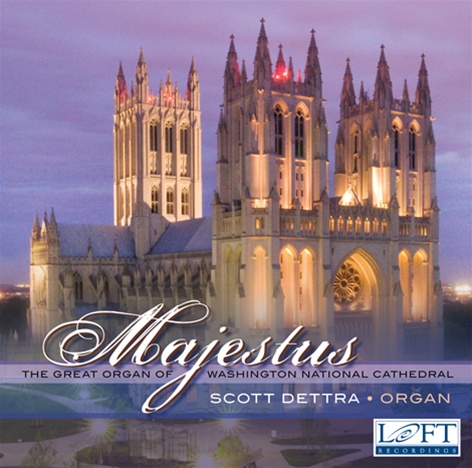
New Release: Majestus: The Great Organ of Washington National Cathedral

Majestus
The Great Organ of Washington National Cathedral
Scott Dettra


Scott Dettra presents a program of large-organ favorites on this, the final recording of the Washington National Cathedral's Great Organ.

Music is an integral part of daily life in most cathedrals, and Washington National Cathedral is no exception. In its primary role as a liturgical instrument, the Great Organ accompanies more than 350 worship services annually and is heard in recital and concert throughout the year as part of the cathedral’s broader musical offerings. This recording presents a cross-section of the organ music one might hear in liturgy and concert at Washington National Cathedral, including pieces that have become particular traditions here, pieces that represent the best of “cathedral music."

Fanfare for the Common Man — Aaron Copland (1900-1990)
Prelude & Fugue in B major, Op. 7, No. 1 — Marcel Dupré (1886-1971)
Prière, Op. 20 — César Franck (1822-1890)
Passacaglia, Op. 40 — Seth Bingham (1882-1972)
Rhapsody in C-sharp minor, Op. 17, No. 3 — Herbert Howells (1892-1983)
Adagio for Strings, Op. 11 — Samuel Barber (1910-1981), arr. William Strickland (1914-1991)
Crown Imperial — William Walton (1902-1983)
Introduction, Passacaglia & Fugue, Op. 149 — Healey Willan (1880-1968)

Total time: 77:03

The Majestus (also, Majestas) is the figure of Christ in Majesty, located at the center of the reredos of the high altar at Washington National Cathedral. The Majestus oversees the organ and choir stalls in the chancel, with Christ’s right hand raised in blessing…

List Price: $18.98 
Our Price:$14.98 
You save $4.00!


Thursday, April 29, 2010

Organ Greats From The Great Organ - Review and Video

Yesterday we featured our new release "Organ Greats from the Great Organ" featuring Erik Wm. Suter on the Washington National Catheral organ. So today we wanted to share some listener feedback and share a video that uses a track from the album.

Best washington national cathedral Organ CD - April 16, 2010
Reviewer: Nathan Roehl from Janesville, WI United States

This is the best Organ CD that I have of his [Erik Wm. Suter] collection. My favorite is Suter's own Amazing Grace. Erik Plays this beautiful hymn with his own arrangement. He is truly a wonderful Organist and this cd is a must have for your collection.

Master Tallis's Testament by Herbert Howells


Purchase Organ Greats from the Great Organ directly from Gothic-Catalog.com and save!

Wednesday, April 28, 2010

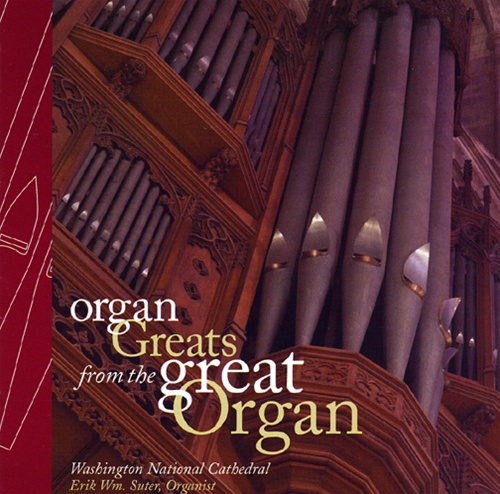
New Release: Organ Greats from the Great Organ

Organ Greats from the Great Organ
Washington National Cathedral
Erik Wm. Suter, organist


A broad cross-section of organ repertoire from Erik Wm. Suter at the Great Organ of Washington National Cathedral.

  1. J. S. Bach - Toccata and Fugue in D minor, BWV 565
  2. Dale Wood - In Thee is Gladness
  3. Cesar Franck - Piece Heroique
  4. Louis Vierne - Final, from Symphonie I
  5. Paul Manz - Aria
  6. William Bolcom - What a Friend we have in Jesus!
  7. Edward Elgar - Imperial March
  8. G. F. Handel - Hornpipe, from Watermusic
  9. J. S. Bach - Wachet auf, ruft uns die stimme, BWV 645
  10. Herbert Howells - Master Tallis’s Testament
  11. Charles-Marie Widor - Toccata, from Symphonie V
  12. J. P. Sousa - The Stars and Stripes Forever
  13. E. W. Suter - Improvisations on Amazing Grace


Buy it Today!

Tuesday, April 27, 2010

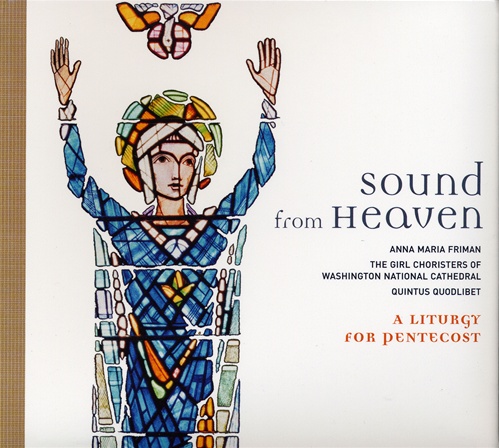
New Release: Sound From Heaven - A Liturgy for Pentecost

Sound from Heaven
A Liturgy for Penteccost

Anna Maria Friman, soprano
The Girl Choristers of Washington National Cathedral, James Litton, director
Quintus Quodlibet, Geoffrey Williams, director
Erik Wm. Suter, organist
Edward M. Nassor, carillonneur


This recording brings together a splendid tapestry of music from the Franco-Belgian tradition, including traditional Gregorian chant, monody from the Notre Dame Conductus which flourished in Paris circa 1200, and the medieval Messe de Tournai. Despite its many connections to earlier tradition, the sequence on this recording is distinctly contemporary, and is indeed an expression of the breadth of liturgy in the Anglican Communion.

Buy it now!

Monday, April 26, 2010

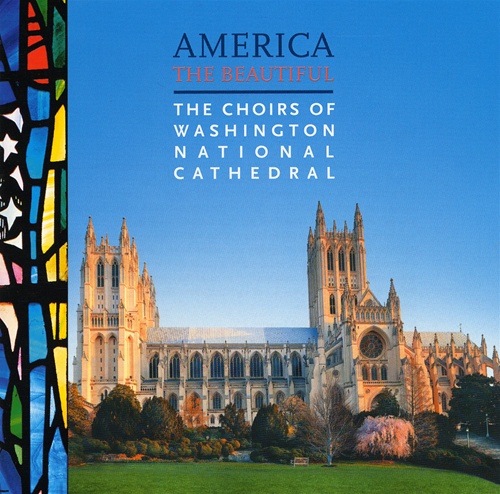
New Release: America the Beautiful from the Washington National Cathedral

America the Beautiful
The Choirs of Washington National Cathedral
Washington Symphonic Brass


Michael McCarthy, conductor

Recorded at Washington National Cathedral on October 7-8 and November 11-12, 2004, this CD weaves a tapestry of the American musical experience, broadly articulating the triumphs and travails, the emerging growth and diversity of the Nation, and defines a healthy sense of what is good about patriotism.

America - arr. David Willcocks
America the Beautiful - Samuel A. Ward, arr. Michael McCarthy
Washington Post March - John Philip Sousa, arr. Joseph M. Linger
Steal Away - arr. Michael Tippett
My Shepherd will supply my need - Joseph Funk, arr. Virgil Thompsen
There is a balm in Gilead - William L. Dawson
Deep river - arr. Michael Tippett
Fanfare for the Common Man - Aaron Copland
O Love of God - C. Hubert H. Parry, arr. Michael McCarthy
Lord of the Dance - Sydney Carter, arr. Michael McCarthy
Aria - Paul Manz
Abide with me - William H. Monk, arr. Moses Hogan
Father, in thy gracious keeping - Richard Wayne Dirksen
Battle Hymn of the Republic - William Steffe, arr. Peter J. Wilhousky
The Star-spangled Banner - John Stafford Smith
The Stars and Stripes Forever - John Philip Sousa, arr. George Faxon

Click to buy now!

Monday, February 15, 2010

President's Day Marches

What do you think of on President's Day? We think of Marches and and parades! So to celebrate, we are featuring Douglas Major as he takes you on a marching tour of the grand Skinner organ of Washington National Cathedral in his album Marches!

Douglas Major, organist
Washington National Cathedral
Marches


From Sousa to Bach, here are some of the most famous, and most stirring marches ever written, played on a large organ in a Gothic acoustic cathedral.

Sousa: Stars & Stripes Forever
Sousa: Washington Post March
Mendelssohn: Bridal March
C.P.E. Bach: March
Karg-Elert: Marche Triomphale
Lloyd Webber: Solemn Procession
Parry: Bridal March
Clarke: Prince of Denmark's March
Walton: Crown Imperial
Marcello: Psalm XIX
J. S. Bach: March (Cantata 208)
Haydn: March
Grieg: Triumphal March
Arnatt: Fanfare for Organ

For more information on this release and more visit The Gothic Catalog

Thursday, December 24, 2009

Messiah

Händel's Messiah is arguably the most widely shared musical experience in our culture. Each year the oratorio is sung by tens and perhaps hundreds of thousands o people in choirs and choral societies across the globe. Händel's music is indelibly part of our musical consciousness, with the "Hallelujah" chorus eliciting a level of recognition and emotional respose perhaps only otherwise achieved by the opening bars of Beethoven's Symphony No. 5. No other composition is so generally familiar or so well loved. - John Scott Organist and Director of Music Saint Thomas Church Fifth Avenue

Please on this eve of Christmas enjoy some samples of the Washington National Cathedral Choirs live recording of Händel's Messiah:

Sinfony (Overture)
For Unto us a Child is Born
Pifa (Pastoral Symphony)
Glory to God in the Highest
"Hallelujah" Chorus
Chorus (revelation 5: 12-14)

Click to Purchase this album

Wednesday, December 23, 2009

Hear the Christmas Angels

"Christmas is maybe the most intimate of seasons. It taps something deep in the human spirit — a yearning to be connected to each other and to God. And it stirs an array of memories of home. We are nomads these days, but beneath our restless lives we often notice the longing to be with those we love, to have a sense that we belong, that there is a place in this universe for us. 'Our hearts are restless till they rest in You,' St. Augustine once prayed. Home is where love is, and where God is.

Christmas is one of the most profound and moving seasons of the year at Washington National Cathedral. During this holy time, the Cathedral welcomes visitors and worshipers from near and far, in person and online, who are seeking a home where they can celebrate the birth of the Christ Child, God coming in flesh to live with us. This event 2,000 years ago unleashed a movement of hope and peace that is still at work today. In the Christmas season more than a billion people will travel to churches across the globe to sing carols and songs of their own traditions as they tell this story again and experience its hopeful, liberating power.

The selections on this recording include some of our favorite hymns and carols. We hope that they will allow you to enter into the mystery and beauty of the Christmas season. And we hope too that as you listen to them, you will be touched by the spirit of this Cathedral and will be reminded that here you have a home, not only at Christmas but throughout the year." - The Very Rev. Samuel T. Lloyd III


Hear The Christmas Angels is a spectacular selection of favorite Hymns and Carols from the Washington National Cathedral featuring: The Cathedral Choir of Men and Boys, The Cathedral Choir of Men and Girls, Cathedral Voices, The Cathedral Orchestra and members of the Washington Symphonic Brass.  Michael McCarthy and Scott Hanoian, directors and Erik Wm. Suter, organist.

Take a listen to these samples from Hear the Christmas Angels:

O Come All Ye Faithful
Angels We Have Heard on High
O Holy Night
Joy to the World

Tuesday, December 22, 2009

Sing in Exultation

From late November through the early weeks of each New Year, the world is alive with music celebrating the feasts and holy days of Advent, Christmas and Epiphany. In times of prosperity or famine, and during years of uncertainty, conflict or peace, the many songs, carols and hymns, as well as the great choral and instrumental works composed for this season, have given voice to this festive Yuletide, expressing the world's yearning for peace and joy. This festive recording of carols and other music for Advent through Epiphany is a musical tour of both the massive and the more intimate spaces of the cathedral.

Feel the spirit of Christmas by listening to these samples from Sing in Exultation: Carols from Washington National Cathedral:

Processional: O come, O come, Emmanuel
O little town of Bethlehem
Gloria in excelsis
Lullay, lullay: Als I lay on Yoolis Night

Monday, December 21, 2009

Dr. Christmas Reviews/Teaser

Today we thought we would share a short review of two of our Christmas albums with the Washington National Cathedral Choirs. More important than the actual reviews though, is the fact that they were included in the "Dr. Christmas" "Nice List" during his annual CD review!


THE DR. CHRISTMAS RADIO SHOW
Every year since 1989, in the week or so before Christmas, UW Oshkosh sociology professor Dr. Gerry Grzyb has become "Dr. Christmas", bringing his astonishing array of holiday music to the airwaves of WRST-FM. Sizeable samples of over 2000 Christmas CDs have been played (there are 7000 in his collection!), with 172 added in 2008 alone. The diversity of the program lies in the fact that there is almost no genre of Christmas music that Dr. Christmas won't play, the one major exception being chlildren's music since it is obviously made for a much younger audience. Dr. C. likes it all, and plays it all, and the playlists provide ample evidence of that.


ABOUT DR. CHRISTMAS
The good doctor has been honored in a number of ways.
Kyle Munson, longtime music critic for the Des Moines Register, wrote that he was “perhaps the nation’s foremost authority on Christmas music."

In recognition of his commitment to independent music, the Association For Independent Music (now defunct) named him one of the five judges in the Seasonal Music category for its Indie Awards (which were the independent music version of the Grammy).

A variety of musicians cite his reviews of their CDs that appeared in the Appleton Post Crescent on their websites.

His show has been written about in newspapers from Morro Bay, CA to Erie, PA, and it was listed as one of the distinctive ways people celebrate Christmas in the Sueddeutsche Zeitung, Munich's largest quality paper (roughly the equivalent of our New York Times).

In 2008 he was featured on WNYC, the public radio station in New York City. He took part in a debate about Christmas music as part of WNYC’s Soundcheck program.

Dr. Christmas is also heard on WRST's web stream. Last year, he had listeners around the country; click here for a map of them all! Stream listeners were also recorded in Toronto and its metro area, Dublin, Ireland, and even Hong Kong, China!


So here is Dr. Christmas' short blurb on our albums:

An equally big sound emanates from the multiple choirs, organ, orchestra, and brass ensemble assembled for “Hear the Christmas Angels” at the Washington National Cathedral. The fare is mostly familiar arrangements of favorite carols, including five from modern carolmeister John Rutter. “Sing In Exultation”, featuring the Cathedral Choirs of Men and Girls and of Men and Boys, aims to provide a musical tour of carols as well as the different acoustical spaces of that same D.C. landmark. There’s plenty of musical diversity here, including instrumental and organ pieces that make for a welcome freshness....Click to Read the full list of Christmas Reviews


It's an honor to be included in a list full of top-notch ensembles and labels.

Here's a quick teaser - We will be featuring select samples and information on these two albums plus one more throughout this week!

Thursday, October 22, 2009

Evensong: Of Love and Angels by Domick Argento

A couple of days ago we shared a review of the performance of Dominick Argento's new piece Evensong: Of Love and Angels, so today thought we would give you the program details of this piece!


Dominick Argento: Evensong: Of Love and Angels
The Cathedral Choral Society
Washington National Cathedral, Washington, D.C.
Elizabeth Futral, soprano
Nelson James LePard Reed, treble
The Very Reverend Samuel T. Lloyd III, reader
J. Reilly Lewis, conductor

WORLD PREMIERE RECORDING!

Commissioned by the Society in commemoration of the 100th anniversary of the Washington National Cathedral, this piece also serves as a moving tribute to the memory of Argento's wife, Carolyn Bailey Argento, who died in 2006.

Threnody—orchestra prelude
Preces: Phos Hilaron—treble (an Angel), chorus (the Afflicted)
Psalm 102—chorus a cappella
The Lesson—reader
Sermon—solo sprano (Homilist)
Meditation—orchestral intermezzo
Canticle: Nunc Dimittis—chorus
Prayer/Lullaby—solo treble (the Angel)
Anthem—chorus


Program Details
The Music, by Dominic Argento

BACKGROUND

In the summer of 2005, my wife, Carolyn, was hospitalized with an undiagnosed neurological ailment. After several months in an intensive care unit, she spent the following six months in a Bethesda Rehabilitation Center in Minnesota. During this period, I was contacted by Reilly Lewis, who wished to commission a work to commemorate Washington National Cathedral’s 100th anniversary. Highly flattered, I nevertheless replied that I intended to spend every day at my wife’s bedside until she recovered, and thus had neither will nor energy to compose music. Persistence by Dr. Lewis and others did not change my mind.

What did change it was Carolyn herself. When she was a young child, her father had taken her to visit the Cathedral, an experience she had never forgotten. Largely because of this wonderful memory, she wanted me to accept the commission. I told her that I would consider the commission after she recovered and was back home. She never recovered.

After her death in February 2006, Dr. Lewis renewed his request. I told him that I probably would never compose again, least of all a celebratory kind of work that the Cathedral’s 100th anniversary seemed to call for. He astutely turned the tables on me: What about a work honoring your late wife? I concluded it would have pleased Carolyn to know that I had accepted the commission.

FOREGROUND

On the 180 consecutive mornings I walked into the Rehabilitation Center, the name Bethesda above the entrance brought to mind the passage in John 5 which speaks of the angel that troubled the water and the sense of hope it quickened in the afflicted who surrounded the pool waiting—like me—for a miracle of healing. Angels were Carolyn’s favorite icon, and she collected them wherever we traveled. Throughout her illness, I kept remembering that angel and hoping for a miracle. When I felt I was ready to write Evensong, I wanted it to be, as the title says, Of Love and Angels.

Normally, a choral Evening Prayer service is a hodgepodge of musical pieces— some old, some new, nothing standard except the traditional order or sequence of its parts. I wished to compose an evening service unified from beginning to end with recurring themes and motives. This even entailed writing the texts of the nonliturgical pieces (Sermon and Anthem) and altering the Phos Hilaron and Prayer texts. The first three notes heard are C, B, and A (Carolyn Bailey Argento).

The final three chords concluding the piece fifty minutes later are also based on those letters. These and other variants of them are used throughout the work although not always in recognizable forms.
The Composer: Dominick Argento

One of America’s leading composers and librettists, Dominick Argento has been hailed as the most eminent creator of lyric opera in the United States. He was awarded the Pulitzer Prize in 1975 for the song cycle From the Diary of Virginia Woolf commissioned by the Schubert Club of St. Paul. In 2004, he received a GRAMMY® award for best classical contemporary composition for Casa Guidi, five songs for mezzo-soprano and orchestra, recorded by Frederica von Stade and the Minnesota Orchestra.

Argento earned his bachelor’s and master’s degrees at Peabody. He went on to receive his Ph.D. from Eastman School of Music, where he studied with Alan Hovhaness and Bernard Rogers. After a year in Florence, where he studied with Luigi Dallapiccola on a Guggenheim Fellowship, Argento accepted on three days’ notice what he expected to be a temporary post teaching music theory and composition at the University of Minnesota. During his four-decade tenure there, he was named Regents’ Professor, the university’s highest honor.

Over forty years, in which he has written more than sixty works, he has been commissioned by nearly every arts organization in Minnesota, most notably the Plymouth Music Series (now VocalEssence) founded by his former student Philip Brunelle.

Evensong: Of Love and Angels is a crypto-memorial to his beloved Carolyn. He began work on September 6, 2006, their wedding anniversary; he put on the finishing touches exactly one year later. “I suppose it was inevitable I would get back, even after vowing not to write anymore,” he said. “It fulfills something in me.”

C-B-A: Remembering CAROLYN BAILEY ARGENTO (1930-2006)

For fifty-one years, Carolyn Bailey Argento was her husband’s most influential adviser and critic. She studied voice at Peabody, where she was the youngest student ever to receive a personal scholarship. There she met and married fellow student Dominick Argento. In 1958, they moved to Minneapolis, where he taught at the University of Minnesota.

“When I would go off to the university,” Argento recalls, “Carolyn would practice in the studio and my notes were on the piano there. When I’d come back in the evening, on the margins of all these pages would be: “Too high,” “Where does she breathe?” “How many times are you going to ask for that note?” And I would ask, “Was anybody in my studio today?” “No,” she’d say.

“In a way, that’s how I learned to write vocal music. I never intended to write for voice. I started out to be what I thought would be an instrumental composer. And she made a vocal composer, an operatic composer out of me.”

Carolyn premiered many works by her husband before retiring in the 1970’s. She died after a long struggle with an
indeterminate neurological illness.