Friday, May 14, 2010

Chorus America Awards!

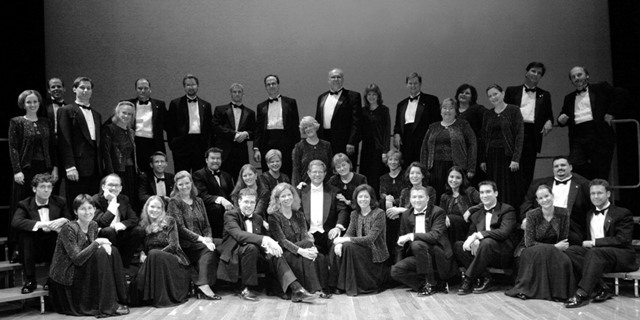
Congratulations to Choral Arts and conductor Robert Bode for winning Chorus America's Margaret Hillis Award for Choral Excellence!

The Margaret Hillis Award for Choral Excellence honors the memory of Margaret Hillis, founder of the Chicago Symphony Chorus and its conductor for 37 years, for her more than 40 years of professional achievement and outstanding contributions to the choral art. An engraved plaque and cash award of $5,000 is presented annually to a member ensemble that demonstrates artistic excellence, a strong organizational structure, and a commitment to outreach, education, and/or culturally diverse activities. Eligibility rotates through a three-year cycle: children/youth choruses (2011), professional and professional-core choruses (2012), and adult volunteer choruses (2013). A chorus may win this award only once.

The award winner was selected by a panel of judges consisting of the Chairman of Chorus America or an appointed delegate, the President of Chorus America or an appointed delegate, a member of the Board of Directors of Chorus America, and a conductor or singer from a Chorus America member chorus, who is not presently serving on the Chorus America Board and whose chorus will not be under consideration for the award.

Recently we released the album, Mornings Like This: Songs of Daybreak and Childhood with Choral Arts and conductor Robert Bode.
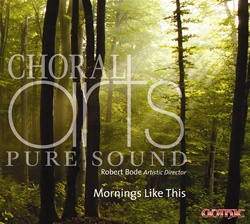
Mornings Like This: Songs of Daybreak and Childhood
Choral Arts
(formerly Choral Arts Northwest)
Lee Thompson, Melissa Loehnig, piano
Robert Bode, conductor

The "Pure Sound" of Choral Arts under their new director, Robert Bode presents several world premiere recordings, including The Dream Keeper, a piece in four movements, each featuring a different text from Langston Hughes. Other pieces feature the poetry of Dylan Thomas, Walt Whitman and the conductor of Choral Arts, Robert Bode.

"My Lord, what a mornin'"—Spiritual, arr. Harry T. Burleigh (1866–1949)
Sunrise, from Give Me the Splendid Silent Sun (1990)—Michael Hennagin (1936–1993)
The Waking (2008)—Giselle Wyers (b. 1969) *
Fern Hill (1960)—John Corigliano (b.1938)
Dawn (2008)—Eric William Barnum (b.1979) *
A Child's Prayer (1996)—James MacMillan (b.1959)
In Dreams—John David Earnest (b. 1940)
The Dream Keeper—William Averitt (b.1948) *
  • The Dream Keeper
  • Dream Variations
  • As I Grew Older
  • Song
Will there really be a "Morning"?—Craig Hella Johnson *
Beautiful River (1995)—arr. William Hawley (b. 1950)
* World Premiere Recordings

So make sure to get your copy of this album featuring an award-winning ensemble!
Buy direct from Gothic-Catalog.com

Also, we would like to make mention of another award that Chorus America presents, the Dale Warland Singers Commission Award. The Dale Warland Singers have 13 albums available from The Gothic Catalog!
The Dale Warland Singers earned acclaim around the United States for their commitment to commissioning and performing 20th-century choral music. They were, in 1992, the first recipient of the Margaret Hillis Achievement Award for Choral Excellence. The Singers were also recognized by ASCAP for their work on behalf of composers and new music.

The Dale Warland Singers Commission Award honors the the life-long commitment of Dale Warland to new music, the American Composers Forum offers an annual $5,000 cash award at the Chorus America Conference for the commission of a new choral work. The award is made possible by the Dale Warland Singers Fund for New Choral Music, a permanently restricted endowment fund established in 2004 to honor Dale and the Singers. The Dale Warland Singers Commission Award was created in 2008.

Royalties from the sale of every Dale Warland Singers recording on Gothic are donated to the Dale Warland Singers Fund for New Choral Music, an endowment administered by the American Composers Forum. Earnings from the Fund are used to commissioning, performance and recording of new choral works. For details click here.

So make sure to complete your collection of the Dale Warland Singers right here on The Gothic Catalog.

Thursday, May 13, 2010

The Haydn Sonatas

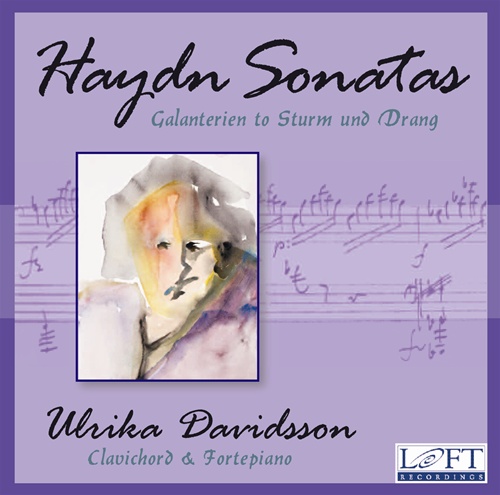
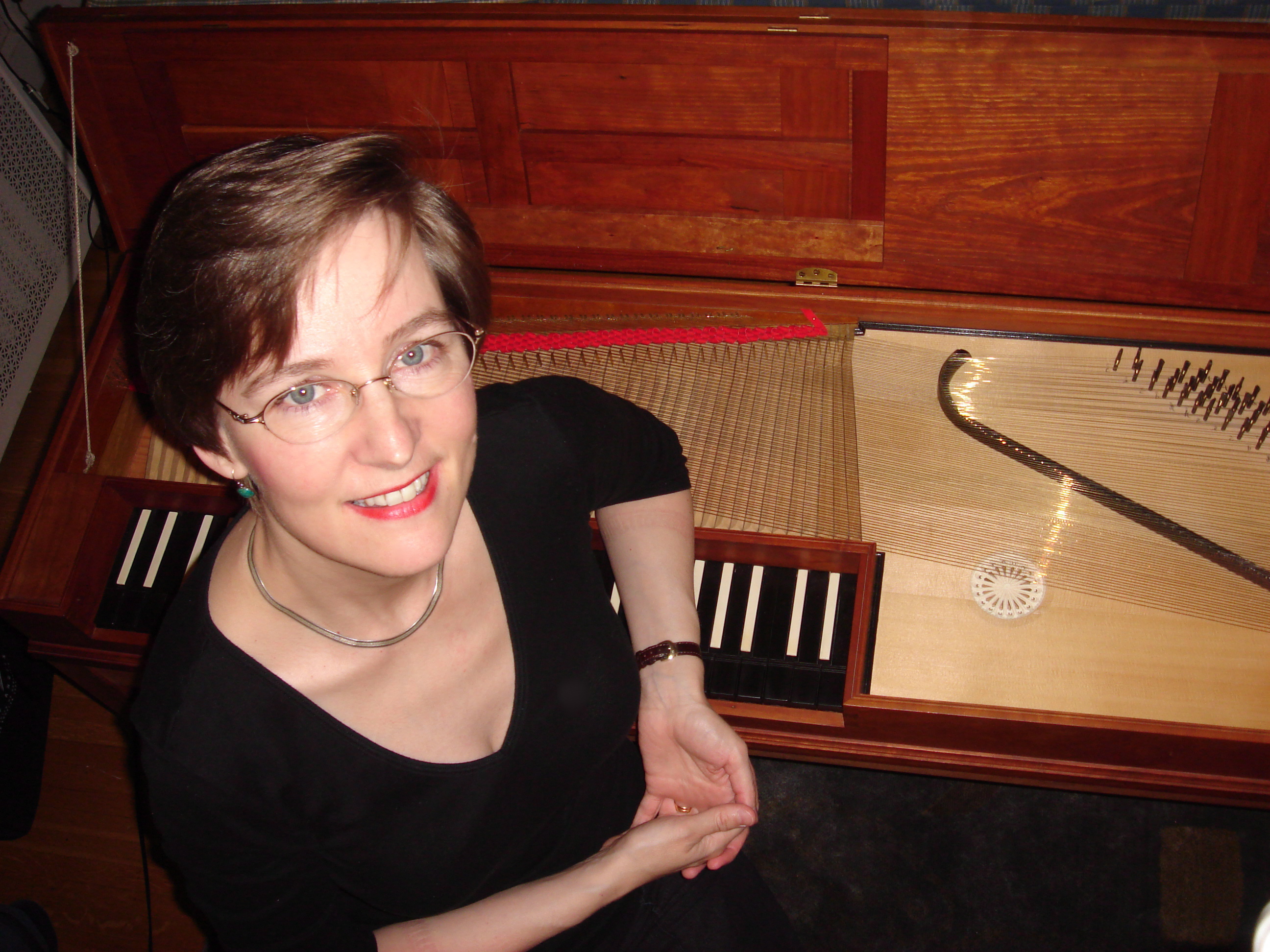
Yesterday we focused on Haydn during our feature of Ulrika Davidsson's latest release. Today, we're going to focus on the actual pieces!

The selected sonatas

The two sonatas performed on clavichord on this recording are early works in the galant style, written before or around 1760. Both belong to the category of Kenner sonatas, with rich textures and technically more challenging than Liebhaber works. The first movement of the Sonata in D, Hoboken XVI:14, Allegro moderato, is rich in its rhythmic vocabulary, and therefore, as is common in opening movements in Haydn’s early works, the pace of the quarter note is quite slow. It has a wonderful liveliness in its declamatory speaking style. There is no “slow” middle movement; rather, a minuet follows, which has brilliant runs in the minuet proper, contrasted with slower note values and an expressive minor mode in the trio. The highly energetic Presto finale exposes brilliant keyboard textures while expressing playful joy.

The first movement of the Sonata in B-flat, Hoboken XVI:2, shows some similarities to the opening movement of the previous sonata. This unhurried Moderato explores the speaking style, in spite of its fanfare-like opening motive. The hauntingly beautiful second movement in g minor is one of only two largos in Haydn’s entire sonata output. One reason it is so unusual might be the problem of sustaining the sound with the quick decay of tone of the keyboard instruments. In this movement, that problem is solved by the repetition of chords in the left hand which keeps the sound going, in the manner of a Vivaldi Largo for strings. This serious and Empfindsam movement displays rhythmic patterns and ornamentation which are quite unique to Haydn’s writing. The last movement is a carefree minuet in Ländler style containing a trio section with pleading motives in the minor mode.

More Galanterien than Empfindsamkeit can be heard in the Sonata in E-flat, Hoboken XVI:28, from 1776. In this Liebhaber type, directed to the Viennese amateur rather than the virtuoso professional, the music is accessible and direct. The Allegro moderato in 3/4 is pleasing and elegant. The relatively thin texture and slow harmonic pulse lightens the character. The Minuet has a noble character, and therefore the pace is a little restrained. The moderator (a strap of wool fabric inserted between the hammer heads and the strings) is used for the trio section in minor mode, to emphasize its introvert character. The spirited Finale presto in 2/4 is in strophic variation form. The theme has eighth notes as the fastest note value; therefore, the movement works best in a faster tempo.

The Sonata in g, Hoboken XVI:44, from around 1770, is introverted and personal. This two-movement chamber-style sonata shows a clear influence from the Empfindsamkeit and C. P. E. Bach. It is not known for whom it is written, and might just have been a personal reflection and experiment by Haydn. The Moderato is full of strong contrasts and rhetorical pauses, and is very rich in its emotional contents. By the end of the movement, there is a beautiful cadenza that captures the lyrical essence of the entire piece. The second movement, Allegretto, has the rhythmic character of a minuet or Ländler. It is a hybrid variation, and uses modal mixture, thus alternating minor and major as a contrasting element, a technique Haydn successfully used in several pieces, among them the f-minor variations.

The Sonata in F, Hoboken XVI:23, written in 1773, was dedicated to and printed for Haydn’s famous patron Prince Nikolaus Esterházy. The first movement lacks character designation, and should thus be played in the so-called tempo giusto, its own proper and natural tempo. It is written in 2/4 meter, but it is structurally rather a movement in 4/8 (a notation Haydn never uses), which influences the character of the metric accentuation and the pace. It starts out with a march-like motive, followed by the speaking style and later the brilliant style with a virtuosic display of keyboard figurations.

The serene Adagio in f minor is one of the most beautiful keyboard movements by the composer. The moderator is used throughout the piece, as is the damper pedal, imitating the early fortepianos where the damping device was operated by a lever, and thus was either on or off. The movement looks back to the Baroque in that it refers to the dance siciliano in the opening motive. Furthermore, it uses one continuous accompanimental figure throughout. The Presto finale is full of mischief and wit, nagging motives and humorous teasing. The texture is light and the higher register of the keyboard is often used, thus a fast pace and a lively character is the natural choice for performance.

Haydn was sensitive to the specific characteristics of pianos by different makers, and on his first trip to London in 1791 he had encountered the English action grand piano. His last three sonatas, which are dedicated to the gifted and acclaimed performer Therese Jansen Bartolozzi, bear witness on his musical response to its expansive sonorities and rich sound. The Sonata in E-flat, Hoboken XVI:52, from 1794, was published as a “Grande Sonate.” The full, rich chords, figurations spanning the entire compass, and shocking dynamic contrasts, are, for Haydn, new pianistic effects, and show that he is entering the early Romantic era.

The first movement displays a string of different and abruptly changing topics. The opening rhythm alludes to the French Overture style. Later there are examples of the galant style, brilliant style, legato style, and Sturm und Drang. One might find the pace of the quarter note unusually slow for a 4/4 Allegro. The music, however, is not slow; it is the musical contents that define the tempo. The rich and varied rhythmic vocabulary and the frequent use of thirty-second notes require sufficient time. Allegro is the designation for the character, not the metronomical tempo.

The sarabande disappeared as a dance by the end of the eighteenth century, but the style and its character as topic remained. We find this slow, serious dance, with its emphasis on the second beat, in the Adagio movement in E major. The form is ABA, and in the B section in e minor, the dance topic is less prominent and the music is dominated by a declamatory style.

The Finale presto is also inspired by dance topics like the contredanse and the musette, as well as the brilliant style. Its character is humorous and witty, topics that are constantly recurring in Haydn’s output. The choice of tempo is motivated more by the virtuosic brilliant texture than the sturdy contredanse.

The highly unusual key relationship between the movements—E-flat / E major / E- flat—presents a polarity that produces an enhanced contrasting expression.


Wednesday, May 12, 2010

Ulrika Davidsson Galanterien to Sturm und Drang

Earlier this year we released Ulrika Davidsson's album, Haydn Sonatas: Galanterien to Sturm und Drang, but today we wanted to tell you a little more about Haydn, Sturm und Drang, and some of the thoughts that have to go into a recording of this magnitude.

From Galanterien to Sturm und Drang

Franz Joseph Haydn’s large body of solo sonatas exceeds 60 in number, though some are lost, and the dates of their creation span more than 40 years. The earliest were written in his youth, in the early 1750s in Vienna, and the last were written in the span from 1791through 1795 during Haydn’s forays to London. There is great diversity in the material, technically and stylistically as well as musically, and they are recognized for their ingenuity and individuality. Every piece has its own set of figurations and its own motives and keyboard textures. Haydn seems to have had an endlessly flowing source of imagination and creativity when it came to exploring a variety of musical ideas. Regardless of the relative complexity of the pieces, Haydn managed to create music which entices the Kenner, or connoisseur, as well as it pleases the Liebhaber (amateur), and that incorporates the characteristic features of many styles, from the galant style, the Empfindsamkeit (the “sensitive style” of the late Baroque), and the Sturm und Drang (an emotional style full of “storm and stress”).

In the Baroque era, most pieces or movements of a larger work contained one single basic character, or Affekt. With the emergence of the galant style in the 1730s, rhetorical concepts still informed musical practice, but the music now expressed constantly changing moods and Affekts. Rather than general emotional states, such as joy, sadness, love, etc., the subjective and changing feelings of an individual (the composer) or of a programmatic idea were expressed. Contrast and variety became the norm. From the galant style, a more intensely expressive style emerged, the so-called Empfindsamer Stil (“highly sensitive style”). It could be expressed by frequent dynamic changes, large leaps, dissonant harmonies, and unexpected rests. Musical characteristics of this kind are well suited to express constantly changing and subjective moods. The foremost advocate for this style was C. P. E. Bach, and according to him, the instrument most suited to express these innermost feelings was the clavichord. (Haydn most likely owned a copy of Bach’s treatise Versuch über die Wahre Art das Clavier zu spielen.) He was also acquainted with some of C. P. E. Bach’s sonatas.

Sturm und Drang, a style which emerged in the 1770s, can be described as a more dramatic version of the Empfindsamkeit style. It was expressed by yet more abrupt changes, chromaticism, the use of minor keys, syncopations, and characteristic rhythms.

The keyboard works of Haydn incorporate the best of all these styles: the gallant, the Empfindsamkeit, and the Sturm und Drang. The various styles are reflected, in the music, by the increasing number of detailed directions for performance in the score, in terms of dynamic indications and articulation, as well as the overall change in texture and dramatic layout.

The “Shakespeare of music”

Haydn was praised for his musical rhetoric, and was referred to as “the Shakespeare of music.” Communication of the passions and the various sentiments in a piece was central to eighteenth-century thoughts on performance. A rich vocabulary of characteristic musical figures had developed, which were associated with various feelings and Affekts. They are usually referred to as “topics,” or subjects for musical discourse. Dances, with their various rhythms and other characteristics, were often used as such topics. A sturdy gavotte had different connotations than an elegant sarabande; a minuet referred to the courtly life, whereas a ländler (piece based on a folk tune) signified the lower social classes. Other “topics” Haydn frequently alluded to were the singing style; the brilliant style; the musette; the pastorale; the learned style or fugue versus galant style; Empfindsamkeit; Sturm und Drang; and the free fantasia. The connection between rhetoric and music was extensively discussed, for instance in the 1739 treatise Der Vollkommene Capellmeister (“The Perfected Chapelmaster”) by Johann Mattheson, a work we know that Haydn had in his library. Clarity of speech was of utmost importance, since a performance was often referred to as a musical declamation, and the musician as an orator and actor had to clearly communicate the character of the topics.

Character and tempo

The successful rendering of musical character depends on the choice of tempo. Various writers in the eighteenth century stressed that there are several factors one has to consider when choosing an appropriate tempo. The main issues are the meter, the tempo designation, the smallest note value, the harmonic pulse, and the Affekt or character of the movement. What we often call “tempo” designation is much more a “character” designation than an indicator of a specific tempo. For the player, the words adagio or allegretto give a sense of the character, or mood, and a feeling of physical movement (called Bewegung). The actual tempo that will suit a piece is then dependent on the interplay between the other factors mentioned. From this it follows that one allegro in 4/4 might have a very different actual tempo (as reflected in the numbers on a metronome) than another allegro in 4/4. The choice of tempo should not be the projection of a limited number of standard formulas or the projection of the performer’s spontaneous subjective preference, but rather a sensitive search for the balance of interacting compositional parameters inherent in each piece. The clue to the tempo is to be found in the piece itself, and its purpose is to render a musical character and its topics.


Tuesday, May 11, 2010

Mendelssohn Organ Sonatas & Jonathan Dimmock

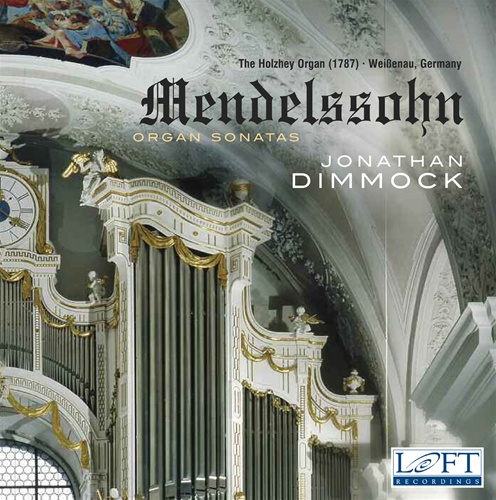
Recently our artist Jonathan Dimmock has been giving many so many different concerts in such diverse musical roles that we thought it would be prudent to remind you that here at The Gothic Catalog, we know him mainly as an organist, and share some more information about his latest release with us, "Mendelssohn Organ Sonatas."

Mendelssohn’s six organ sonatas are not sonatas in the classical sense of that term, but rather a collection of pieces which he composed mostly between 1844 and 1845 - one year after his founding of the Leipzig Conservatory. Although we know that Mendelssohn made numerous corrections and changes to the first two editions which were published (Coventry, London and Breitkopf & Härtel, Leipzig), there are no indications of registration choices. In his “Prefatory Remarks” he says: Much depends in these Sonatas on the right choice of the Stops; however, as every Organ with which I am acquainted has its own peculiar mode of treatment in this respect, and as the same nominal combination does not produce exactly the same effect in different Instruments, I have given only a general indication of the kind of effect intended to be produced, without giving a precise List of the particular Stops to be used. By “Fortissimo” I intend to designate the Full Organ; by “Pianissimo” I generally mean a soft 8 foot Stop alone; by “Forte” the Great Organ, but without some of the most powerful Stops; by “Piano” some of the soft 8 foot Stops combined; and so forth. In the Pedal part, I should prefer throughout, even in the Pianissimo passages, the 8 foot and the 16 foot Stops united; except when the contrary is expressly specified; (see the 6th Sonata). It is therefore left to the judgment of the Performer, to mix the different Stops appropriately to the style of the various Pieces; advising him, however, to be careful that in combining the Stops belonging to two different sets of keys, the kind of tone in the one, should be distinguished from that in the other; but without forming too violent a contrast between the two distinct qualities of tone.

By the time these sonatas were composed, Mendelssohn was well-known as composer, pianist, and organist, having made many tours as a soloist throughout Germany and England. His improvisations were highly regarded; and it was while on tour in England that he was approached, by a publisher there, to compose some works for the organ. The 35 year old Mendelssohn may have wanted to impress his English colleagues, or perhaps even show them up, because he composed works with extremely virtuosic pedal parts, at a time in history when English organists had marginal pedal technique. Perhaps he wanted to assert his lineage to the great Bach tradition and the magnificent German organs which influenced his tonal pallette. Regardless, his masterworks for organ are justly regarded as the finest examples of Classical German organ literature.

These pieces are marked by two affects, strength and beauty. From the full and dramatic F minor chords of the opening sonata to the toccata-style final variation of “Vater unser im Himmelreich” (Sonata 6), it’s clear that this is intensely masculine, strong, technically demanding, and emotionally assertive music. Yet the magic of Mendelssohn’s pieces lies in his ability to play with light and shadow so convincingly. Assertiveness yields to lyricism and gentleness over and over again. In the midst of an angry opening section of Sonata 1, a simply-stated, soft chorale (“Was mein Gott will, das g’scheh’ allzeit”) enters to calm the storm. Slow movements of heart-rending beauty blend the yin and yang of his musical vocabulary as if he were touching our very soul.

It is this assimilation of the Romantic sentiment expressed within Classical and Baroque forms that makes this music so important to us today. The lineage from Bach to Mendelssohn is clear. But looking forward, we can also see how Mendelssohn’s Romantic side influenced the music of Schumann, Brahms, and Liszt. The organ, as an instrument, was undergoing tonal changes in the early nineteenth century; and it’s likely that Mendelssohn, as an international concert performer, and the students and colleagues he directly influenced (Richter, Gade, Becker, van Eyken) was the most significant force in establishing this change.

Notes on the Weißenau organ

Much has been said about Mendelssohn's penchant for Classically-voiced organs, his traditional leanings in his compositional style, and his conviction that Swell pedals were not necessary to convey the music of his organ pieces, yet the vast majority of Mendelssohn organ recordings ignore these points. This recording, however, highlights a Bavarian organ (a region Mendelssohn knew well), an organ builder that Mendelssohn praised (Holzhey), and a true Classical instrument placed in a stunning acoustical setting.

Often dwarfed by the fame of its large neighbor, the 1750 Gabler organ of Weingarten which is a mere five minutes drive from Weißenau, the 1787 organ in the Abbey church of Weißenau is undeservedly little-known. Three manuals and pedal in original condition, with many warm 8 foot flues, very supportive bass, and original strings and celestes, this organ has a unique and soothing tonal quality: strong without being strident, warm without being muddy, clear without being self-consciously bright. The temperament (Werkmeister III) was a slight challenge for some of the keys, but not insurmountable. And the advantages of an unequal temperament (standard for virtually all the organs Mendelssohn knew in Germany) for giving different tonal color to each key far outweigh the disadvantages. The trickiest aspect of the organ was the old pedal board. As is visible in the picture, the pedals could be more accurately described as "buttons" than as "keys." For Mendelssohn's extremely virtuosic pedal passages, this required some careful pedaling!

The Abbey church was founded in 1145 as a Premonstratensian monastery. Originally named "Weissenau" ("white meadow"), it is now a part of Ravensburg. The current church was built in the baroque style between 1708 and 1724. The monastery closed in 1802. Since 1283 Weißenau has been famous for its possession of the relic of the Precious Blood (referred to in "Lohengrin").

Check out everything Jonathan Dimmock is up to on his website

Friday, May 7, 2010

The Organ Loft - Easter Echoes


The Organ Loft - May 9, 2010
Easter Echoes
Webcast and Broadcast Schedule


This week on The Organ Loft, we're featuring "Easter Echoes" – music based on themes of the Easter season. One piece of major interest is the Improvisation by Charles Tournemire on the chant Victimae Paschali. (Tournemire was a student of Cesar Franck, and his successor at St Clotilde in Paris). This improvisation, and several others were recorded on 78RPM records in the 1930’s. In the 1950’s, Tournemire’s student Maurice Durufle transcribed and published them as sheet music. The recording is of J. Melvin Butler at St Mark’s Cathedral.


Program: Easter Echoes
  1. Randall Thompson: Alleluia
  2. Richard Purvis: Partita on „Christ ist Erstanden”
  3. John Ireland: “Greater love hath no man”
  4. Charles Tournemire: Choral-Improvisation on “Victimae Paschali”
  5. Leo Sowerby: Prelude on “Land of Rest”
  6. Healey Willan: “Rise up, my love, my fair one”


Recordings Used:
  1. “The Light of Stars” Choral Arts, Richard Sparks, dir; Gothic G-49226
  2. “The Artistry of Frederick Swann”, Frederick Swann, organ; Gothic G-49271
  3. “Greater Love” East Carolina University Chamber Singers, Dan Bara, dir; Gothic G-49256
  4. “French on the Flentrop” J. Melvin Butler, organ; Loft LRCD-1013
  5. “Land of Rest”, Robert Parris, organ; Loft LRCD-1080
  6. “Easter” Choir of All Saints‟ Episcopal Church, Beverly Hills, Thomas Foster, dir; Gothic G-49097


Listen Online:

KING-FM Seattle's Classical Choice — Sundays at 10:00 PM

OREGON: KWAX-FM and the University of Oregon radio network — Sundays at 8:00 AM and 6:00 PM

Wednesday, May 5, 2010

What do Frederick Swann and Peter Richard Conte have in Common?

What do Frederick Swann and Peter Richard Conte have in common? Well, they've both played the Wanamaker Organ, and they both have recordings with The Gothic Catalog! We recently recorded Peter Richard Conte on the Wanamaker Organ with the Philadelphia Orchestra on the album "A Grand Celebration/The Philadelphia Orchestra live with the Wanamaker Organ" and have many more Wanamaker Organ recordings with Peter Richard Conte!

And today we came across a fun YouTube video that we wanted to share of our artist Frederick Swann performing on the Wanamaker Organ!


Speaking of Frederick Swann...if you will recall, we informed you about some re-releases on Monday, and of those re-releases, Frederick Swann was the artist on FVE of them! So make sure you get these recordings of Mr. Swann before we go out of stock again.

The Mystic Organ
The Riverside Years/Swann
Frederick Swann in Hawaii, v.1
Frederick Swann Plays Two Organs by Reuter
The Riverside Years, v.2 (The Choir)

Monday, May 3, 2010

Last Chants!

Recently we were able to reacquire small quantities of our titles from a wholesaler that is leaving the distribution business. These titles are some include best-sellers which have recently gone out of print. They are available now, but only while supplies last—most will not be repressed. Here are just a few of these titles:


G-18828 Marches/Douglas Major at Washington National Cathedral
G-47931 Christmas Masterpieces/Westminster Choir
G-49053 The Mystic Organ/Swann
G-49054 The Transcribers Art / Thomas Murray at Yale
G-49070 Times and Seasons/Grogan at National Shrine, DC
G-49077 Charpentier Mass/Brown
G-49082 The Riverside Years v. 1 / Swann
G-49091 Come Let Us Sing / Choir of St Patrick's Cathedral, NYC
G-49092 Frederick Swann in Hawaii
G-49098 The Worlds Above / Grace Cathedral
G-49102 Two Organs by Reuter/Swann
G-49109 Christmas Improvisations/Hancock at St Thomas, NYC
G-49122 Virgil Fox Memorial Concert in NYC (2 CDs!)
G-49126 A Choral Feast/Douglas Major - Washington National Cathedral
G-49131 The Riverside Years v. 2/Swann (3 CDs!)
G-49201 L’Organiste Parisien/Adams
LRCD-1003 Rising Dawn/Opus 7
LRCD-1009 The Young Bach/Harald Vogel
LRCD-1012 Complete organ works of Bruhns and Hanff/William Porter in Roskilde
LRCD-1017 A Scandinavian Christmas / Choral Arts / Sparks
LRCD-1022 Out of this World/Butler and the Boston Brass
LRCD-1042 The Shapenote Album/Tudor Choir
LRCD-1071-74 Complete Vierne Symphonies /Martin Jean at Yale